Chhatre Sumedha, Gallo Joseph J, Guzzo Thomas, Morales Knashawn H, Newman Diane K, Vapiwala Neha, Van Arsdalen Keith, Wein Alan J, Malkowicz Stanley Bruce, Jayadevappa Ravishankar
Department of Psychiatry, Perelman School of Medicine, University of Pennsylvania, Philadelphia, PA 19104, USA.
Corporal Michael J. Crescenz VAMC, Philadelphia, PA 19104, USA.
Cancers (Basel). 2023 Apr 2;15(7):2124. doi: 10.3390/cancers15072124.
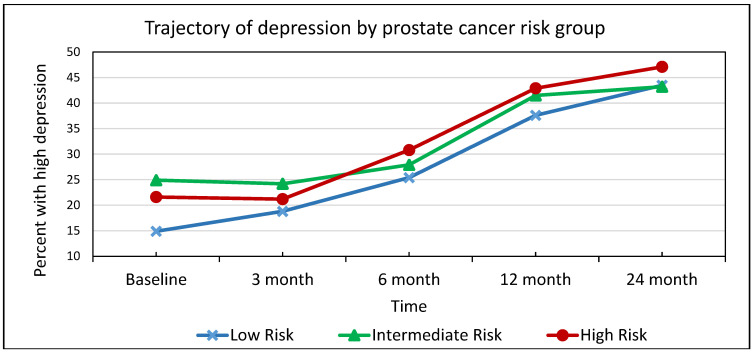
While psychological difficulties, such as depression, among prostate cancer patients are known, their longitudinal burden remains understudied. We assessed the burden of depression across low-, intermediate- and high-risk prostate cancer groups, and the association between regret and long-term depression. Secondary analysis of data from a multi-centered randomized controlled study among localized prostate cancer patients was carried out. Assessments were performed at baseline, and at 3-, 6-, 12- and 24-month follow-up. Depression was assessed using the Center for Epidemiologic Studies Depression (CES-D) scale. A CES-D score ≥ 16 indicates high depression. Regret was measured using the regret scale of the Memorial Anxiety Scale for Prostate Cancer (MAX-PC). The proportion of patients with high depression was compared over time, for each risk category. Logistic regression was used to assess the association between regret, and long-term depression after adjusting for age, race, insurance, smoking status, marital status, income, education, employment, treatment, number of people in the household and study site. The study had 743 localized prostate cancer patients. Median depression scores at 6, 12 and 24 months were significantly larger than the baseline median score, overall and for the three prostate cancer risk groups. The proportion of participants with high depression increased over time for all risk groups. Higher regret at 24-month follow-up was significantly associated with high depression at 24-month follow-up, after adjusting for covariates. A substantial proportion of localized prostate cancer patients continued to experience long-term depression. Patient-centered survivorship care strategies can help reduce depression and regret, and improve outcomes in prostate cancer care.
虽然前列腺癌患者存在诸如抑郁等心理问题已为人所知,但其纵向负担仍未得到充分研究。我们评估了低风险、中风险和高风险前列腺癌组中抑郁的负担,以及遗憾与长期抑郁之间的关联。对一项针对局限性前列腺癌患者的多中心随机对照研究的数据进行了二次分析。在基线以及3个月、6个月、12个月和24个月随访时进行评估。使用流行病学研究中心抑郁量表(CES-D)评估抑郁情况。CES-D得分≥16表明存在高度抑郁。使用前列腺癌纪念焦虑量表(MAX-PC)的遗憾量表来衡量遗憾程度。比较了每个风险类别中随时间推移出现高度抑郁的患者比例。在调整年龄、种族、保险、吸烟状况、婚姻状况、收入、教育程度、就业情况、治疗方式、家庭人口数量和研究地点后,使用逻辑回归评估遗憾与长期抑郁之间的关联。该研究纳入了743名局限性前列腺癌患者。总体以及三个前列腺癌风险组在6个月、12个月和24个月时的抑郁得分中位数均显著高于基线中位数得分。所有风险组中出现高度抑郁的参与者比例随时间增加。在调整协变量后,24个月随访时较高的遗憾程度与24个月随访时的高度抑郁显著相关。相当一部分局限性前列腺癌患者持续经历长期抑郁。以患者为中心的生存护理策略有助于减轻抑郁和遗憾,并改善前列腺癌护理的结果。