Department of Precision and Regenerative Medicine and Ionian Area (DiMePRe-J), Polyclinic Hospital, University of Bari, 70124 Bari, Italy.
Division of Clinical Rheumatology, ASST Gaetano Pini-CTO Institute, 20122 Milan, Italy.
Int J Mol Sci. 2023 Mar 30;24(7):6463. doi: 10.3390/ijms24076463.
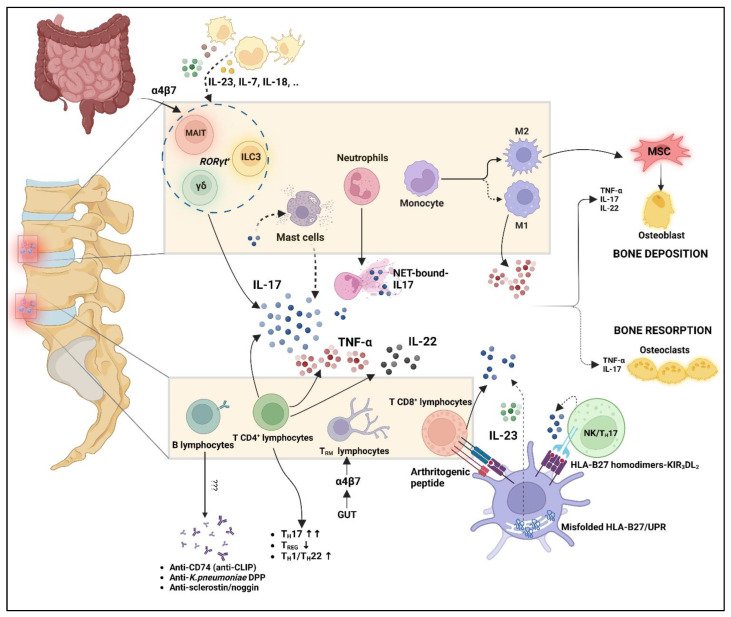
Axial spondyloarthritis (axial-SpA) is a multifactorial disease characterized by inflammation in sacroiliac joints and spine, bone reabsorption, and aberrant bone deposition, which may lead to ankylosis. Disease pathogenesis depends on genetic, immunological, mechanical, and bioenvironmental factors. HLA-B27 represents the most important genetic factor, although the disease may also develop in its absence. This MHC class I molecule has been deeply studied from a molecular point of view. Different theories, including the arthritogenic peptide, the unfolded protein response, and HLA-B27 homodimers formation, have been proposed to explain its role. From an immunological point of view, a complex interplay between the innate and adaptive immune system is involved in disease onset. Unlike other systemic autoimmune diseases, the innate immune system in axial-SpA has a crucial role marked by abnormal activity of innate immune cells, including γδ T cells, type 3 innate lymphoid cells, neutrophils, and mucosal-associated invariant T cells, at tissue-specific sites prone to the disease. On the other hand, a T cell adaptive response would seem involved in axial-SpA pathogenesis as emphasized by several studies focusing on TCR low clonal heterogeneity and clonal expansions as well as an interindividual sharing of CD4/8 T cell receptors. As a result of this immune dysregulation, several proinflammatory molecules are produced following the activation of tangled intracellular pathways involved in pathomechanisms of axial-SpA. This review aims to expand the current understanding of axial-SpA pathogenesis, pointing out novel molecular mechanisms leading to disease development and to further investigate potential therapeutic targets.
中轴型脊柱关节炎(axial-SpA)是一种多因素疾病,其特征为骶髂关节和脊柱炎症、骨质吸收和异常骨沉积,可能导致关节强直。发病机制取决于遗传、免疫、机械和生物环境因素。HLA-B27 是最重要的遗传因素,但该疾病也可能在缺乏 HLA-B27 时发生。该 MHC I 类分子已从分子角度进行了深入研究。包括致病肽、未折叠蛋白反应和 HLA-B27 同源二聚体形成在内的不同理论被提出以解释其作用。从免疫学角度来看,先天和适应性免疫系统之间的复杂相互作用涉及疾病的发生。与其他系统性自身免疫性疾病不同,在 axial-SpA 中,先天免疫系统具有重要作用,其特征为先天免疫细胞(包括 γδ T 细胞、3 型固有淋巴样细胞、中性粒细胞和黏膜相关不变 T 细胞)在易患疾病的组织特异性部位异常活跃。另一方面,几项研究强调了 T 细胞适应性反应在 axial-SpA 发病机制中的作用,这些研究集中于 TCR 低克隆异质性和克隆扩增以及 CD4/8 T 细胞受体的个体间共享。由于这种免疫失调,在涉及 axial-SpA 发病机制的细胞内途径的激活后,会产生几种促炎分子。本综述旨在扩展对 axial-SpA 发病机制的现有认识,指出导致疾病发展的新分子机制,并进一步研究潜在的治疗靶点。