First Department of Internal Medicine & Laboratory of Molecular Hematology, University Hospital of Alexandroupolis, Democritus University of Thrace, Alexandroupolis, Greece.
Rheumazentrum Ruhrgebiet, Herne, Ruhr-University Bochum, Bochum, Germany.
Arthritis Res Ther. 2022 Aug 16;24(1):195. doi: 10.1186/s13075-022-02888-6.
Accumulating evidence supports the role of monocytes and neutrophils in radiographic axSpA (r-axSpA). Granulocyte-macrophage colony-stimulating factor (GM-CSF) is a growth factor for both leukocyte lineages and a pro-inflammatory cytokine activating myeloid cells and promoting osteoclastogenesis. It acts through the JAK-STAT pathway. We measured serum GM-CSF and markers of bone metabolism in patients with r-axSpA before and after anti-TNF treatment.
Patients with active r-axSpA despite treatment with NSAIDs, all eligible for treatment with a biologic agent, were recruited. Healthy donors were sampled as controls. Serum was collected before (baseline) and after 4-6 months (follow-up) of anti-TNF treatment and the following molecules were measured with ELISA: GM-CSF, sclerostin (SOST), and dickkopf-1 (Dkk-1).
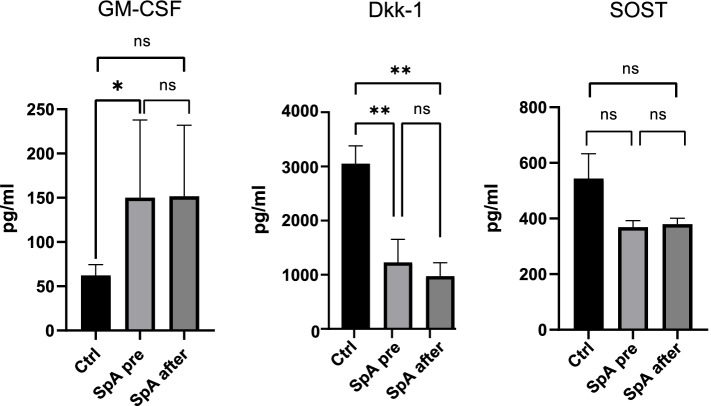
Twelve r-axSpA patients (7 males, 5 females, median age 37 years) with a median disease duration of 1 year and 16 age- and sex-matched controls were included. At baseline, patients had mean BASDAI 6.3±2 and ASDAS 3.2±0.7, which decreased to 4.1±1.7 and 2.2±0.6 at follow-up, respectively. At baseline, r-axSpA patients had significantly higher mean serum levels of GM-CSF (150 vs 62pg/ml, p=0.049), significantly lower Dkk-1 (1228 vs 3052pg/ml, p=0.001), but similar levels of SOST (369 vs 544pg/ml, p=0.144) compared to controls. Anti-TNF treatment did not affect GM-CSF, Dkk-1, or SOST levels. Spearman correlation analysis showed that GM-CSF correlated positively with ASDAS at baseline (r=0.61, p=0.039), while no correlations were identified between bone markers (Dkk-1, SOST) on one hand and GM-CSF or disease activity indices on the other.
GM-CSF is increased in patients with active AS and strongly correlates with disease activity. TNF inhibition does not affect GM-SCF levels, despite improving disease activity. GM-CSF may represent an important pathway responsible for residual inflammation during TNF blockade, but also a potential target of JAK inhibitors, explaining their efficacy in r-axSpA.
越来越多的证据表明单核细胞和中性粒细胞在放射学 axSpA(r-axSpA)中起作用。粒细胞-巨噬细胞集落刺激因子(GM-CSF)是白细胞谱系的生长因子,也是一种促炎细胞因子,可激活髓样细胞并促进破骨细胞生成。它通过 JAK-STAT 途径发挥作用。我们在接受抗 TNF 治疗前后测量了 r-axSpA 患者的血清 GM-CSF 和骨代谢标志物。
招募了患有活动性 r-axSpA 的患者,尽管他们接受了 NSAIDs 治疗,但均符合生物制剂治疗条件。健康供体被采样作为对照。在接受抗 TNF 治疗前(基线)和 4-6 个月后(随访)采集血清,并通过 ELISA 测量以下分子:GM-CSF、骨硬化蛋白(SOST)和 Dickkopf-1(Dkk-1)。
共纳入 12 例 r-axSpA 患者(7 名男性,5 名女性,中位年龄 37 岁)和 16 名年龄和性别匹配的对照者。基线时,患者的 BASDAI 平均为 6.3±2,ASDAS 为 3.2±0.7,随访时分别降至 4.1±1.7 和 2.2±0.6。基线时,r-axSpA 患者的血清 GM-CSF 水平明显较高(150 比 62pg/ml,p=0.049),Dkk-1 水平明显较低(1228 比 3052pg/ml,p=0.001),但 SOST 水平相似(369 比 544pg/ml,p=0.144)。抗 TNF 治疗并未影响 GM-CSF、Dkk-1 或 SOST 水平。Spearman 相关分析显示,GM-CSF 与基线时的 ASDAS 呈正相关(r=0.61,p=0.039),而骨标志物(Dkk-1、SOST)与 GM-CSF 或疾病活动指数之间无相关性。
活动期 AS 患者的 GM-CSF 增加,与疾病活动度密切相关。尽管 TNF 抑制可改善疾病活动度,但不影响 GM-SCF 水平。GM-CSF 可能是 TNF 阻断时残留炎症的重要途径,但也是 JAK 抑制剂的潜在靶点,解释了其在 r-axSpA 中的疗效。