Institute for Sexual and Gender Minority Health and Wellbeing, Northwestern University, Chicago, IL; Department of Medical Social Sciences, Northwestern University Feinberg School of Medicine, Chicago, IL.
Institute for Sexual and Gender Minority Health and Wellbeing, Northwestern University, Chicago, IL.
Ann Epidemiol. 2022 Feb;66:44-51. doi: 10.1016/j.annepidem.2021.10.006. Epub 2021 Oct 31.
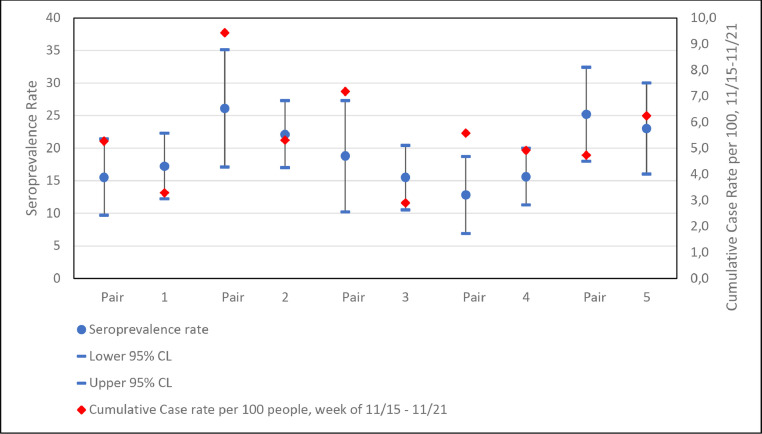
To date, COVID-19 case rates are disproportionately higher in Black and Latinx communities across the US, leading to more hospitalizations, and deaths in those communities. These differences in case rates are evident in comparisons of Chicago neighborhoods with differing race and/or ethnicities of their residents. Disparities could be due to neighborhoods with more adverse health outcomes associated with poverty and other social determinants of health experiencing higher prevalence of SARS-CoV-2 infection or due to greater morbidity and mortality resulting from equivalent SARS-CoV-2 infection prevalence. We surveyed five pairs of adjacent ZIP codes in Chicago with disparate COVID-19 case rates for highly specific and quantitative serologic evidence of any prior infection by SARS-CoV-2 to compare with their disparate COVID-19 case rates. Dried blood spot samples were self-collected at home by internet-recruited participants in summer 2020, shortly after Chicago's first wave of the COVID-19 pandemic. Pairs of neighboring ZIP codes with very different COVID-19 case rates had similar seropositivity rates for anti-SARS-CoV-2 receptor binding domain IgG antibodies. Overall, these findings of comparable exposure to SARS-CoV-2 across neighborhoods with very disparate COVID-19 case rates are consistent with social determinants of health, and the co-morbidities related to them, driving differences in COVID-19 rates across neighborhoods.
迄今为止,美国各地的黑人和拉丁裔社区 COVID-19 病例率不成比例地更高,导致这些社区的住院率和死亡率更高。在比较芝加哥不同种族和/或族裔的社区时,病例率的这些差异是明显的。差异可能是由于与贫困和其他健康决定因素相关的不良健康结果更多的社区,SARS-CoV-2 感染的流行率更高,或者由于同等 SARS-CoV-2 感染流行率导致发病率和死亡率更高。我们调查了芝加哥五个具有不同 COVID-19 病例率的相邻邮政编码地区,以获取与 SARS-CoV-2 任何既往感染有关的高度特异性和定量血清学证据,以与其不同的 COVID-19 病例率进行比较。在 COVID-19 大流行的第一波之后不久,2020 年夏天,通过互联网招募的参与者在家中自行采集干血斑样本。具有非常不同 COVID-19 病例率的相邻邮政编码地区的 SARS-CoV-2 受体结合域 IgG 抗体血清阳性率相似。总体而言,这些在 COVID-19 病例率非常不同的社区中接触 SARS-CoV-2 的发现与健康的社会决定因素以及与之相关的合并症一致,导致了社区之间 COVID-19 率的差异。