Volpi Valeria, Volpato Eleonora, Compalati Elena, Pierucci Paola, Nicolini Antonello, Lax Agata, Fagetti Laura, Annunziata Anna, Cauteruccio Rosa, Fiorentino Giuseppe, Banfi Paolo
IRCCS Fondazione Don Carlo Gnocchi ONLUS, 20148 Milan, Italy.
Department of Psychology, Università Cattolica del Sacro Cuore, 20123 Milan, Italy.
J Clin Med. 2023 Mar 23;12(7):2453. doi: 10.3390/jcm12072453.
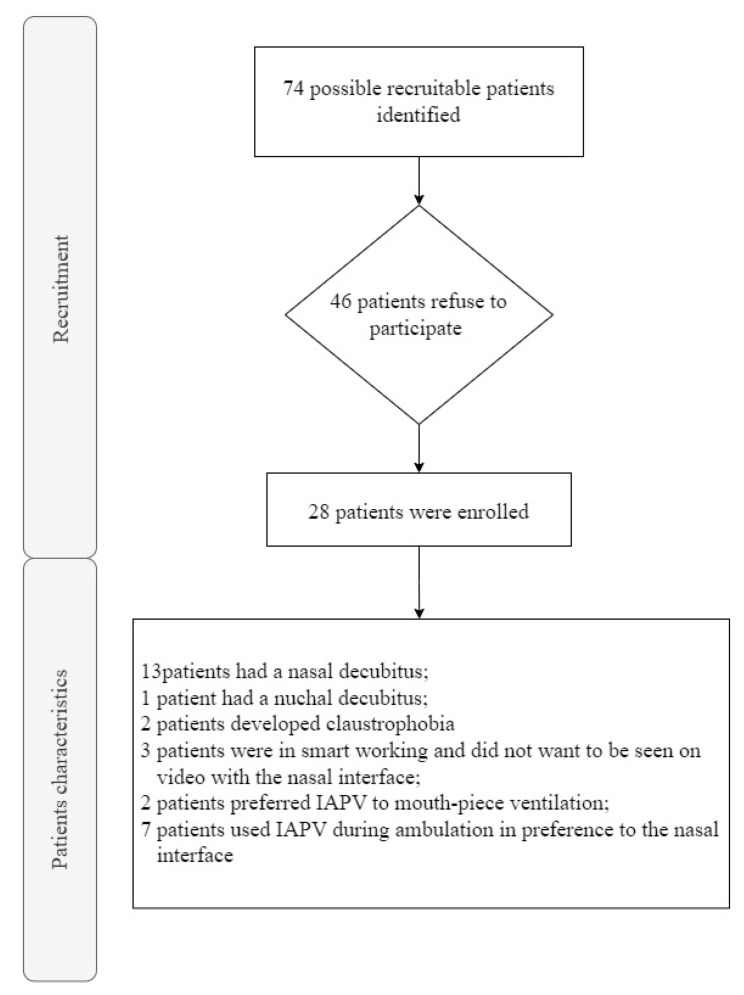
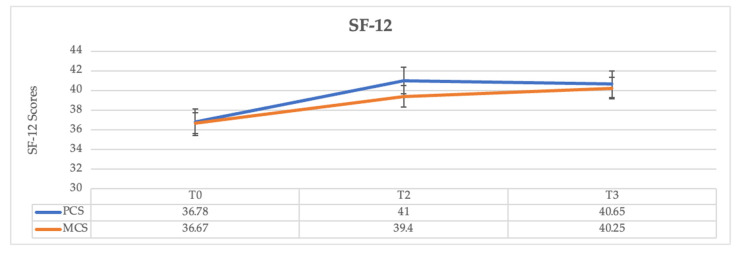
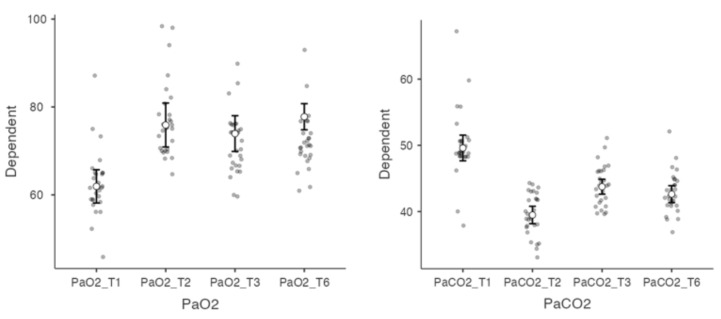
Non-invasive ventilatory support (NVS) is a technique used to reduce respiratory work in neuromuscular diseases, preventing the progression of respiratory failure. NVS is usually administered via a nasal or an oronasal mask, causing discomfort, especially in patients ventilated for more than 16 h/day. Intermittent abdominal pressure ventilation (IAPV) differs completely from conventional NVS and consists of a portable ventilator and a corset with Velcro closures as the interface. In our study, the practicability and efficacy of IAPV were studied in three Italian centers monitoring 28 neuromuscular patients using IAPV who were then retrospectively analyzed. The primary outcomes were an improvement in hypoxemia and the normalization of hypercapnia, and the secondary outcome was an improvement in quality of life. Data were collected at baseline (T0) and after two hours of ventilation (T1), with follow-ups at three months (T2) and six months (T3). Statistical significance was found for PaCO over time (F (2.42) = 7.63, = 0.001) and PaO (W = 0.539, = 0.033). The time of NVS usage also significantly affected the quality of life (F (2.14) = 6.90, = 0.010), as seen when comparing T0 and T3. As an alternative ventilation method, IAPV is still relevant today and could become a key part of daytime support, especially for patients who do not tolerate standard daytime NVS with an oral interface.
无创通气支持(NVS)是一种用于减轻神经肌肉疾病患者呼吸负荷、防止呼吸衰竭进展的技术。NVS通常通过鼻罩或口鼻面罩进行,会引起不适,尤其是对于每天接受通气超过16小时的患者。间歇性腹压通气(IAPV)与传统的NVS完全不同,它由一台便携式呼吸机和一个带有魔术贴闭合装置的束腹带作为接口组成。在我们的研究中,在三个意大利中心对28名使用IAPV的神经肌肉疾病患者进行了监测,研究了IAPV的实用性和有效性,随后进行了回顾性分析。主要结局是低氧血症改善和高碳酸血症正常化,次要结局是生活质量改善。在基线(T0)、通气两小时后(T1)收集数据,并在三个月(T2)和六个月(T3)进行随访。发现PaCO随时间有统计学意义(F(2.42)= 7.63,P = 0.001),PaO也有统计学意义(W = 0.539,P = 0.033)。比较T0和T3时可以看出,NVS使用时间也显著影响生活质量(F(2.14)= 6.90,P = 0.010)。作为一种替代通气方法,IAPV如今仍然具有相关性,并且可能成为日间支持的关键部分,特别是对于那些不能耐受带有口腔接口的标准日间NVS的患者。