Department of Psychiatry and Behavioral Sciences, Stanford University, Palo Alto, CA, USA.
Department of Neurology and Neurological Sciences, Stanford University, Palo Alto, CA, USA.
Sleep. 2023 Aug 14;46(8). doi: 10.1093/sleep/zsad103.
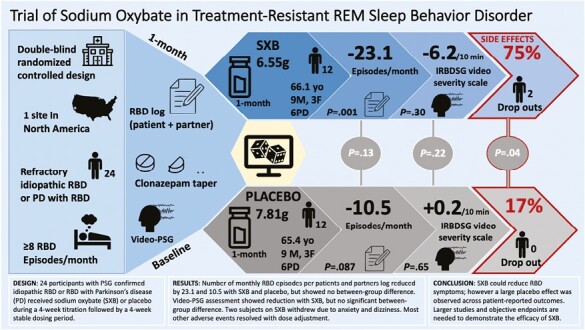
Symptomatic therapies for rapid-eye-movement (REM) sleep behavior disorder (RBD) are limited. Sodium oxybate (SXB), a gamma-aminobutyric acid (GABA)-B agonist, could be effective but has not been evaluated against placebo.
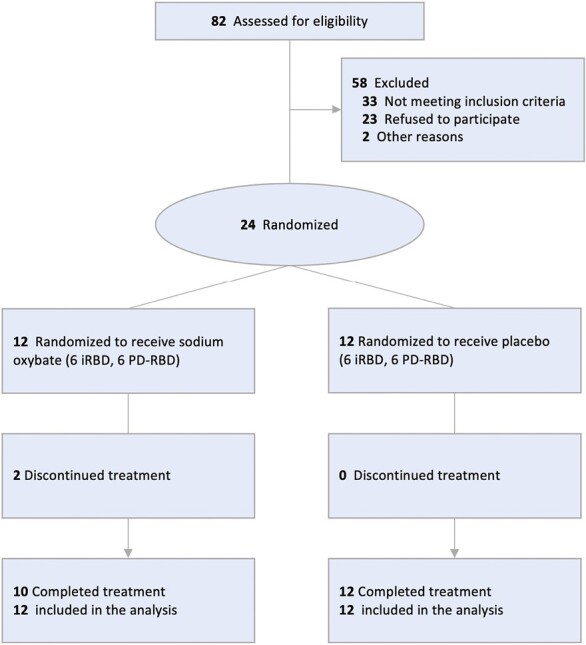
This double-blind, parallel-group, randomized, placebo-controlled trial in 24 participants was conducted at the Stanford Sleep Center. Patients were adults with definite iRBD or Parkinson's disease and probable RBD (PD-RBD), and persistence of ≥ 2 weekly episodes despite standard therapy. Patients were randomized 1:1 to receive SXB during a 4-week titration followed by a 4-week stable dosing period. Primary outcome was number of monthly RBD episodes according to a diary filled by patients and partners. Secondary outcomes were severity, number of severe RBD episodes, and objective RBD activity on video polysomnography.
Twelve iRBD and 12 PD-RBD participated (mean 65.8 years), and 22 (n = 10 SXB, 12 placebo) completed the study. Although no significant between-group difference was found, SXB showed reduction of monthly RBD episodes by 23.1 (95% CI -36.0, -10.2; p = 0.001) versus 10.5 with placebo (95% CI, -22.6, 1.6; p = 0.087). Improvement from baseline was similarly observed for RBD overall severity burden (each episode weighted for severity), number of severe episodes, and objective RBD activity per video-polysomnography. Two participants receiving SXB withdrew due to anxiety and dizziness. The majority of adverse events are otherwise resolved with dose adjustment.
SXB could reduce RBD symptoms; however, response was inconsistent and a large placebo effect was observed across patient-reported outcomes. Larger studies using objective endpoints are needed.
Treatment of REM Sleep Behavior Disorder (RBD) With Sodium Oxybate https://clinicaltrials.gov/ct2/show/NCT04006925 ClinicalTrials.gov identifier: NCT04006925.
快速眼动 (REM) 睡眠行为障碍 (RBD) 的对症治疗有限。γ-氨基丁酸 (GABA)-B 激动剂羟丁酸钠 (SXB) 可能有效,但尚未与安慰剂进行对照评估。
本研究为在斯坦福睡眠中心进行的一项 24 名参与者参与的双盲、平行组、随机、安慰剂对照试验。患者为有明确的 iRBD 或帕金森病和可能的 RBD(PD-RBD)的成年人,并且尽管接受了标准治疗,但每周仍有≥2 次发作。患者以 1:1 的比例随机接受 SXB,进行为期 4 周的滴定,然后进行为期 4 周的稳定剂量期。主要结局是根据患者和伴侣填写的日记计算的每月 RBD 发作次数。次要结局是严重程度、严重 RBD 发作次数和视频多导睡眠图上的客观 RBD 活动。
12 例 iRBD 和 12 例 PD-RBD 患者(平均年龄 65.8 岁)参与了研究,22 例(n = 10 SXB,12 例安慰剂)完成了研究。尽管未发现组间有显著差异,但与安慰剂相比,SXB 使每月 RBD 发作减少 23.1(95%CI -36.0,-10.2;p = 0.001),而安慰剂为 10.5(95%CI,-22.6,1.6;p = 0.087)。基线时 RBD 总体严重程度负担(每个发作的严重程度加权)、严重发作次数和视频多导睡眠图上的客观 RBD 活动也有类似的改善。2 名接受 SXB 的患者因焦虑和头晕而退出研究。大多数不良事件通过剂量调整得到解决。
SXB 可能会减轻 RBD 症状;然而,反应不一致,并且在患者报告的结果中观察到较大的安慰剂效应。需要使用客观终点的更大规模研究。
羟丁酸钠治疗 REM 睡眠行为障碍(RBD)https://clinicaltrials.gov/ct2/show/NCT04006925
NCT04006925