Richards Lucas, Dalla Shiv, Fitzgerald Sharon, Walter Carissa, Ash Ryan, Miller Kirk, Alli Adam, Rohr Aaron
University of Kansas School of Medicine, 3901 Rainbow Boulevard, 66160, Kansas City, KS, USA.
Department of Population Health, University of Kansas Medical Center, 3901 Rainbow Boulevard, Mail Stop 1008, 66160, Kansas City, KS, USA.
3D Print Med. 2023 Apr 13;9(1):10. doi: 10.1186/s41205-023-00176-w.
3D (three-dimensional) printing has been adopted by the medical community in several ways, procedure planning being one example. This application of technology has been adopted by several subspecialties including interventional radiology, however the planning of transjugular intrahepatic portosystemic shunt (TIPS) placement has not yet been described. The impact of a 3D printed model on procedural measures such as procedure time, radiation exposure, intravascular contrast dosage, fluoroscopy time, and provider confidence has also not been reported.
This pilot study utilized a quasi-experimental design including patients who underwent TIPS. For the control group, retrospective data was collected on patients who received a TIPS prior to Oct 1, 2020. For the experimental group, patient-specific 3D printed models were integrated in the care of patients that received TIPS between Oct 1, 2020 and April 15, 2021. Data was collected on patient demographics and procedural measures. The interventionalists were surveyed on their confidence level and model usage following each procedure in the experimental group.
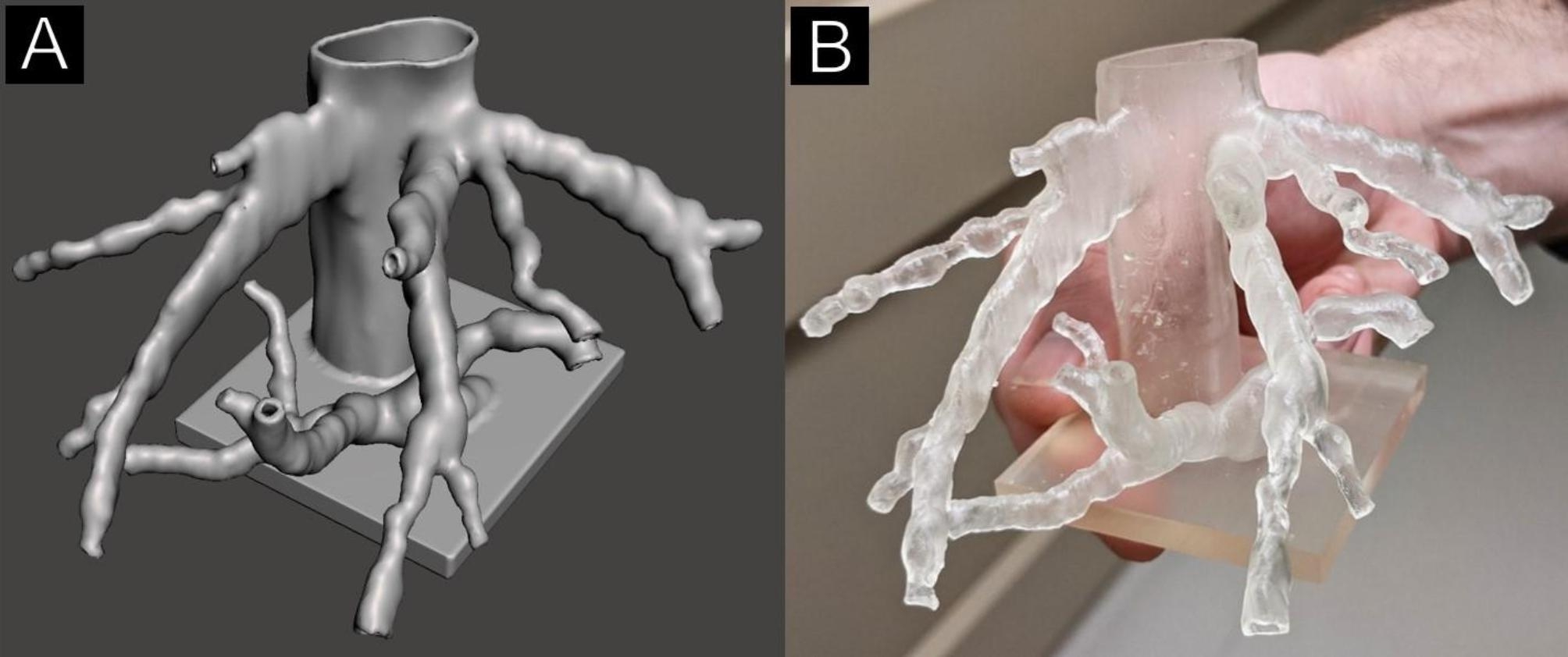
3D printed models were created for six TIPS. Procedure time (p = 0.93), fluoroscopy time (p = 0.26), and intravascular contrast dosage (p = 0.75) did not have significant difference between groups. Mean radiation exposure was 808.8 mGy in the group with a model compared to 1731.7 mGy without, however this was also not statistically significant (p = 0.09). Out of 11 survey responses from interventionists, 10 reported "increased" or "significantly increased" confidence after reviewing the 3D printed model and all responded that the models were a valuable tool for trainees.
3D printed models of patient anatomy can consistently be made using consumer-level, desktop 3D printing technology. This study was not adequately powered to measure the impact that including 3D printed models in the planning of TIPS procedures may have on procedural measures. The majority of interventionists reported that patient-specific models were valuable tools for teaching trainees and that confidence levels increased as a result of model inclusion in procedure planning.
3D(三维)打印已在多个方面被医学界采用,手术规划就是其中一个例子。包括介入放射学在内的多个亚专业都采用了这项技术应用,然而经颈静脉肝内门体分流术(TIPS)置入的规划尚未见相关描述。3D打印模型对诸如手术时间、辐射暴露、血管内造影剂用量、透视时间和术者信心等手术指标的影响也未见报道。
本前瞻性研究采用准实验设计,纳入接受TIPS的患者。对于对照组,收集2020年10月1日前接受TIPS的患者的回顾性数据。对于实验组,将患者特异性3D打印模型应用于2020年10月1日至2021年4月15日期间接受TIPS的患者的治疗中。收集患者人口统计学和手术指标数据。对实验组的每位术者在每次手术后就其信心水平和模型使用情况进行调查。
为6例TIPS制作了3D打印模型。两组之间的手术时间(p = 0.93)、透视时间(p = 0.26)和血管内造影剂用量(p = 0.75)无显著差异。使用模型组的平均辐射暴露为808.8 mGy,未使用模型组为1731.7 mGy,但这也无统计学意义(p = 0.09)。在术者的11份调查问卷回复中,10份报告在查看3D打印模型后信心“增强”或“显著增强”,且所有人都表示这些模型对实习生是有价值的工具。
使用消费级桌面3D打印技术能够始终如一地制作患者解剖结构的3D打印模型。本研究的样本量不足以衡量在TIPS手术规划中纳入3D打印模型对手术指标可能产生的影响。大多数介入放射科医生报告称,患者特异性模型是培训实习生的有价值工具,并且由于在手术规划中纳入模型,信心水平有所提高。