Melanoma Institute Australia, The University of Sydney, Sydney, NSW, Australia.
Faculty of Medicine and Health, The University of Sydney, Sydney, NSW, Australia.
J Transl Med. 2023 Apr 13;21(1):257. doi: 10.1186/s12967-023-04092-9.
Gene expression profiling is increasingly being utilised as a diagnostic, prognostic and predictive tool for managing cancer patients. Single-sample scoring approach has been developed to alleviate instability of signature scores due to variations from sample composition. However, it is a challenge to achieve comparable signature scores across different expressional platforms.
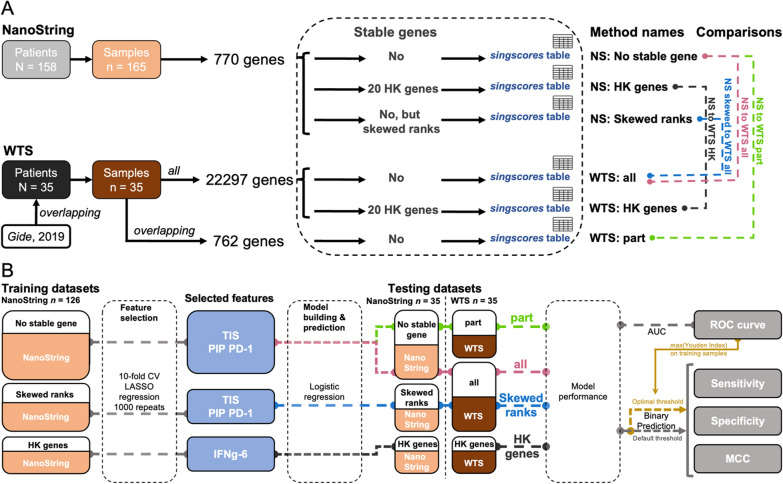
The pre-treatment biopsies from a total of 158 patients, who have received single-agent anti-PD-1 (n = 84) or anti-PD-1 + anti-CTLA-4 therapy (n = 74), were performed using NanoString PanCancer IO360 Panel. Multiple immune-related signature scores were measured from a single-sample rank-based scoring approach, singscore. We assessed the reproducibility and the performance in reporting immune profile of singscore based on NanoString assay in advance melanoma. To conduct cross-platform analyses, singscores between the immune profiles of NanoString assay and the previous orthogonal whole transcriptome sequencing (WTS) data were compared through linear regression and cross-platform prediction.
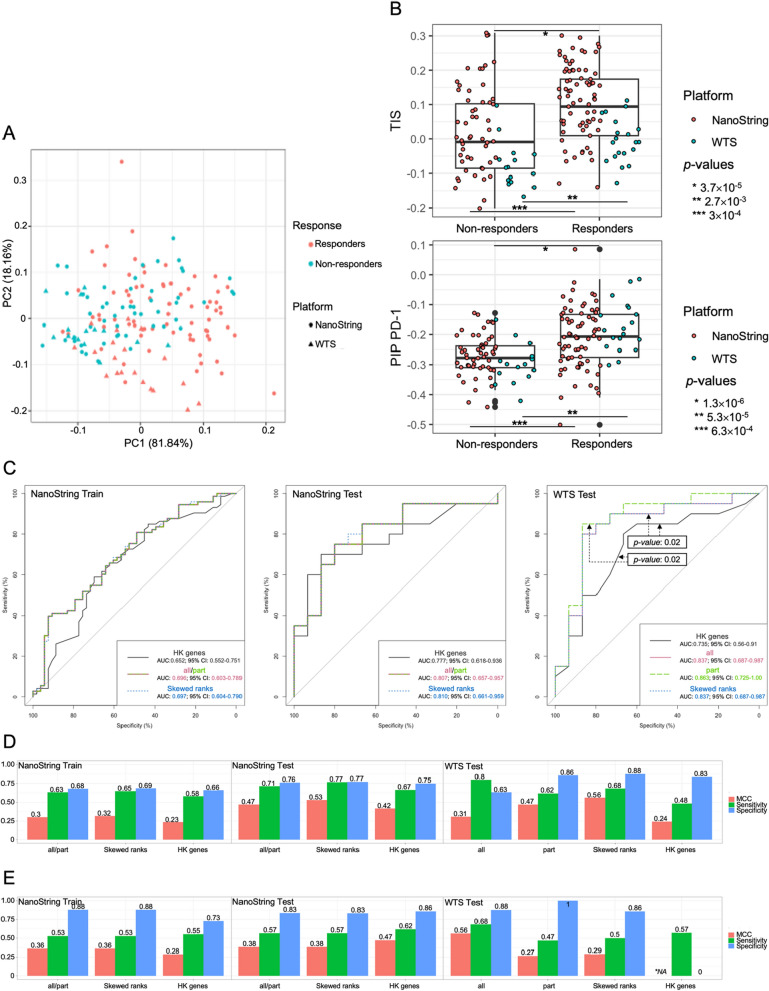
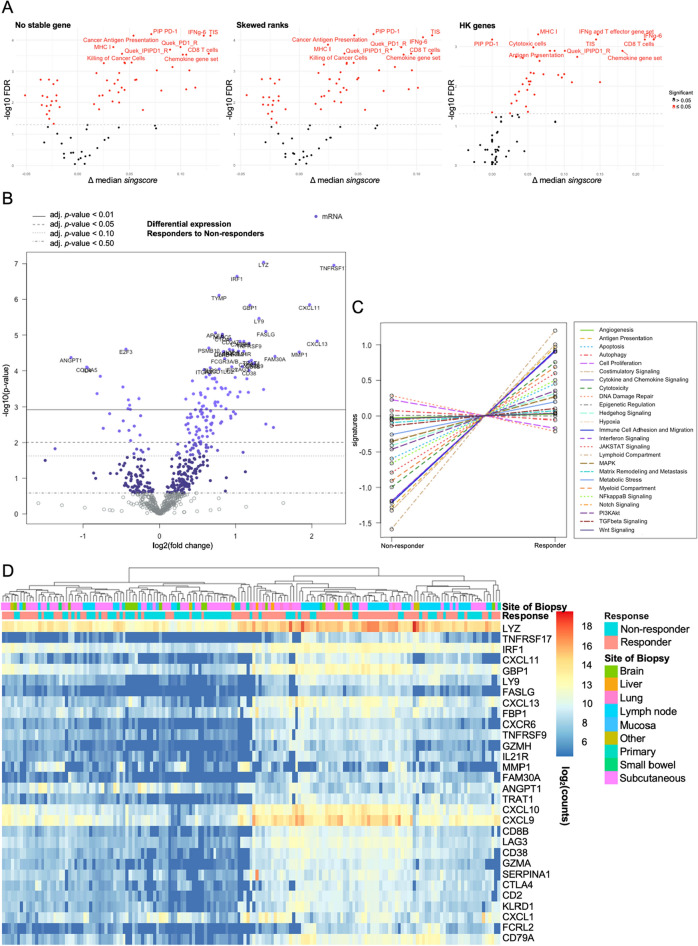
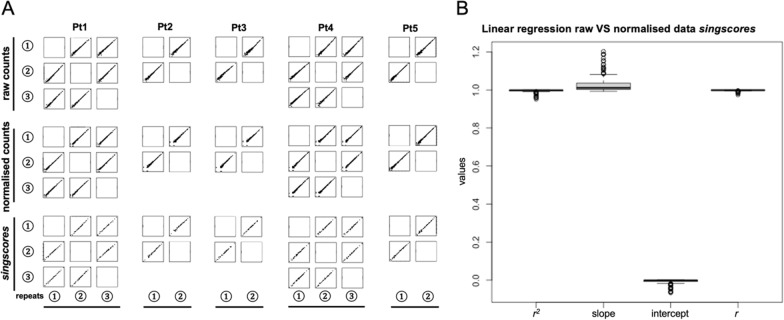
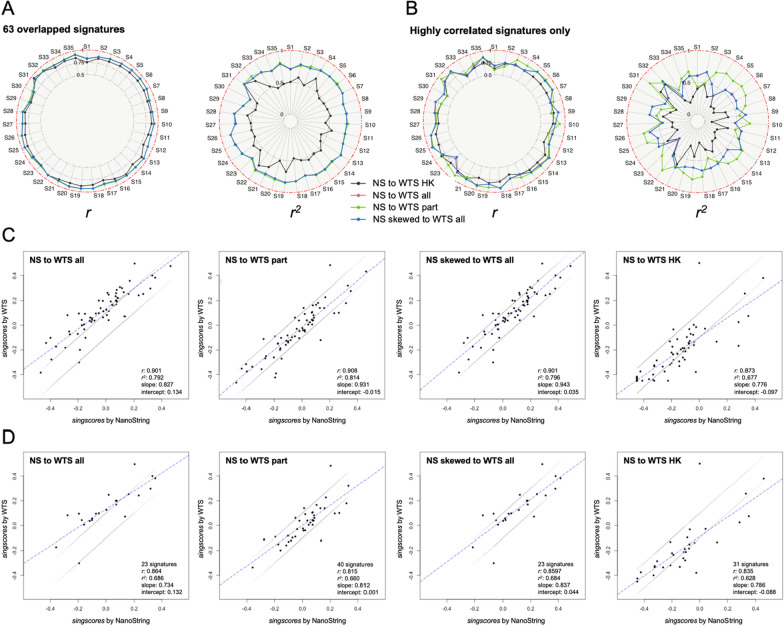
singscore-derived signature scores reported significantly high scores in responders in multiple PD-1, MHC-1-, CD8 T-cell-, antigen presentation-, cytokine- and chemokine-related signatures. We found that singscore provided stable and reproducible signature scores among the repeats in different batches and cross-sample normalisations. The cross-platform comparisons confirmed that singscores derived via NanoString and WTS were comparable. When singscore of WTS generated by the overlapping genes to the NanoString gene set, the signatures generated highly correlated cross-platform scores (Spearman correlation interquartile range (IQR) [0.88, 0.92] and r IQR [0.77, 0.81]) and better prediction on cross-platform response (AUC = 86.3%). The model suggested that Tumour Inflammation Signature (TIS) and Personalised Immunotherapy Platform (PIP) PD-1 are informative signatures for predicting immunotherapy-response outcomes in advanced melanoma patients treated with anti-PD-1-based therapies.
Overall, the outcome of this study confirms that singscore based on NanoString data is a feasible approach to produce reliable signature scores for determining patients' immune profiles and the potential clinical utility in biomarker implementation, as well as to conduct cross-platform comparisons, such as WTS.
基因表达谱分析越来越多地被用作管理癌症患者的诊断、预后和预测工具。为了缓解由于样本组成变化导致的签名分数不稳定,已经开发了单样本评分方法。然而,在不同表达平台上实现可比的签名分数仍然是一个挑战。
对总共 158 名接受单一抗 PD-1(n=84)或抗 PD-1+抗 CTLA-4 治疗(n=74)的患者的预处理活检进行了分析,使用了 NanoString PanCancer IO360 面板。从基于单样本排名的评分方法(singscore)中测量了多个免疫相关的签名评分。我们评估了基于 NanoString 检测的 singscore 在预先诊断黑色素瘤中的重现性和报告免疫特征的性能。为了进行跨平台分析,通过线性回归和跨平台预测比较了 NanoString 检测的免疫特征与之前的正交全转录组测序(WTS)数据之间的 singscore。
在多个 PD-1、MHC-1、CD8 T 细胞、抗原呈递、细胞因子和趋化因子相关的签名中,singscore 衍生的签名评分在应答者中报告了显著较高的评分。我们发现,在不同批次和跨样本归一化之间,singscore 提供了稳定和可重现的签名评分。跨平台比较证实,通过 NanoString 和 WTS 获得的 singscores 是可比的。当通过与 NanoString 基因集重叠的基因生成 WTS 的 singscore 时,生成的签名具有高度相关的跨平台评分(Spearman 相关四分位距(IQR)[0.88,0.92]和 r IQR [0.77,0.81])和更好的跨平台反应预测(AUC=86.3%)。该模型表明,肿瘤炎症特征(TIS)和个性化免疫治疗平台(PIP)PD-1 是预测接受基于 PD-1 的治疗的晚期黑色素瘤患者免疫治疗反应结果的有意义的特征。
总的来说,这项研究的结果证实,基于 NanoString 数据的 singscore 是一种可行的方法,可以为确定患者的免疫特征和在生物标志物实施中以及进行跨平台比较(如 WTS)方面产生可靠的签名评分。