Department of Clinical Psychology, Central South University, The Third Xiangya Hospital, Changsha, 410013, Hunan, China.
Department of Psychiatry, and National Clinical Research Center for Mental Disorders, The Second Xiangya Hospital of Central South University, Changsha, 410011, Hunan, China.
BMC Psychiatry. 2023 Apr 13;23(1):248. doi: 10.1186/s12888-023-04735-7.
BACKGROUND: Non-suicidal self-injury (NSSI) is a vital public concern around the world, and it often starts in adolescence. Emotional neglect (EN) has been considered a distal risk factor for NSSI, but the effects of social anxiety symptoms (SA) and insomnia on this relationship have remained unclear. This study aimed to investigate the potential pathways from EN to NSSI, examining the role of SA and insomnia in this association.
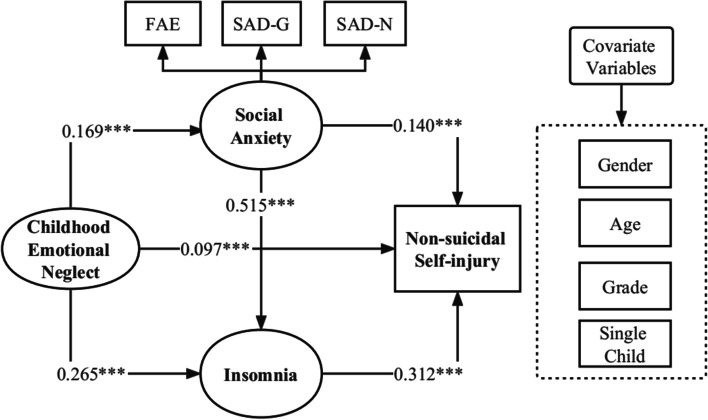
One thousand three hundred thirty seven Chinese middle school students (M = 13.040, SD = 0.981, 50.2% males) in China were enrolled in this cross-sectional study. Participants completed the Emotional Neglect sub-scale of Childhood Trauma Questionnaire (CTQ-SF), the Social Anxiety Scale for Adolescent (SAS-A), Athens Insomnia Scale (AIS) and non-suicidal self-injury assessment. Structural equation modelling (SEM) was used to test the possible mediation model among these variables.
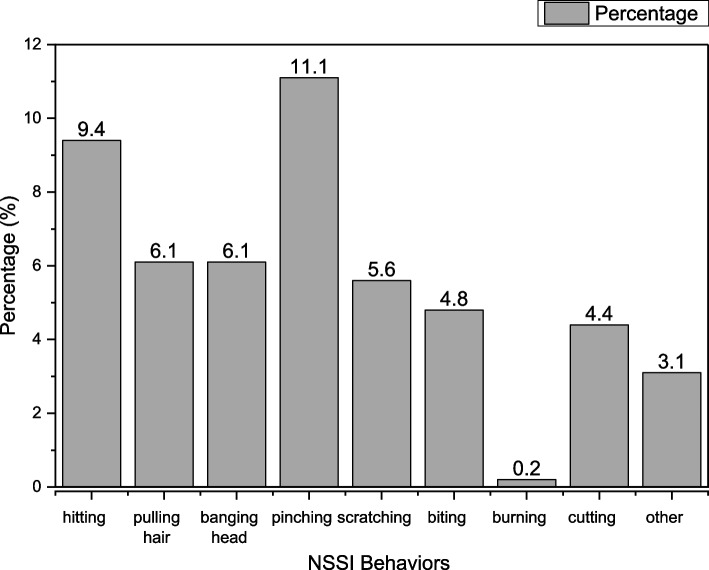
231(17.3%) students reported NSSI history during last year and 322 (24.1%) participants reported experiences of EN. Students who experienced EN have higher rates of NSSI compared to students without EN history (29.2% vs 13.5%). EN, SA, insomnia and NSSI were positively related to each other. Furthermore, both SA and insomnia played a mediating role in the relationship between EN and NSSI, the series mediating effect of SA and insomnia on this association was also significant after controlling for demographics. Indirect effects accounted for 58.26% of the total effects (EN → NSSI).
Our study revealed that EN was associated with NSSI, SA and insomnia play indirect roles in the association between EN and NSSI. The findings of our research may have implications for clinicians, families, and schools in their efforts to lower the risk of NSSI in adolescents.
背景:非自杀性自伤(NSSI)是全世界一个重要的公共关注问题,通常始于青少年时期。情感忽视(EN)已被认为是 NSSI 的一个远端风险因素,但社交焦虑症状(SA)和失眠对这种关系的影响仍不清楚。本研究旨在探讨从 EN 到 NSSI 的潜在途径,研究 SA 和失眠在这种关联中的作用。
在中国,这项横断面研究共纳入了 1337 名中国中学生(M=13.040,SD=0.981,50.2%为男性)。参与者完成了儿童创伤问卷(CTQ-SF)的情感忽视子量表、青少年社交焦虑量表(SAS-A)、雅典失眠量表(AIS)和非自杀性自伤评估。结构方程模型(SEM)用于测试这些变量之间可能的中介模型。
231 名(17.3%)学生在过去一年中报告有 NSSI 史,322 名(24.1%)参与者报告有 EN 经历。经历 EN 的学生与没有 EN 史的学生相比,NSSI 发生率更高(29.2%比 13.5%)。EN、SA、失眠和 NSSI 之间呈正相关。此外,SA 和失眠在 EN 与 NSSI 之间的关系中均起中介作用,在控制人口统计学因素后,SA 和失眠对这种关联的串联中介效应也具有统计学意义。间接效应占总效应的 58.26%(EN→NSSI)。
我们的研究表明,EN 与 NSSI 相关,SA 和失眠在 EN 与 NSSI 之间的关系中起间接作用。我们研究结果的意义可能在于为临床医生、家庭和学校提供参考,以降低青少年 NSSI 的风险。