Department of Environmental Health, Boston University School of Public Health, Boston, Massachusetts, USA.
Channing Division of Network Medicine, Department of Medicine, Brigham and Women's Hospital and Harvard Medical School, Boston, Massachusetts, USA.
Environ Health Perspect. 2023 Apr;131(4):47010. doi: 10.1289/EHP10959. Epub 2023 Apr 14.
Sleep disruption is linked with chronic disease, and aircraft noise can disrupt sleep. However, there are few investigations of aircraft noise and sleep in large cohorts.
We examined associations between aircraft noise and self-reported sleep duration and quality in the Nurses' Health Study, a large prospective cohort.
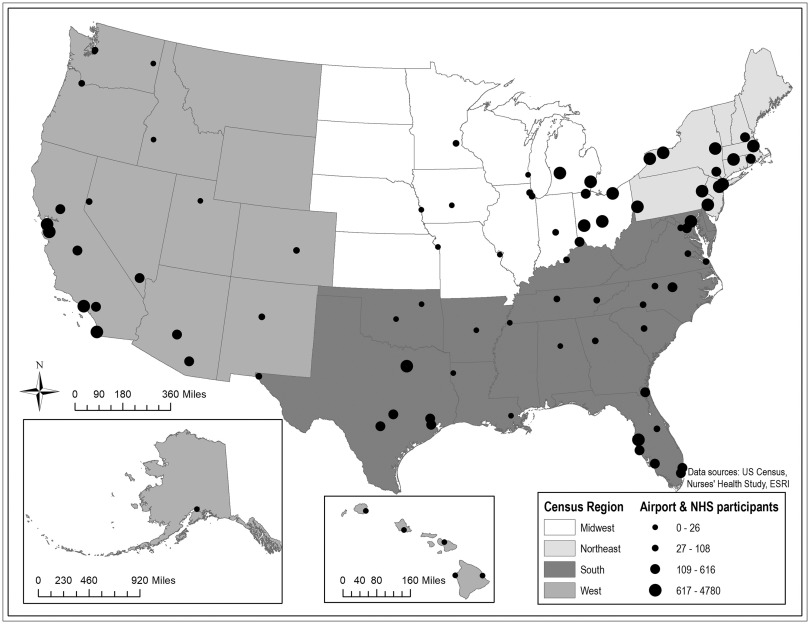
Aircraft nighttime equivalent sound levels (Lnight) and day-night average sound levels (DNL) were modeled around 90 U.S. airports from 1995 to 2015 in 5-y intervals using the Aviation Environmental Design Tool and linked to geocoded participant residential addresses. Lnight exposure was dichotomized at the lowest modeled level of 45 A-weighted decibels [dB(A)] and at multiple cut points for DNL. Multiple categories of both metrics were compared with dB(A). Self-reported short sleep duration ( h/24-h day) was ascertained in 2000, 2002, 2008, 2012, and 2014, and poor sleep quality (frequent trouble falling/staying asleep) was ascertained in 2000. We analyzed repeated sleep duration measures using generalized estimating equations and sleep quality by conditional logistic regression. We adjusted for participant-level demographics, behaviors, comorbidities, and environmental exposures (greenness and light at night) and examined effect modification.
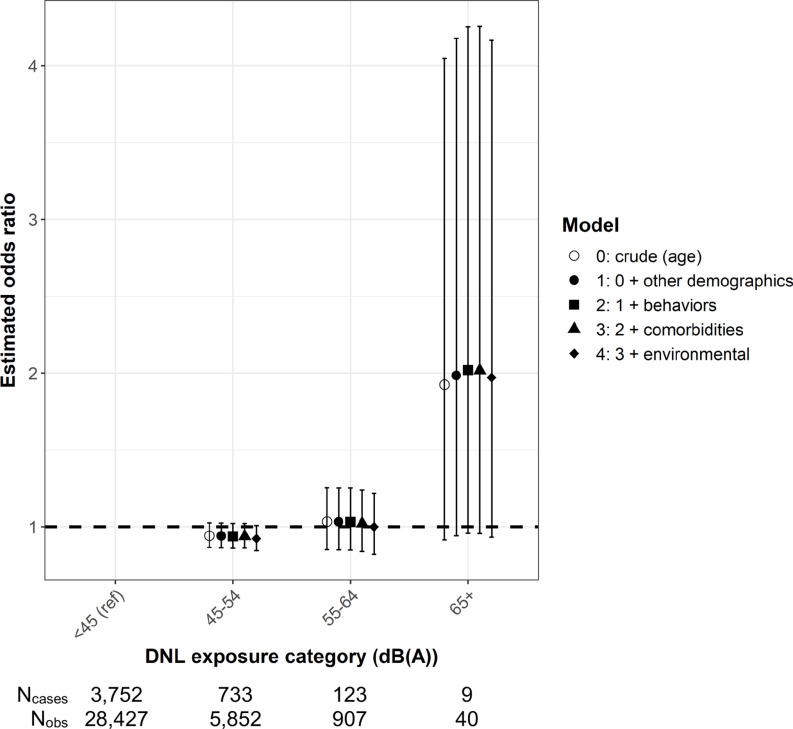
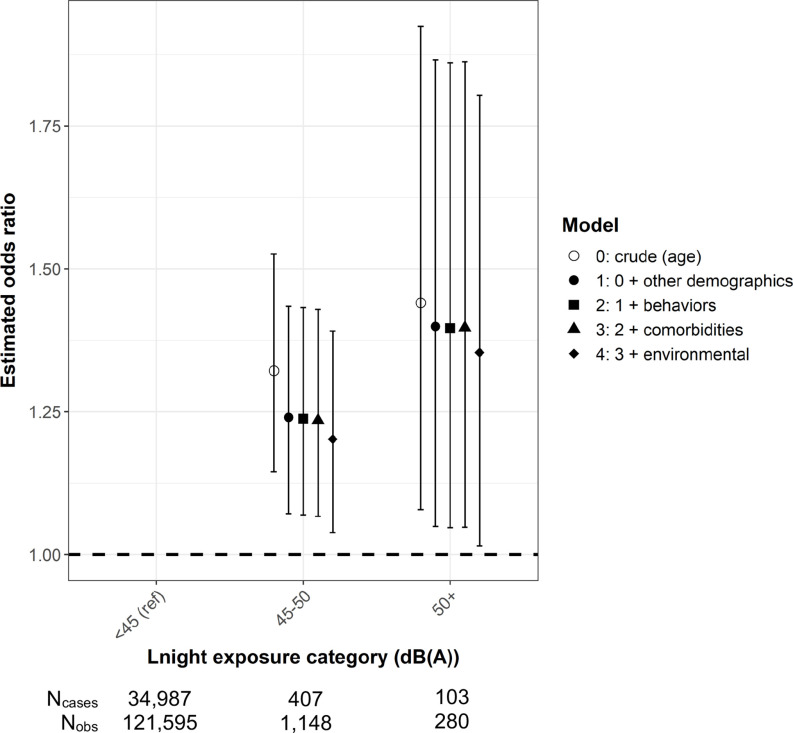
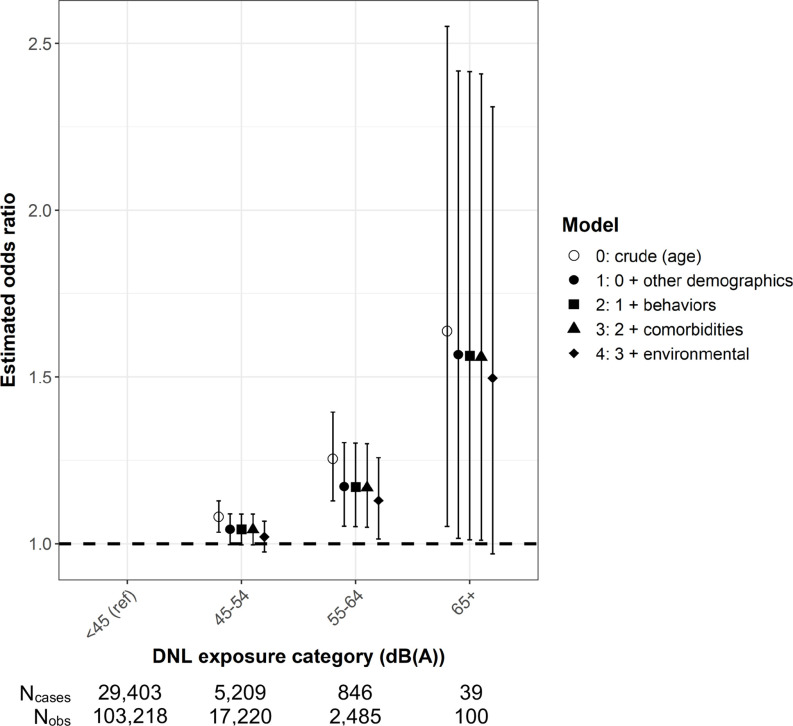
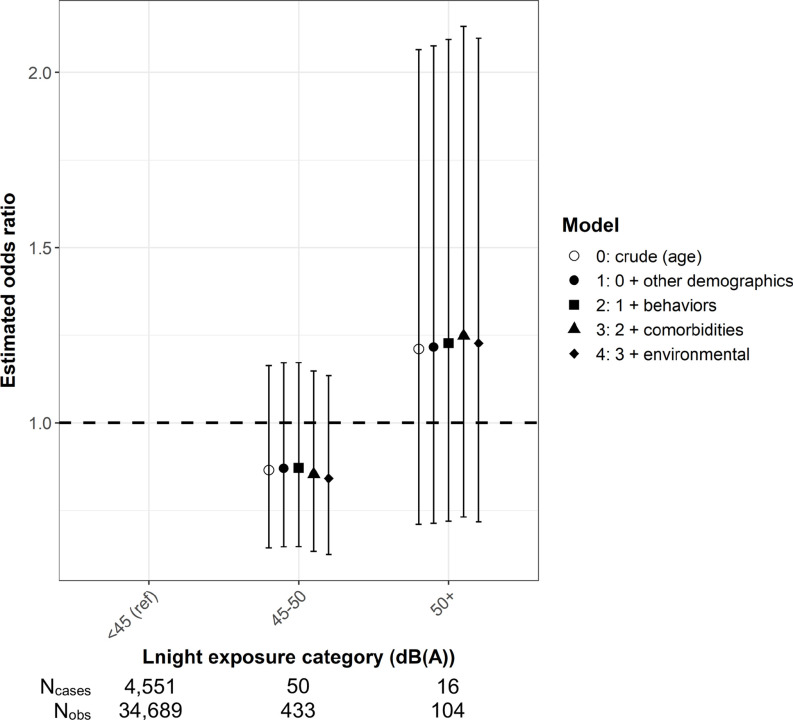
In 35,226 female nurses averaging 66.1 years of age at baseline, prevalence of short sleep duration and poor sleep quality were 29.6% and 13.1%, respectively. In multivariable models, exposure to Lnight dB(A) was associated with 23% [95% confidence interval (CI): 7%, 40%] greater odds of short sleep duration but was not associated with poor sleep quality (9% lower odds; 95% CI: , 19%). Increasing categories of Lnight and DNL dB(A) suggested an exposure-response relationship for short sleep duration. We observed higher magnitude associations among participants living in the West, near major cargo airports, and near water-adjacent airports and among those reporting no hearing loss.
Aircraft noise was associated with short sleep duration in female nurses, modified by individual and airport characteristics. https://doi.org/10.1289/EHP10959.
睡眠障碍与慢性病有关,而飞机噪音会干扰睡眠。然而,在大型队列中,很少有关于飞机噪音和睡眠的研究。
我们在一项大型前瞻性队列研究——护士健康研究中,研究了飞机噪音与自我报告的睡眠时间和睡眠质量之间的关系。
使用航空环境设计工具,在 1995 年至 2015 年的 5 年间隔内,围绕美国 90 多个机场建立了飞机夜间等效声级(Lnight)和昼夜平均声级(DNL)模型,并将其与参与者居住地址的地理编码相联系。Lnight 暴露按照最低模型水平 45 加权分贝(A 计权)[dB(A)]和 DNL 的多个切点进行二分法。用 dB(A)比较了这两个指标的多个类别。2000 年、2002 年、2008 年、2012 年和 2014 年,确定了自我报告的短睡眠时间(每 24 小时睡眠时间),2000 年,确定了睡眠质量差(经常入睡困难/难以入睡)。我们使用广义估计方程分析了重复的睡眠持续时间测量值,并用条件逻辑回归分析了睡眠质量。我们调整了参与者层面的人口统计学、行为、合并症和环境暴露(绿色和夜间光照),并检查了效应修饰。
在 35226 名平均年龄为 66.1 岁的女性护士中,短睡眠时间和睡眠质量差的患病率分别为 29.6%和 13.1%。在多变量模型中,Lnight 分贝(A)的暴露与短睡眠时间增加 23%[95%置信区间(CI):7%,40%]相关,但与睡眠质量差无关(低 9%;95%CI:,19%)。Lnight 和 DNL dB(A)的分类增加表明,短睡眠时间存在暴露反应关系。我们在居住在西部、靠近主要货运机场和靠近临水机场的参与者以及报告无听力损失的参与者中观察到更大的关联。
飞机噪音与女性护士的短睡眠时间有关,且与个体和机场特征有关。