Department of Thoracic Surgery, Peking Union Medical College, Peking Union Medical College Hospital, Chinese Academy of Medical Sciences, No. 1, Shuai Fu Yuan, Dong Cheng District, Beijing, 100730, China.
Biol Direct. 2023 Apr 14;18(1):16. doi: 10.1186/s13062-023-00371-z.
With the rapidly increasing morbidity and mortality, lung cancer has been considered one of the serious malignant tumors, affecting millions of patients globally. Currently, the pathogenesis of lung cancer remains unclear, hindering the development of effective treatment. This study aims to investigate the mechanisms of lung cancer and develop an effective therapeutic approach for intervention in preventing lung cancer progress.
The USP5 levels are detected in lung cancerous and paracancerous tissue by quantitative real-time polymerase chain reaction (qRT-PCR) and Western blotting methods to explore their roles in lung cancer progression. MTT, colony assay, and transwell chamber approaches are employed to measure cell viability, proliferation, and migration, respectively. Further, flow cytometry experiments are performed to examine the effect of USP5 on lung cancer. Finally, the investigations in vivo are executed using the mice subcutaneous tumor model to identify the effect of USP5 in promoting lung cancer development.
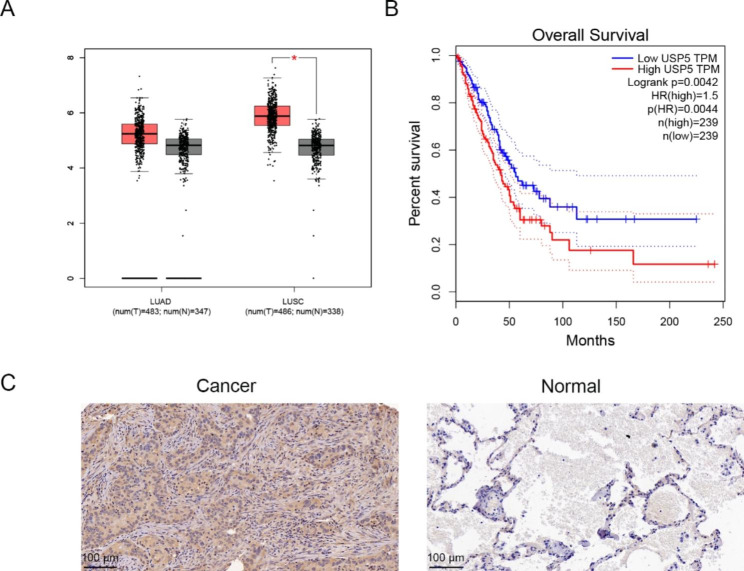
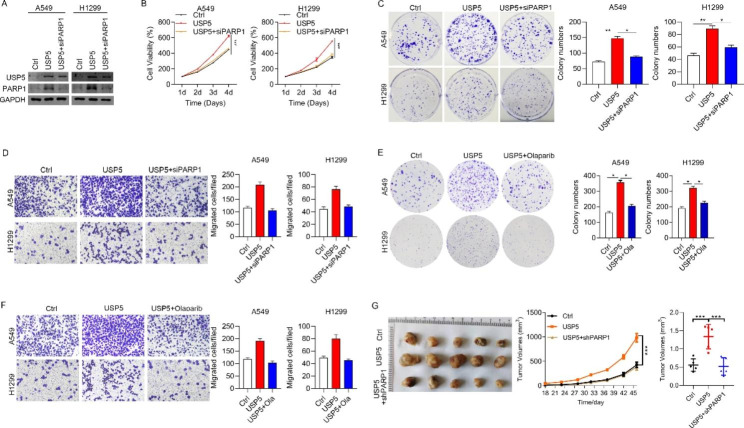
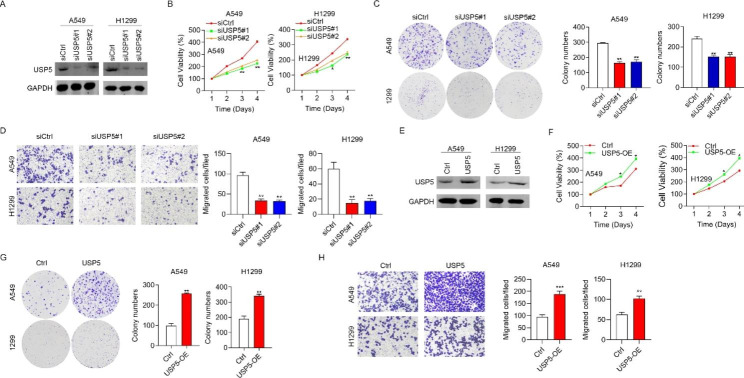
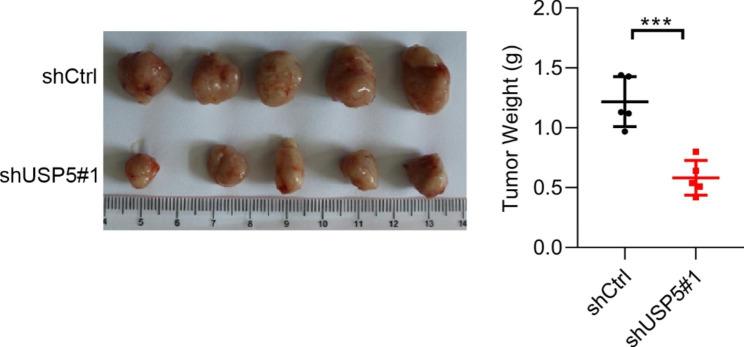
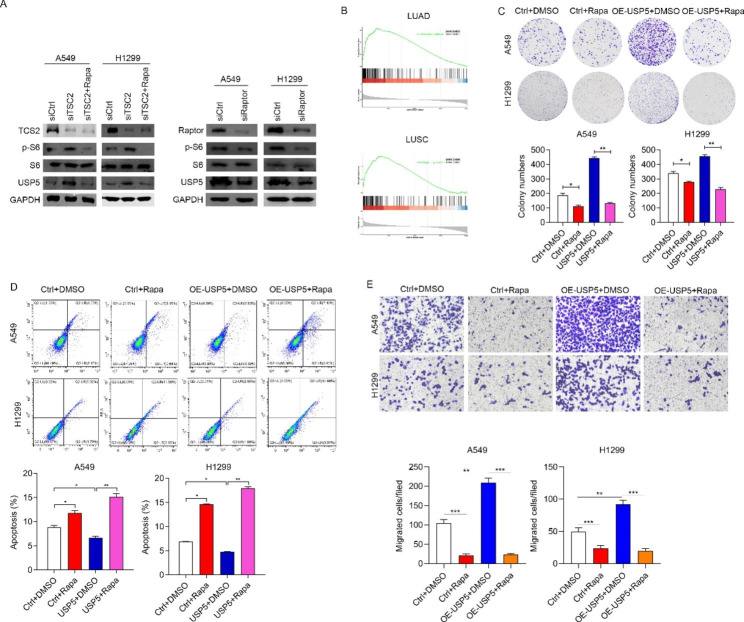
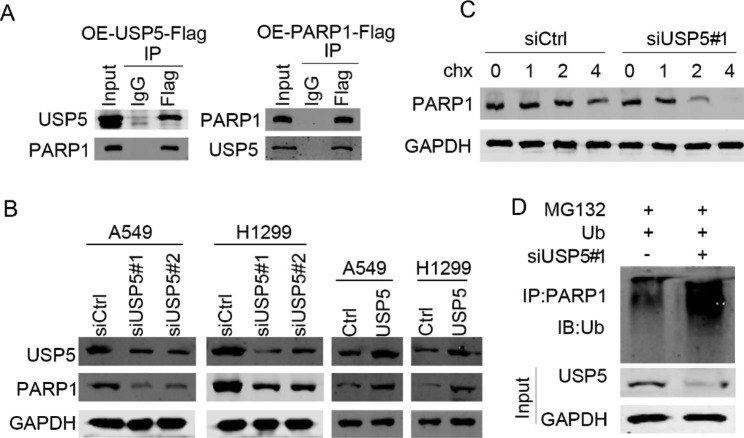
Notably, USP5 is highly expressed in lung cancer, USP5 overexpression promoted the proliferation and migration in the lung cancer cell lines, H1299 and A549, while knockdown of USP5 inhibited these via regulating the PARP1-mediated mTOR signaling pathway. Furthermore, the subcutaneous tumors model was established in C57BL/6 mice, and the volume of subcutaneous tumors was significantly reduced after silencing USP5, while increased after USP5 overexpression and decreased significantly with shRARP1 treatment at the same time.
Together, USP5 could promote the progression of lung cancer cells by mTOR signaling pathway and interacting with PARP1, indicating that USP5 may become a new target for lung cancer treatment.
随着发病率和死亡率的迅速上升,肺癌已被认为是一种严重的恶性肿瘤,影响着全球数以百万计的患者。目前,肺癌的发病机制仍不清楚,这阻碍了有效治疗方法的发展。本研究旨在探讨肺癌的发病机制,并开发一种有效的治疗方法来干预预防肺癌的进展。
通过定量实时聚合酶链反应(qRT-PCR)和 Western blot 方法检测肺癌组织和癌旁组织中的 USP5 水平,探讨其在肺癌进展中的作用。MTT、集落形成和 Transwell 室方法分别用于测量细胞活力、增殖和迁移。进一步通过流式细胞术实验研究 USP5 对肺癌的影响。最后,使用小鼠皮下肿瘤模型进行体内研究,以确定 USP5 在促进肺癌发展中的作用。
值得注意的是,USP5 在肺癌中高表达,USP5 过表达促进了肺癌细胞系 H1299 和 A549 的增殖和迁移,而 USP5 的敲低通过调节 PARP1 介导的 mTOR 信号通路抑制了这些作用。此外,在 C57BL/6 小鼠中建立了皮下肿瘤模型,沉默 USP5 后皮下肿瘤的体积明显减小,而过表达 USP5 后则增加,同时用 shRARP1 处理后则明显减少。
总之,USP5 可以通过 mTOR 信号通路与 PARP1 相互作用促进肺癌细胞的进展,表明 USP5 可能成为治疗肺癌的新靶点。