Department of Orthopaedics and Traumatology, Taipei Veterans General Hospital, No. 201, Sec. 2, Shi-Pai Road, Beitou District, Taipei, 112, Taiwan.
Department of Orthopaedics, School of Medicine, National Yang Ming Chiao Tung University, Taipei, Taiwan.
Sci Rep. 2023 Apr 15;13(1):6155. doi: 10.1038/s41598-023-33196-x.
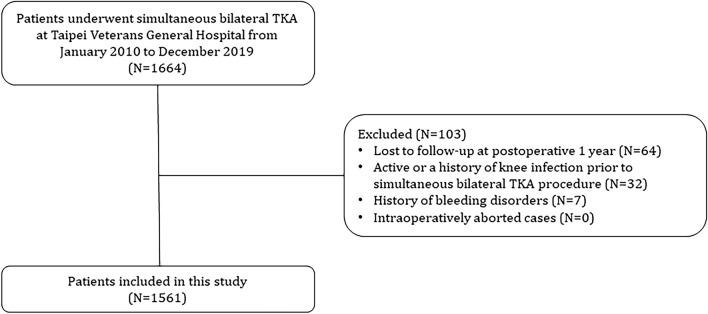
Simultaneous bilateral total knee arthroplasty (TKA) might be associated with higher postoperative morbidity and mortality rates compared with staged bilateral TKA. However, risk factors for surgical complications and reoperations following simultaneous bilateral TKA remain elusive. We conducted this retrospective, single-surgeon case series from 2010 through 2019. A total of 1561 patients who underwent simultaneous bilateral TKA procedures were included. The outcome domains included 30-day and 90-day readmission events for medical or surgical complications and 1-year reoperation events. We performed logistic regression analysis and backward stepwise selection to identify possible risk factors, including age, sex, body mass index, diabetes mellitus (DM), rheumatoid arthritis, American Society of Anesthesiologist (ASA) classification, Charlson Comorbidity Index (CCI), receiving venous thromboembolism (VTE) prophylaxis, or blood transfusion. The overall 30-day, 90-day readmission, and 1-year reoperation rates were 2.11%, 2.88%, and 1.41%, respectively. Higher CCI score (CCI = 4+) was a risk factor for 90-day readmission (aOR: 2.783; 95% CI 0.621-12.465), 90 day readmission for surgical complications (aOR: 10.779; 95% CI 1.444-80.458), and 1 year reoperation (aOR: 4.890; 95% CI 0.846-28.260). Other risk factors included older age, higher ASA level, DM, and receiving VTE prophylaxis. In conclusion, high CCI scores were associated with increased risks of surgical complications and reoperations following simultaneous bilateral TKA procedures.
同期双侧全膝关节置换术(TKA)与分期双侧 TKA 相比,术后发病率和死亡率可能更高。然而,同期双侧 TKA 后手术并发症和再次手术的危险因素仍不清楚。我们进行了这项回顾性的单外科医生病例系列研究,时间为 2010 年至 2019 年。共纳入 1561 例同期双侧 TKA 患者。结果包括 30 天和 90 天因医疗或手术并发症再次入院的事件以及 1 年再次手术的事件。我们进行了逻辑回归分析和向后逐步选择,以确定可能的危险因素,包括年龄、性别、体重指数、糖尿病(DM)、类风湿关节炎、美国麻醉师协会(ASA)分类、Charlson 合并症指数(CCI)、接受静脉血栓栓塞(VTE)预防或输血。总体 30 天、90 天再入院和 1 年再次手术率分别为 2.11%、2.88%和 1.41%。CCI 评分较高(CCI=4+)是 90 天再入院的危险因素(OR:2.783;95%CI 0.621-12.465)、90 天因手术并发症再入院(OR:10.779;95%CI 1.444-80.458)和 1 年再次手术(OR:4.890;95%CI 0.846-28.260)。其他危险因素包括年龄较大、ASA 水平较高、DM 和接受 VTE 预防。总之,高 CCI 评分与同期双侧 TKA 后手术并发症和再次手术的风险增加相关。