Department of Medical Oncology, Inselspital, University Hospital of Bern, Center for Hemato-Oncology; University Cancer Center, Bern, 3010, Switzerland.
Department for Biomedical Research, University of Bern, Bern, 3008, Switzerland.
BMC Cancer. 2023 Apr 15;23(1):345. doi: 10.1186/s12885-023-10824-3.
Chimeric antigen receptor (CAR) T-cell therapy has revolutionized the treatment landscape of relapsed/refractory multiple myeloma (RRMM), leading to unprecedented responses in this patient population. Idecabtagene vicleucel (ide-cel) has been recently approved for treatment of triple-class exposed RRMM. We report real-life experiences with the commercial use of ide-cel in RRMM patients.
We performed a retrospective analysis of the first 16 triple-class exposed RRMM patients treated with ide-cel at a single academic center. We assessed toxicities, response to treatment, CAR T expansion and soluble BCMA (sBCMA) levels.
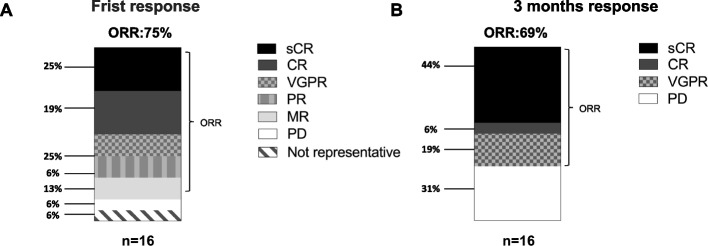
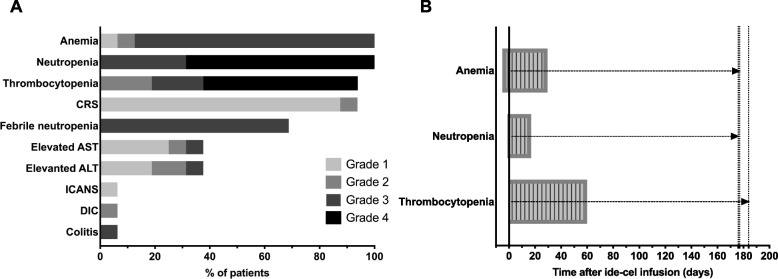
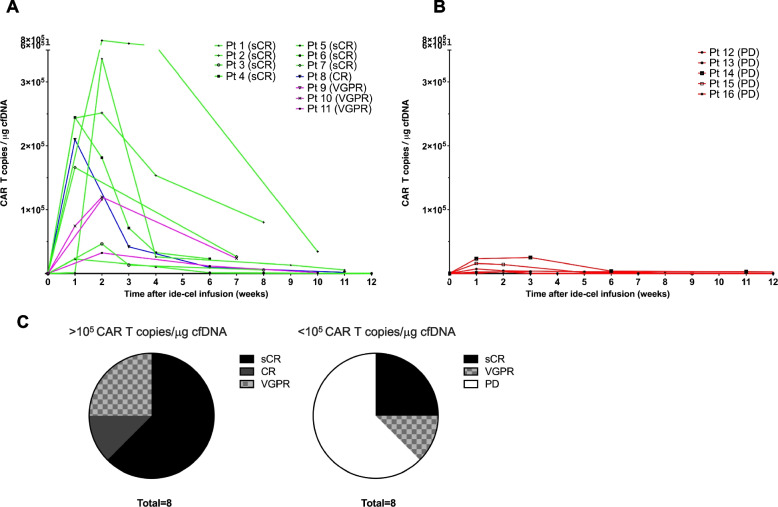
We identified 16 consecutive RRMM patients treated with ide-cel between 06-10/2022. Median age was 69 years, 6 (38%) patients had high-risk cytogenetics, 3 (19%) R-ISS stage III, and 5 (31%) extramedullary disease. Median number of previous treatment lines was 6 (3-12). Manufacturing success rate was 88% (6% required second lymphapheresis, 6% received an out-of-specification product). At 3 months, the overall response rate (ORR) was 69% (44% sCR, 6% CR, 19% VGPR). Cytokine release syndrome (CRS) occurred in 15 (94%) patients (88% G1, 6% G2), immune effector-cell associated neurotoxicity syndrome (ICANS) in 1 (6% G1), febrile neutropenia in 11 (69%), and infections in 5 (31%). Prolonged hematologic toxicity occurred in 4/16 (25%) patients. Other non-hematological toxicities were elevated hepatic enzymes (38%), colitis (6%, G3) and DIC (6%, G2). Responses were more frequent in patients with higher CAR T expansion (100% vs 38%), and lack of decrease or plateau of sBCMA levels was typically observed in non-responders.
We report one of the first cohorts of RRMM treated with commercial ide-cel. The ORR was 69% and safety profile was manageable, but prolonged hematologic toxicity still represents a major challenge. Responses correlated with in vivo CAR T cell expansion, underlining the need of further research to optimize CAR T expansion.
嵌合抗原受体 (CAR) T 细胞疗法彻底改变了复发/难治性多发性骨髓瘤 (RRMM) 的治疗格局,为这一患者群体带来了前所未有的缓解。Idecabtagene vicleucel (ide-cel) 最近已被批准用于治疗三药暴露的 RRMM。我们报告了在单中心使用 ide-cel 治疗 RRMM 患者的真实临床经验。
我们对在单中心接受 ide-cel 治疗的 16 例三药暴露 RRMM 患者进行了回顾性分析。我们评估了毒性、治疗反应、CAR T 扩增和可溶性 BCMA (sBCMA) 水平。
我们确定了 16 例连续的 RRMM 患者,他们在 2022 年 6 月至 10 月期间接受了 ide-cel 治疗。中位年龄为 69 岁,6 例(38%)患者具有高危细胞遗传学特征,3 例(19%)为 R-ISS Ⅲ期,5 例(31%)有髓外疾病。中位治疗线数为 6 条(3-12 条)。制造成功率为 88%(6%需要第二次淋巴细胞清除术,6%产品不符合规格)。3 个月时,总缓解率 (ORR) 为 69%(44% sCR,6% CR,19% VGPR)。15 例(94%)患者发生细胞因子释放综合征 (CRS)(88% G1,6% G2),1 例(6%)发生免疫效应细胞相关神经毒性综合征 (ICANS)(G1),11 例(69%)发生发热性中性粒细胞减少症,5 例(31%)发生感染。4/16(25%)例患者出现长期血液学毒性。其他非血液学毒性包括肝酶升高(38%)、结肠炎(6%,G3)和 DIC(6%,G2)。在 CAR T 扩增较高的患者中,缓解更为常见(100% vs 38%),而无缓解或 sBCMA 水平平台期的患者通常可见。
我们报告了首批使用商业 ide-cel 治疗的 RRMM 患者之一。ORR 为 69%,安全性可管理,但长期血液学毒性仍是一个主要挑战。反应与体内 CAR T 细胞扩增相关,这强调了需要进一步研究来优化 CAR T 扩增。