Janiukstyte Vytene, Owen Thomas W, Chaudhary Umair J, Diehl Beate, Lemieux Louis, Duncan John S, de Tisi Jane, Wang Yujiang, Taylor Peter N
CNNP Lab (www.cnnp-lab.com), Interdisciplinary Computing and Complex BioSystems Group, School of Computing, Newcastle University, Newcastle upon Tyne, United Kingdom, NE4 5DG.
Department of Clinical and Experimental Epilepsy, UCL Queen Square Institute of Neurology, University College London, Queen Square, London, United Kingdom, WC1N 3BG.
ArXiv. 2023 Apr 6:arXiv:2304.03204v1.
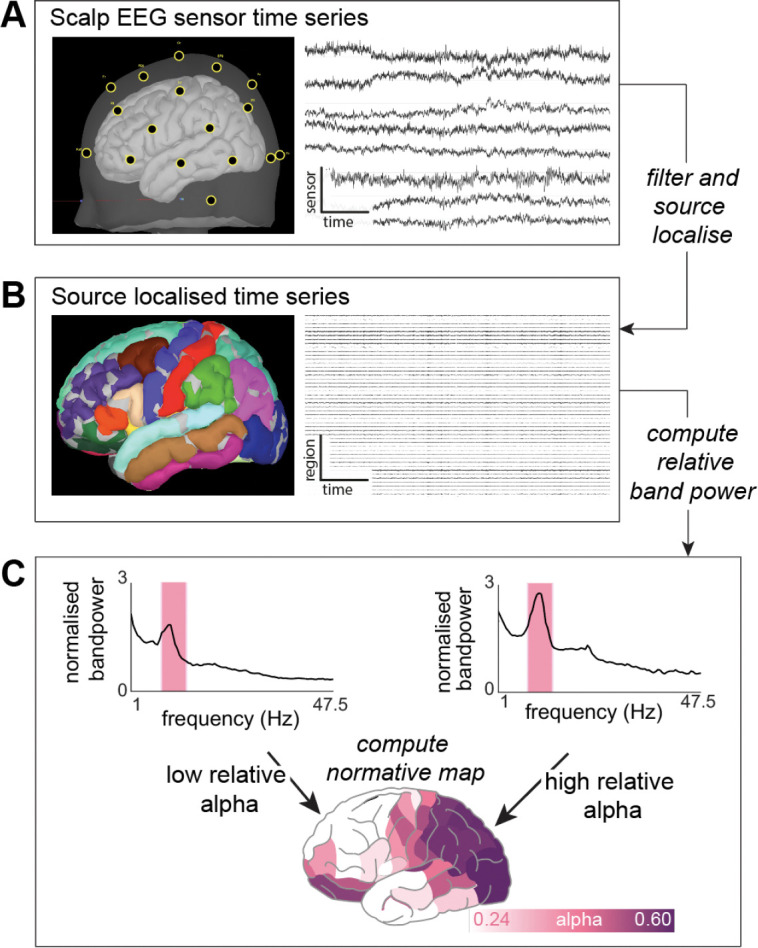
A normative electrographic activity map could be a powerful resource to understand normal brain function and identify abnormal activity. Here, we present a normative brain map using scalp EEG in terms of relative band power. In this exploratory study we investigate its temporal stability, its similarity to other imaging modalities, and explore a potential clinical application. We constructed scalp EEG normative maps of brain dynamics from 17 healthy controls using source-localised resting-state scalp recordings. We then correlated these maps with those acquired from MEG and intracranial EEG to investigate their similarity. Lastly, we use the normative maps to lateralise abnormal regions in epilepsy. Spatial patterns of band powers were broadly consistent with previous literature and stable across recordings. Scalp EEG normative maps were most similar to other modalities in the alpha band, and relatively similar across most bands. Towards a clinical application in epilepsy, we found abnormal temporal regions ipsilateral to the epileptogenic hemisphere. Scalp EEG relative band power normative maps are spatially stable across time, in keeping with MEG and intracranial EEG results. Normative mapping is feasible and may be potentially clinically useful in epilepsy. Future studies with larger sample sizes and high-density EEG are now required for validation.
一个规范的脑电图活动图谱可能是理解正常脑功能和识别异常活动的有力资源。在此,我们展示了一个基于相对频段功率的头皮脑电图规范脑图谱。在这项探索性研究中,我们研究了其时间稳定性、与其他成像方式的相似性,并探索了潜在的临床应用。我们使用源定位静息态头皮记录,从17名健康对照者构建了脑动力学的头皮脑电图规范图谱。然后,我们将这些图谱与从脑磁图和颅内脑电图获得的图谱进行关联,以研究它们的相似性。最后,我们使用规范图谱对癫痫中的异常区域进行定位。频段功率的空间模式与先前文献大致一致,且在记录中稳定。头皮脑电图规范图谱在α频段与其他方式最为相似,在大多数频段相对相似。在癫痫的临床应用方面,我们发现致痫半球同侧的颞叶区域异常。头皮脑电图相对频段功率规范图谱在时间上空间稳定,与脑磁图和颅内脑电图结果一致。规范图谱是可行的,在癫痫中可能具有潜在的临床应用价值。现在需要更大样本量和高密度脑电图的未来研究来进行验证。