Hussain Afzal, Afzal Obaid, Yasmin Sabina, Haider Nazima, Altamimi Abdulmalik Saleh Alfawaz, Martinez Fleming, Acree William E, Ramzan Mohhammad
Department of Pharmaceutics, College of Pharmacy, King Saud University, P.O. Box 2457, Riyadh 11451, Saudi Arabia.
Department of Pharmaceutical Chemistry, College of Pharmacy, Prince Sattam Bin Abdulaziz University, Al Kharj 11942, Saudi Arabia.
ACS Omega. 2023 Mar 28;8(14):12761-12772. doi: 10.1021/acsomega.2c07968. eCollection 2023 Apr 11.
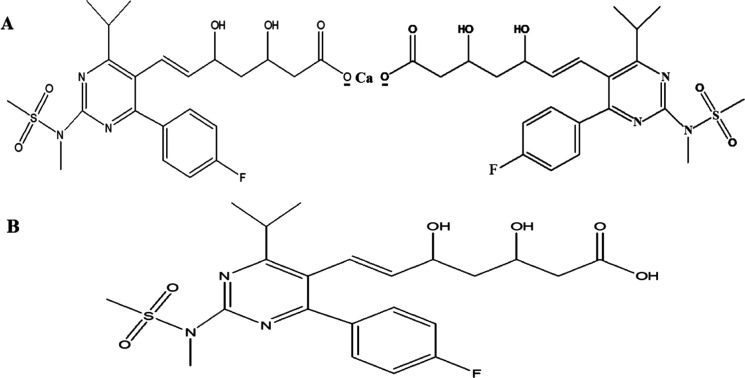
Rosuvastatin (RST) is a poorly water-soluble drug responsible for limited in vivo dissolution and subsequently low oral systemic absorption (poor bioavailability). The mole fraction solubility values of RST in various ratios of binary mixtures "{PEG400 (1) + water (2)}" at 298.15 K were employed to investigate the preferential solvation (PS) of RST (3) by the binary components. Moreover, the GastroPlus program predicted the drug dissolution/absorption rates, plasma drug concentration, and compartmental regional drug absorbed from a conventional tablet as compared to the RST-loaded (PEG400 + water) mixture (at = 0.5) in healthy subjects (considering the fast condition). Fedors' method was adopted to estimate the values of molar volume (314.8 cm·mol) and Hildebrand solubility parameter (28.08 MPa) of RST. The results of inverse Kirkwood-Buff integrals showed the PS of RST by PEG400 as observed in all studied ratios of the binary mixture. The highest PS value (δ = 1.65 × 10) for RST by PEG400 was attained at = 0.5. Finally, the GastroPlus program predicted the maximum dissolution rate [20 mg within 15 min as compared to pure RST (1.5 mg within 15 min)]. Moreover, the program predicted increased in vivo oral absorption (1.2 μg/mL) and enhanced regional absorption (95.3%) of RST from upper segments of the gastrointestinal tract for the RST-loaded PEG400 + water mixture in humans as compared to conventional tablets (87.5% as total regional absorption and 0.88 μg/mL as in vivo absorption). Hence, the present binary system ferrying RST can be a promising strategy to control systemic dyslipidemia after oral or subcutaneous administration.
瑞舒伐他汀(RST)是一种水溶性差的药物,其体内溶出受限,进而导致口服全身吸收较低(生物利用度差)。采用RST在298.15 K下于二元混合物“{聚乙二醇400(1)+水(2)}”的各种比例中的摩尔分数溶解度值,来研究二元组分对RST(3)的优先溶剂化作用(PS)。此外,GastroPlus程序预测了在健康受试者中(考虑快速条件),与载有RST的(聚乙二醇400 +水)混合物(在 = 0.5时)相比,传统片剂的药物溶出/吸收率、血浆药物浓度以及从传统片剂中吸收的药物在体内各隔室区域的情况。采用费多尔斯方法估算了RST的摩尔体积值(314.8 cm³·mol⁻¹)和希尔德布兰德溶解度参数(28.08 MPa)。反向柯克伍德-布夫积分结果表明,在二元混合物的所有研究比例中,均观察到聚乙二醇400对RST的优先溶剂化作用。聚乙二醇400对RST的最高优先溶剂化值(δ = 1.65 × 10⁻³)出现在 = 0.5时。最后,GastroPlus程序预测了最大溶出速率[15分钟内为20毫克,而纯RST为15分钟内1.5毫克]。此外,该程序预测,与传统片剂相比,载有RST的聚乙二醇400 +水混合物在人体胃肠道上段中,RST的体内口服吸收增加(1.2 μg/mL),区域吸收增强(95.3%)(传统片剂的总区域吸收为87.5%,体内吸收为0.88 μg/mL)。因此,目前运载RST的二元体系可能是口服或皮下给药后控制系统性血脂异常的一种有前景的策略。