School of Acupuncture-Moxibustion and Tuina, Shanghai University of Traditional Chinese Medicine, Shanghai, China.
Xiangya Boai Renabilitation Hospital, Changsha, Hunan, China.
Technol Health Care. 2023;31(S1):505-513. doi: 10.3233/THC-236044.
Thumb rubbing is one of the widely accepted massage techniques, owing to its simple and effective operation. Exploring the biomechanical characteristics of the thumb rubbing method can assist the understanding of the operating characteristics of manipulation, thereby improvising the therapeutic role of manipulation.
To study the kinematic and kinetic characteristics of the thumb kneading method from the biomechanical point of view, and to quantitatively analyze the key points of thumb kneading operation.
We explored the biomechanical characteristics of the thumb kneading operation by an analysis of the parameters scored by the experts and students using the "thumb kneading data glove and data collection system".
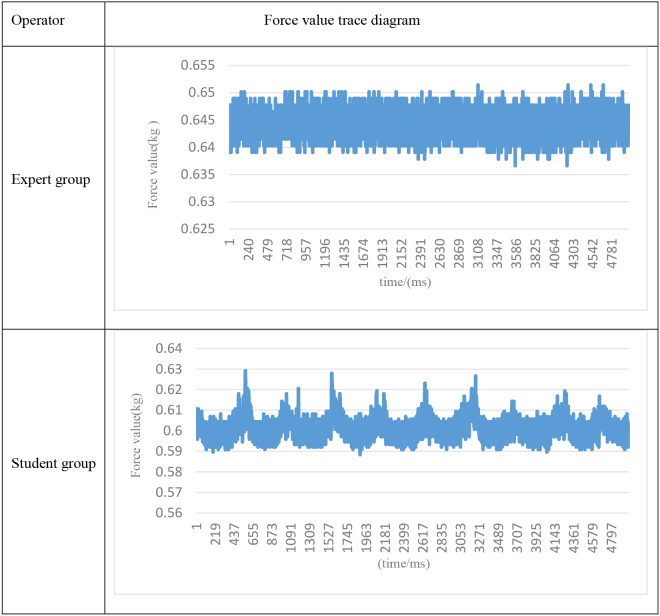
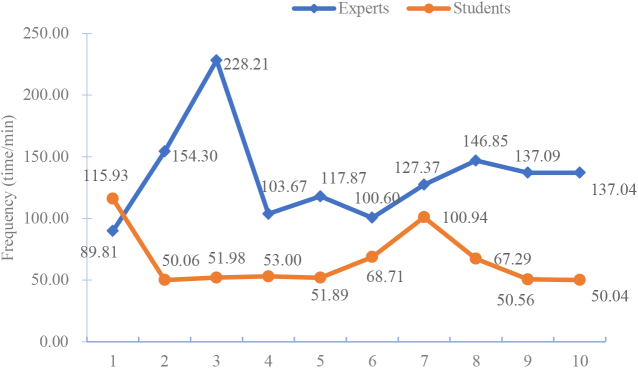
(1) Force trajectory: The expert group showed a regular force trajectory compared to the student group, with a stable thumb suction position, small drift and concentrated force. (2) Force value: The average force value of the expert group was concentrated in the range 0.614 ± 0.041 kg, while the average force value of the student group was concentrated in the range 0.650 ± 0.146 kg and the difference was not statistically significant. (3) Frequency: The frequency of the expert group was mainly concentrated in the range 134.280 ± 39.106 times/min, while that of the student group was 66.04 ± 23.651 times/min, (P< 0.05). (4) Period: The operation cycle during the thumb kneading of the expert and student groups was mainly concentrated in the range of 0.476 ± 0.117 s and (0.990 ± 0.259) s, respectively, and the difference was statistically significant (P< 0.05).
The present study revealed that the technical operation of the expert group was more stable and standardized than that of the student group. It was found that the force value was inversely proportional to the frequency of the operation. In the "circular rotation" operation of the thumb rubbing method, the force value conversion degree of different parts of the thumb reflected the motion trajectory. Furthermore, the "circular rotation" operation performed by the expert group was better than the student group. The study of the parameters, including the angle of frequency, period and force value can reflect the biomechanical characteristics of thumb rubbing method to a significant extent.
拇指揉法是一种被广泛认可的按摩技术,因其操作简单、效果显著而备受青睐。探究拇指揉法的生物力学特征有助于理解推拿手法的操作特点,从而提高推拿的治疗作用。
从生物力学角度探讨拇指揉法的运动学和动力学特征,定量分析拇指揉法操作要点。
采用“拇指揉法数据手套及数据采集系统”对专家和学生进行手法参数评分,对拇指揉法的生物力学特征进行分析。
(1)力轨迹:与学生组相比,专家组表现出规则的力轨迹,拇指吸力位置稳定,漂移小,力集中。(2)力值:专家组的平均力值集中在 0.614±0.041 kg,而学生组的平均力值集中在 0.650±0.146 kg,差异无统计学意义。(3)频率:专家组的频率主要集中在 134.280±39.106 次/min,学生组的频率为 66.04±23.651 次/min,差异有统计学意义(P<0.05)。(4)周期:拇指揉法的操作周期,专家组和学生组主要集中在 0.476±0.117 s 和(0.990±0.259)s 范围内,差异有统计学意义(P<0.05)。
本研究表明,专家组的技术操作比学生组更稳定、规范。研究发现,力值与操作频率成反比。在拇指揉法的“回旋”操作中,拇指各部位的力值转换程度反映了运动轨迹。此外,专家组的“回旋”操作优于学生组。频率、周期和力值等参数的研究在很大程度上反映了拇指揉法的生物力学特征。