Department of Applied Clinical Research, University of Texas Southwestern Medical Center, Dallas, Texas, United States.
Department of Internal Medicine, University of Texas Southwestern Medical Center, Dallas, Texas, United States.
Am J Physiol Regul Integr Comp Physiol. 2023 Jul 1;325(1):R13-R20. doi: 10.1152/ajpregu.00327.2022. Epub 2023 Apr 17.
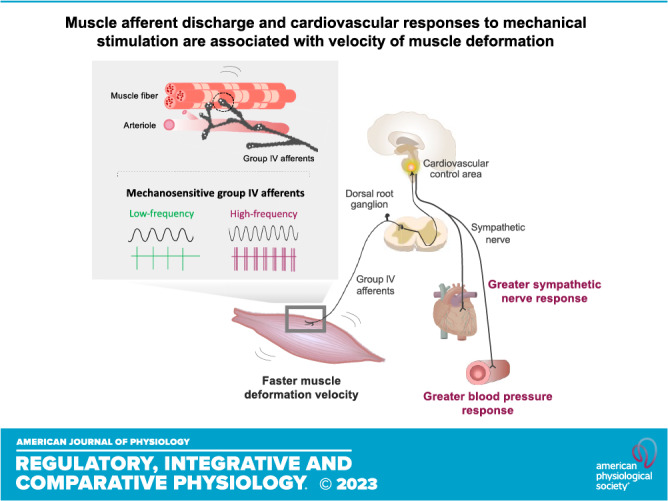
Skeletal muscle reflexes play a crucial role in determining the magnitude of the cardiovascular response to exercise. However, evidence supporting an association between the magnitude of the pressor response and the velocity of muscle deformation has remained to be elucidated. Thus, we investigated the impact of different muscle deformation rates on the neural discharge of muscle afferents and pressor and sympathetic responses in Sprague-Dawley rats. In an ex vivo muscle-nerve preparation, action potentials elicited by sinusoidal mechanical stimuli (137 mN) at different frequencies (0.01, 0.05, 0.1, 0.2, and 0.25 Hz) were recorded in mechanosensitive group III and IV fibers. The afferent response magnitude to sine-wave stimulation significantly varied at different frequencies (ANOVA, = 0.01). Specifically, as compared with 0.01 Hz (0.83 ± 0.96 spikes/s), the response magnitudes were significantly greater at 0.20 Hz (4.07 ± 5.04 spikes/s, = 0.031) and 0.25 Hz (4.91 ± 5.30 spikes/s, = 0.014). In an in vivo decerebrated rat preparation, renal sympathetic nerve activity (RSNA) and mean arterial pressure (MAP) responses to passive stretch (1 kg) of hindlimb skeletal muscle at different velocities of loading (slow, medium, and fast) were measured. Pressor responses to passive stretch were significantly associated with the velocity of muscle deformation (ANOVA, < 0.001). The MAP response to fast stretch (Δ 56 ± 12 mmHg) was greater than slow (Δ 33 ± 11 mmHg, = 0.006) or medium (Δ 30 ± 11 mmHg, < 0.001) stretch. Likewise, the RSNA response was related to deformation velocity (ANOVA, = 0.024). These findings suggest that the muscle neural afferent discharge and the cardiovascular response to mechanical stimulation are associated with muscle deformation velocity.
骨骼肌反射在确定运动对心血管反应的幅度方面起着至关重要的作用。然而,支持压力反应幅度与肌肉变形速度之间存在关联的证据仍有待阐明。因此,我们研究了不同肌肉变形率对肌肉传入神经放电以及加压和交感神经反应的影响。在离体肌肉-神经标本中,记录了机械刺激(137 mN)以不同频率(0.01、0.05、0.1、0.2 和 0.25 Hz)产生的正弦波时,机械敏感 III 型和 IV 型纤维中的动作电位。正弦波刺激的传入反应幅度在不同频率下差异显著(ANOVA, = 0.01)。具体而言,与 0.01 Hz(0.83 ± 0.96 个 spikes/s)相比,在 0.20 Hz(4.07 ± 5.04 个 spikes/s, = 0.031)和 0.25 Hz(4.91 ± 5.30 个 spikes/s, = 0.014)时,反应幅度显著更大。在去大脑大鼠的体内准备中,测量了后肢骨骼肌被动拉伸(1 kg)在不同加载速度(慢、中、快)时的肾交感神经活动(RSNA)和平均动脉压(MAP)反应。被动拉伸的加压反应与肌肉变形速度显著相关(ANOVA, < 0.001)。快拉伸时的 MAP 反应(Δ 56 ± 12 mmHg)大于慢拉伸(Δ 33 ± 11 mmHg, = 0.006)或中拉伸(Δ 30 ± 11 mmHg, < 0.001)。同样,RSNA 反应与变形速度相关(ANOVA, = 0.024)。这些发现表明,肌肉神经传入放电和机械刺激引起的心血管反应与肌肉变形速度有关。