Sanderson Bailey C, Rollins Korynne S, Hopkins Tyler D, Butenas Alec L, Felice Kennedy P, Ade Carl J, Copp Steven W
Department of Kinesiology, Kansas State University, Manhattan, Kansas.
Physiol Rep. 2019 Jan;7(1):e13974. doi: 10.14814/phy2.13974.
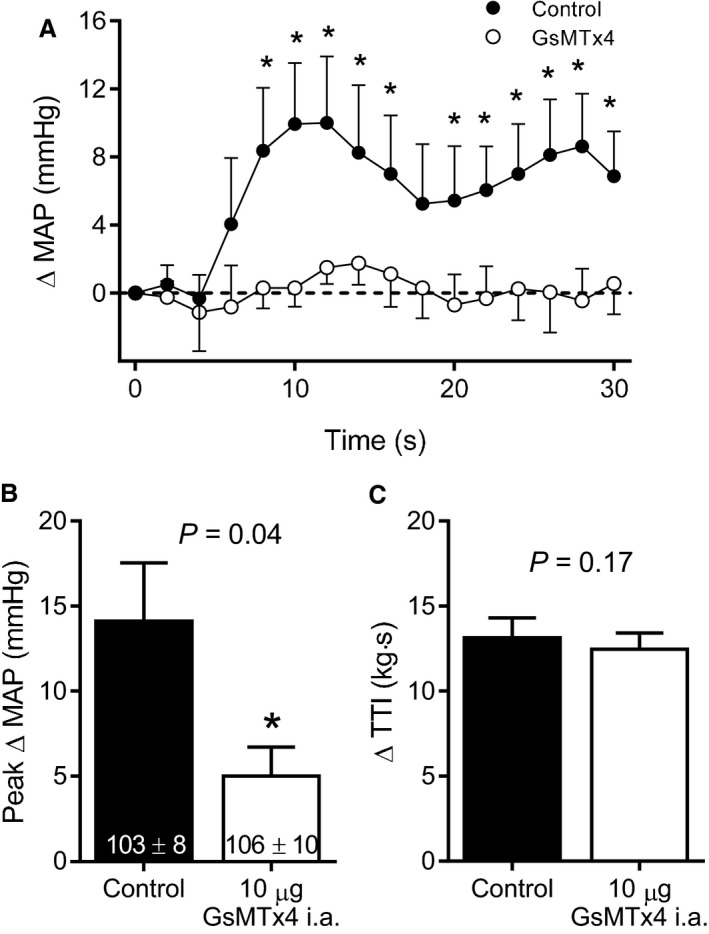
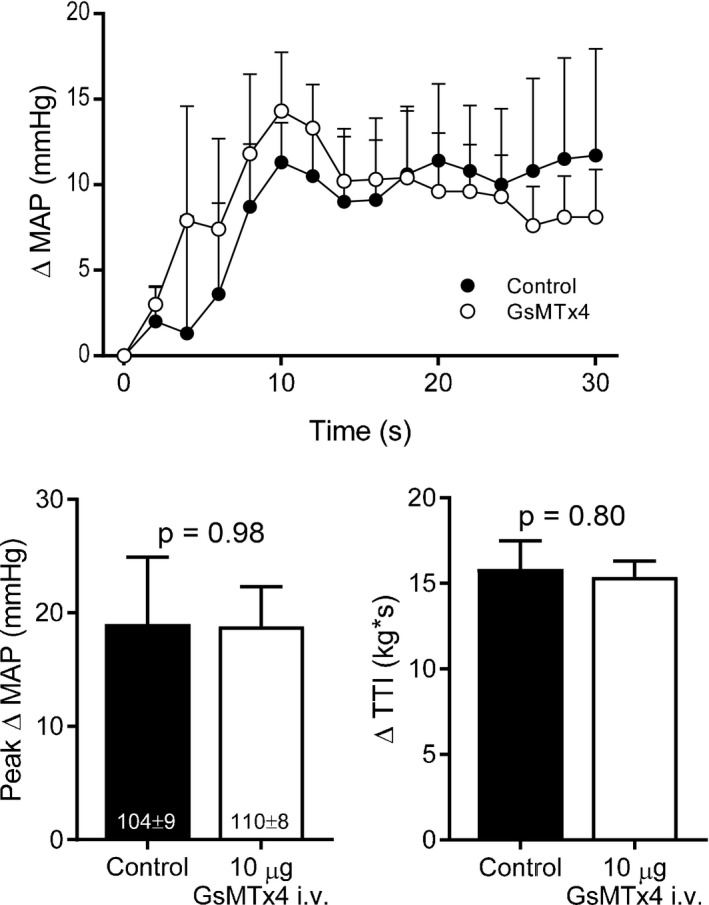
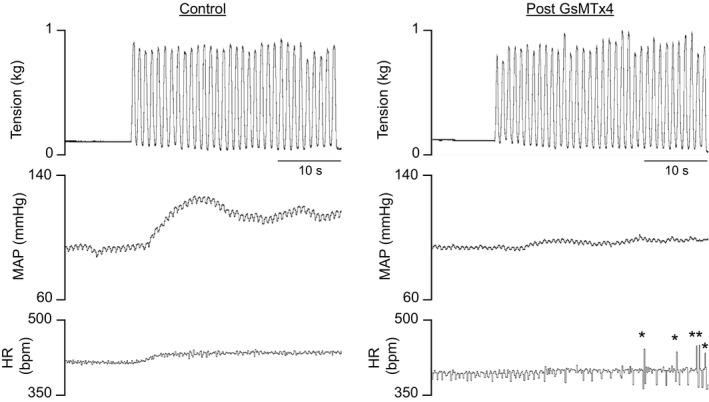
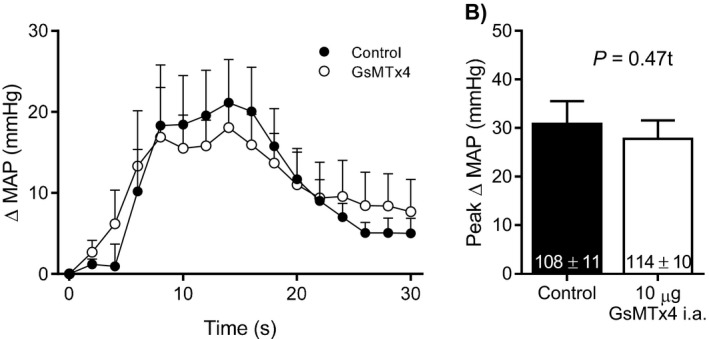
Mechanical signals within contracting skeletal muscles contribute to the generation of the exercise pressor reflex; an important autonomic and cardiovascular control mechanism. In decerebrate rats, the mechanically activated channel inhibitor GsMTx4 was found to reduce the pressor response during static hindlimb muscle stretch; a maneuver used to investigate specifically the mechanical component of the exercise pressor reflex (i.e., the mechanoreflex). However, the effect was found only during the initial phase of the stretch when muscle length was changing and not during the later phase of stretch when muscle length was relatively constant. We tested the hypothesis that in decerebrate, unanesthetized rats, GsMTx4 would reduce the pressor response throughout the duration of a 30 sec, 1 Hz dynamic hindlimb muscle stretch protocol that produced repetitive changes in muscle length. We found that the injection of 10 μg of GsMTx4 into the arterial supply of a hindlimb reduced the peak pressor response (control: 15 ± 4, GsMTx4: 5 ± 2 mmHg, P < 0.05, n = 8) and the pressor response at multiple time points throughout the duration of the stretch. GsMTx4 had no effect on the pressor response to the hindlimb arterial injection of lactic acid which indicates the lack of local off-target effects. Combined with the recent finding that GsMTx4 reduced the pressor response only initially during static stretch in decerebrate rats, the present findings suggest that GsMTx4-sensitive channels respond primarily to mechanical signals associated with changes in muscle length. The findings add to our currently limited understanding of the channels that contribute to the activation of the mechanoreflex.
收缩的骨骼肌内的机械信号有助于运动升压反射的产生;这是一种重要的自主神经和心血管控制机制。在去大脑大鼠中,发现机械激活通道抑制剂GsMTx4可降低静态后肢肌肉伸展期间的升压反应;该操作专门用于研究运动升压反射的机械成分(即机械反射)。然而,仅在伸展的初始阶段(此时肌肉长度在变化)发现了这种效应,而在伸展的后期阶段(此时肌肉长度相对恒定)未发现该效应。我们测试了这样一个假设:在去大脑、未麻醉的大鼠中,GsMTx4会在30秒、1赫兹动态后肢肌肉伸展方案的整个过程中降低升压反应,该方案会使肌肉长度产生重复性变化。我们发现,将10μg GsMTx4注入后肢的动脉供应中,可降低峰值升压反应(对照组:15±4,GsMTx4组:5±2mmHg,P<0.05,n = 8)以及伸展过程中多个时间点的升压反应。GsMTx4对后肢动脉注射乳酸引起的升压反应没有影响,这表明不存在局部脱靶效应。结合最近的一项发现,即GsMTx4仅在去大脑大鼠的静态伸展初始阶段降低升压反应,目前的研究结果表明,GsMTx4敏感通道主要对与肌肉长度变化相关的机械信号作出反应。这些发现增加了我们目前对促成机械反射激活的通道的有限理解。