Bouldin Emerson, Sandeep Shelly, Gillespie Amanda, Tkaczuk Andrew
Emory University School of Medicine, Atlanta, Georgia.
Emory University Hospital Midtown, Medical Office Tower, Atlanta, Georgia.
J Voice. 2023 Mar 2. doi: 10.1016/j.jvoice.2023.02.024.
OBJECTIVE(S): To assess laryngologic symptomatology following severe acute respiratory syndrome coronavirus 2 (SARS-CoV-2) infection and determine whether symptom severity correlates with disease severity.
Single-institution survey study in participants with documented SARS-CoV-2 infection between March 2020 and February 2021. Data acquired included demographic, infection severity characteristics, comorbidities, and current upper aerodigestive symptoms via validated patient reported outcome measures. Primary outcomes of interest were scores of symptom severity questionnaires. Coronavirus disease of 2019 (COVID-19) severity was defined by hospitalization status. Descriptive subgroup analyses were performed to investigate differences in demographics, comorbidities, and symptom severity in hospitalized participants stratified by ICU status. Multivariate logistical regression was used to evaluate significant differences in symptom severity scores by hospitalization status.
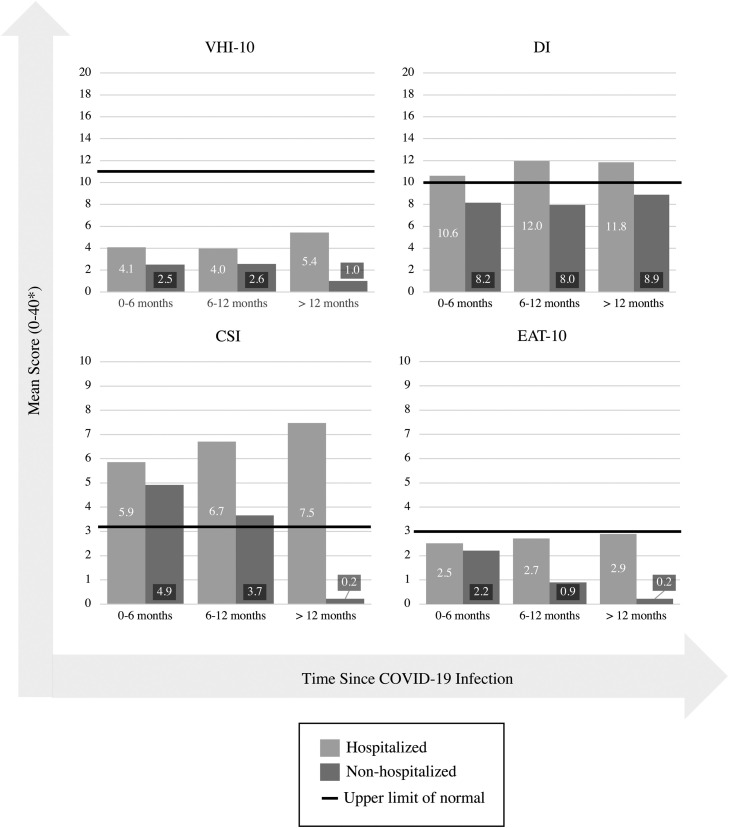
Surveys were distributed to 5300 individuals with upper respiratory infections. Ultimately, 470 participants with COVID-19 were included where 352 were hospitalized and 118 were not hospitalized. Those not hospitalized were younger (45.87 vs. 56.28 years), more likely female (74.17 vs. 58.92%), and less likely white (44.17 vs. 52.41%). Severity of dysphonia, dyspnea, cough, and dysphagia was significantly worse in hospitalized patients overall and remained worse at all time points. Cough severity paradoxically worsened in hospitalized respondents over time. Dyspnea scores remained abnormally elevated in respondents even 12 months after resolution of infection.
Results indicate that laryngologic symptoms are expected to be worse in patients hospitalized with COVID-19. Dyspnea and cough symptoms can be expected to persist or even worsen by 1-year post infection in those who were hospitalized. Dysphagia and dysphonia symptoms were mild. Nonhospitalized participants tended to have minimal residual symptoms by 1 year after infection.
评估严重急性呼吸综合征冠状病毒2(SARS-CoV-2)感染后的喉科症状,并确定症状严重程度是否与疾病严重程度相关。
对2020年3月至2021年2月间有SARS-CoV-2感染记录的参与者进行单机构调查研究。通过经过验证的患者报告结局指标收集的数据包括人口统计学、感染严重程度特征、合并症和当前上呼吸道消化道症状。主要关注的结局是症状严重程度问卷的得分。2019冠状病毒病(COVID-19)的严重程度由住院状态定义。进行描述性亚组分析,以调查按ICU状态分层的住院参与者在人口统计学、合并症和症状严重程度方面的差异。使用多变量逻辑回归来评估按住院状态划分的症状严重程度得分的显著差异。
对5300名上呼吸道感染患者进行了调查。最终,纳入了470名COVID-19患者,其中352人住院,118人未住院。未住院患者更年轻(45.87岁对56.28岁),女性比例更高(74.17%对58.92%),白人比例更低(44.17%对52.41%)。总体而言,住院患者的声音嘶哑、呼吸困难、咳嗽和吞咽困难的严重程度明显更差,并且在所有时间点都更差。随着时间的推移,住院受访者的咳嗽严重程度反而恶化。即使在感染消退12个月后,受访者的呼吸困难得分仍异常升高。
结果表明,COVID-19住院患者的喉科症状预计会更严重。对于住院患者,预计呼吸困难和咳嗽症状在感染后1年内会持续甚至加重。吞咽困难和声音嘶哑症状较轻。未住院参与者在感染后1年往往残留症状极少。