Department of Allergy and Clinical Immunology, University of Ulsan College of Medicine, Asan Medical Center, Seoul, Korea.
Royal Free Hampstead NHS Foundation Trust, London, UK.
Lancet Respir Med. 2021 May;9(5):533-544. doi: 10.1016/S2213-2600(21)00125-9. Epub 2021 Apr 12.
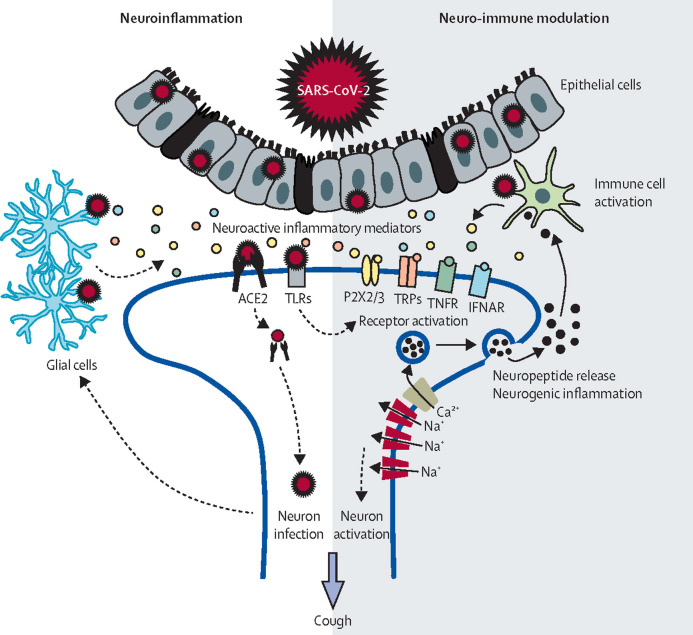
Cough is one of the most common presenting symptoms of COVID-19, along with fever and loss of taste and smell. Cough can persist for weeks or months after SARS-CoV-2 infection, often accompanied by chronic fatigue, cognitive impairment, dyspnoea, or pain-a collection of long-term effects referred to as the post-COVID syndrome or long COVID. We hypothesise that the pathways of neurotropism, neuroinflammation, and neuroimmunomodulation through the vagal sensory nerves, which are implicated in SARS-CoV-2 infection, lead to a cough hypersensitivity state. The post-COVID syndrome might also result from neuroinflammatory events in the brain. We highlight gaps in understanding of the mechanisms of acute and chronic COVID-19-associated cough and post-COVID syndrome, consider potential ways to reduce the effect of COVID-19 by controlling cough, and suggest future directions for research and clinical practice. Although neuromodulators such as gabapentin or opioids might be considered for acute and chronic COVID-19 cough, we discuss the possible mechanisms of COVID-19-associated cough and the promise of new anti-inflammatories or neuromodulators that might successfully target both the cough of COVID-19 and the post-COVID syndrome.
咳嗽是 COVID-19 的最常见症状之一,此外还有发热、味觉和嗅觉丧失。SARS-CoV-2 感染后,咳嗽可持续数周或数月,常伴有慢性疲劳、认知障碍、呼吸困难或疼痛——这些长期影响被称为新冠后综合征或长新冠。我们假设,通过迷走感觉神经的神经嗜性、神经炎症和神经免疫调节途径,与 SARS-CoV-2 感染有关,导致咳嗽高敏状态。新冠后综合征也可能是大脑中的神经炎症事件引起的。我们强调了对急性和慢性 COVID-19 相关咳嗽和新冠后综合征机制理解的差距,考虑了通过控制咳嗽减轻 COVID-19 影响的潜在方法,并为研究和临床实践提出了未来的方向。尽管加巴喷丁或阿片类药物等神经调节剂可能被考虑用于治疗急性和慢性 COVID-19 咳嗽,但我们讨论了 COVID-19 相关咳嗽的可能机制,以及新型抗炎药或神经调节剂可能成功靶向 COVID-19 咳嗽和新冠后综合征的前景。