Center for Clinical Best Practices, Clinical and Translational Research Incubator (CITRIC), Aga Khan University, Karachi, 74800, Pakistan.
Medical College, Aga Khan University, Karachi, 74800, Pakistan.
BMC Pulm Med. 2023 Apr 17;23(1):123. doi: 10.1186/s12890-023-02409-4.
In Pakistan, chronic respiratory conditions contribute a large burden of morbidity and mortality. A major reason for this is the lack of availability of local evidence-based clinical practice guidelines (EBCPGs) in Pakistan, particularly at the primary care level. Thus, we developed EBCPGs and created clinical diagnosis and referral pathways for the primary care management of chronic respiratory conditions in Pakistan.
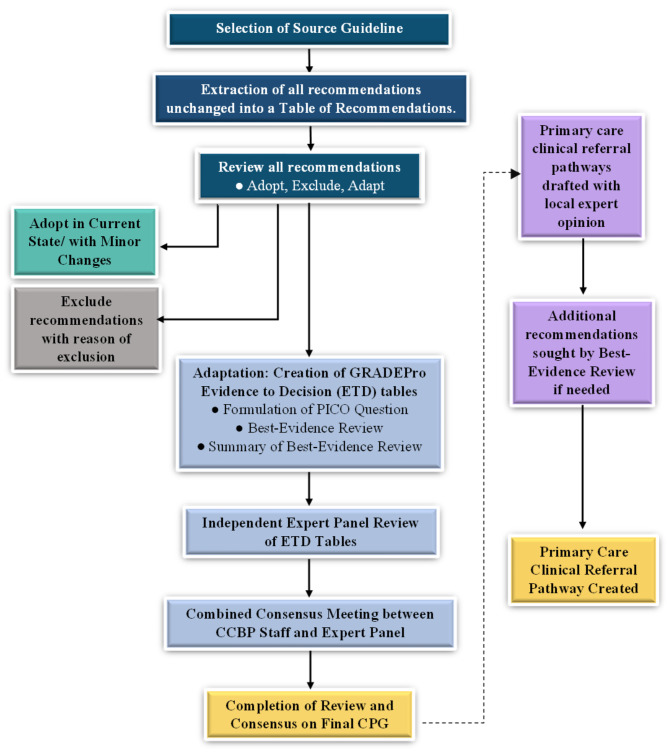
The source guidelines were selected by two local expert pulmonologists after a thorough literature review on PubMed and Google Scholar from 2010 to December 2021. The source guidelines covered idiopathic pulmonary fibrosis, asthma, chronic obstructive pulmonary disorders, and bronchiectasis. The GRADE-ADOLOPMENT process consists of three key elements: adoption (using recommendations as is or with minor changes), adaptation (effective context-specific changes to recommendations) or additions (including new recommendations to fill a gap in the EBCPG). We employed the GRADE-ADOLOPMENT process to adopt, adapt, adopt with minor changes, or exclude recommendations from a source guideline. Additional recommendations were added to the clinical pathways based on a best-evidence review process.
46 recommendations were excluded mainly due to the unavailability of recommended management in Pakistan and scope beyond the practice of general physicians. Clinical diagnosis and referral pathways were designed for the four chronic respiratory conditions, explicitly delineating the role of primary care practitioners in the diagnosis, basic management, and timely referral of patients. Across the four conditions, 18 recommendations were added (seven for IPF, three for bronchiectasis, four for COPD, and four for asthma).
The widespread use of the newly created EBCPGs and clinical pathways in the primary healthcare system of Pakistan can help alleviate the morbidity and mortality related to chronic respiratory conditions disease in the country.
在巴基斯坦,慢性呼吸系统疾病导致了大量的发病和死亡。造成这种情况的一个主要原因是缺乏当地循证临床实践指南(EBCPG),尤其是在初级保健水平。因此,我们制定了 EBCPG,并为巴基斯坦慢性呼吸系统疾病的初级保健管理制定了临床诊断和转诊途径。
两位当地的肺病学专家在对 PubMed 和 Google Scholar 进行了全面的文献回顾后,选择了来源指南。来源指南涵盖特发性肺纤维化、哮喘、慢性阻塞性肺疾病和支气管扩张症。GRADE-ADOLOPMENT 过程由三个关键要素组成:采用(原样或进行微小更改地采用建议)、适应(针对建议进行有效的具体情况更改)或添加(包括新建议以填补 EBCPG 中的空白)。我们采用 GRADE-ADOLOPMENT 过程来采用、适应、采用微小更改或排除来源指南中的建议。根据最佳证据审查过程,向临床途径添加了额外的建议。
46 条建议主要由于推荐的管理措施在巴基斯坦不可用以及超出了普通医生的实践范围而被排除在外。为四种慢性呼吸系统疾病设计了临床诊断和转诊途径,明确规定了初级保健医生在诊断、基本管理和及时转诊患者方面的作用。在这四种疾病中,添加了 18 条建议(特发性肺纤维化 7 条,支气管扩张症 3 条,慢性阻塞性肺疾病 4 条,哮喘 4 条)。
在巴基斯坦的初级卫生保健系统中广泛使用新创建的 EBCPG 和临床途径,可以帮助减轻该国与慢性呼吸系统疾病相关的发病和死亡。