Laboratory of Microbiology, Wageningen University and Research, P.O. Box 8033, 6700 EH, Wageningen, The Netherlands.
Donders Institute for Brain, Cognition and Behaviour, Department of Cognitive Neuroscience, Radboud University Medical Center, P.O. Box 9010, 6500 GL, Nijmegen, The Netherlands.
Eur Child Adolesc Psychiatry. 2024 Mar;33(3):847-860. doi: 10.1007/s00787-023-02205-9. Epub 2023 Apr 18.
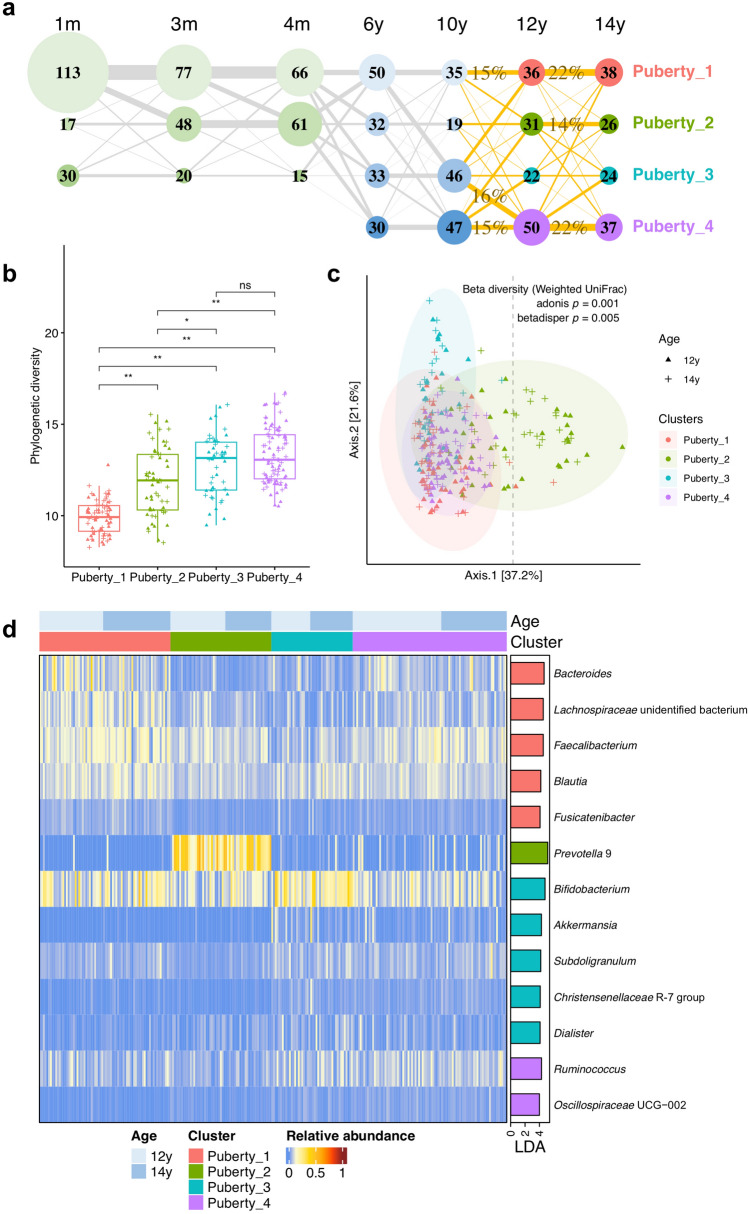
Relations between the gut microbiota and host mental health have been suggested by a growing number of case-control and cross-sectional studies, while supporting evidence is limited in large community samples followed during an extended period. Therefore, the current preregistered study ( https://osf.io/8ymav , September 7, 2022) described child gut microbiota development in the first 14 years of life and explored its relations to internalizing and externalizing difficulties and social anxiety in puberty, a period of high relevance for the development of mental health problems. Fecal microbiota composition was analysed by 16S ribosomal RNA gene amplicon sequencing in a total of 1003 samples from 193 children. Through a clustering method, four distinct microbial clusters were newly identified in puberty. Most children within three of these clusters remained in the same clusters from the age of 12 to 14 years, suggesting stability in microbial development and transition during this period. These three clusters were compositionally similar to enterotypes (i.e., a robust classification of the gut microbiota based on its composition across different populations) enriched in Bacteroides, Prevotella, and Ruminococcus, respectively. Two Prevotella 9-predominated clusters, including one reported by us earlier in middle childhood and the other one in puberty, were associated with more externalizing behavior at age 14. One Faecalibacterium-depleted pubertal cluster was related to more social anxiety at age 14. This finding was confirmed by a negative cross-sectional relation between Faecalibacterium and social anxiety in the 14-year-olds. The findings of this study continue to map gut microbiota development in a relatively large community sample followed from birth onwards, importantly extending our knowledge to puberty. Results indicate that Prevotella 9 and Faecalibacterium may be relevant microbial taxa in relation to externalizing behavior and social anxiety, respectively. These correlational findings need validations from other similar cohort studies, as well as well-designed mechanistic pre-clinical investigations before inferring cause and effect.
越来越多的病例对照和横断面研究表明,肠道微生物群与宿主心理健康之间存在关系,而在长期随访的大型社区样本中,支持这一关系的证据有限。因此,本预先注册的研究(https://osf.io/8ymav,2022 年 9 月 7 日)描述了儿童在生命的头 14 年中肠道微生物群的发展,并探讨了其与青春期内化和外化困难以及社交焦虑的关系,这是心理健康问题发展的高相关时期。在总共 193 名儿童的 1003 个样本中,通过 16S 核糖体 RNA 基因扩增子测序分析了粪便微生物群落组成。通过聚类方法,在青春期新鉴定出四个不同的微生物群簇。在这三个簇中的大多数儿童在 12 至 14 岁时仍保持在相同的簇中,这表明在此期间微生物的发展和过渡具有稳定性。这三个簇的组成与基于不同人群组成的肠道微生物群的分类(即基于组成的分类)相似,分别富含拟杆菌、普雷沃氏菌和瘤胃球菌。两个以普雷沃氏菌 9 为主导的簇,包括我们之前在儿童中期报道的一个和青春期的另一个,与 14 岁时更多的外化行为有关。一个 Faecalibacterium 耗竭的青春期簇与 14 岁时更多的社交焦虑有关。这一发现通过 14 岁儿童 Faecalibacterium 与社交焦虑之间的负横断面关系得到了证实。这项研究的结果继续在一个相对较大的社区样本中描绘了从出生开始的肠道微生物群的发展,重要的是将我们的知识扩展到青春期。结果表明,Prevotella 9 和 Faecalibacterium 可能分别是与外化行为和社交焦虑相关的相关微生物类群。这些相关性发现需要其他类似队列研究的验证,以及在推断因果关系之前进行精心设计的临床前机制研究。