Department of Medicine and Surgery, University of Perugia - Unit of Internal Medicine, "Santa Maria" University Hospital, Terni.
Institute of Clinical Physiology, Italian National Research Council, Pisa.
J Hypertens. 2023 Jul 1;41(7):1100-1107. doi: 10.1097/HJH.0000000000003433. Epub 2023 May 19.
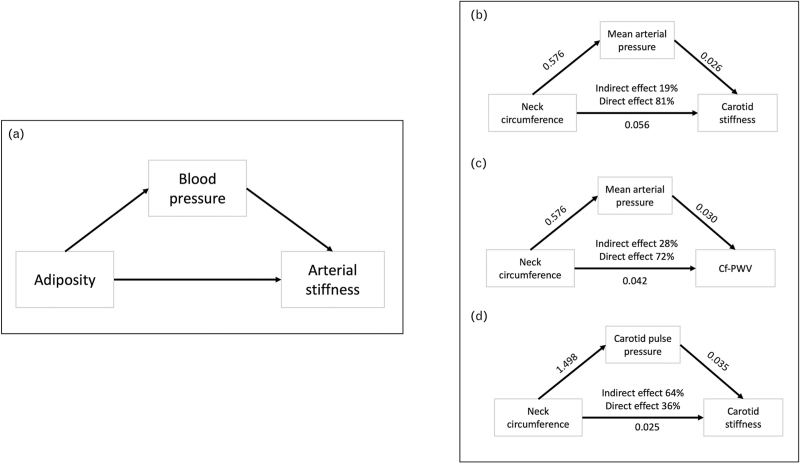
Children and adolescents with adiposity excess are at increased risk of future cardiovascular (CV) disease. Fat accumulation promotes the development of elevated blood pressure (BP) and arterial stiffness, two main determinants of CV risk which are strongly inter-related. We aimed at investigating whether the association between overweight and arterial stiffness, taken at different arterial segments, is mediated by increased BP or is BP-independent.
Three hundred and twenty-two Italian healthy adolescents (mean age 16.9±1.4 years, 12% with overweight) attending the "G. Donatelli" High School in Terni, Italy, underwent measurement of arterial stiffness by arterial tonometry (aortic stiffness) and semiautomatical detection of pressure-volume ratio of the common carotid (carotid stiffness). The mediator effect of BP was tested for each anthropometric or biochemical measure of fat excess related to arterial stiffness.
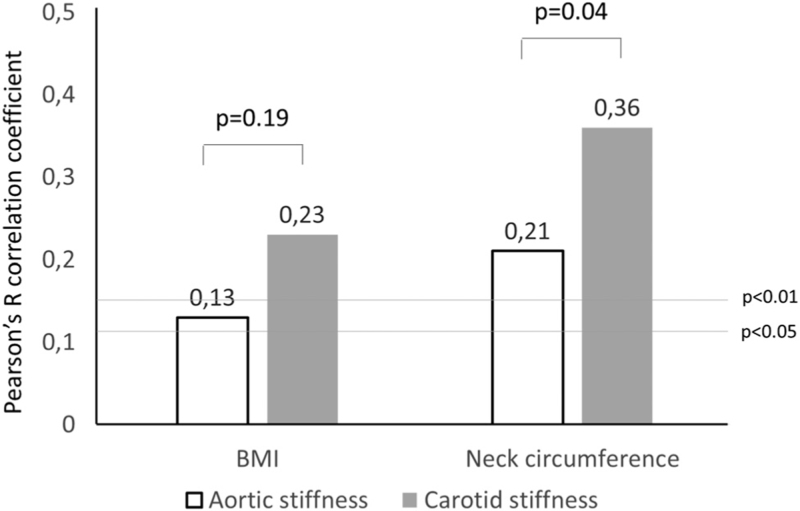
Both carotid and aortic stiffness showed positive correlations with body mass index, waist, hip, and neck circumferences (NC). Only carotid stiffness, but not aortic stiffness, was associated with serum markers of fat accumulation and metabolic impairment such as insulin, homeostatic model of insulin resistance (HOMA-IR), serum gamma-glutamyl transferase (sGGT) and uric acid. The association with NC was stronger for carotid than for aortic stiffness (Fisher z -to- R 2.07, P = 0.04), and independent from BP.
In healthy adolescents, fat accumulation is associated with arterial stiffness. The degree of this association differs by arterial segments, since carotid stiffness is more strongly associated to adipose tissue excess than aortic stiffness and shows a BP-independent association with NC whereas aortic stiffness does not.
肥胖的儿童和青少年未来发生心血管疾病的风险增加。脂肪堆积促进血压升高和动脉僵硬的发展,这两个主要的心血管风险决定因素密切相关。我们旨在研究超重与不同动脉段动脉僵硬之间的关联是否通过血压升高来介导,还是独立于血压之外。
意大利特伦蒂诺的“G. Donatelli”高中的 322 名健康青少年(平均年龄 16.9±1.4 岁,12%超重)参与了这项研究,他们接受了动脉张力测量法(主动脉僵硬)和颈总动脉压力-容积比半自动检测(颈动脉僵硬)来测量动脉僵硬。对于与动脉僵硬相关的每个超重的人体测量或生化指标,我们都测试了血压的中介效应。
颈动脉和主动脉僵硬均与体重指数、腰围、臀围和颈围(NC)呈正相关。只有颈动脉僵硬与血清脂肪堆积和代谢损伤的标志物如胰岛素、胰岛素抵抗稳态模型(HOMA-IR)、血清γ-谷氨酰转移酶(sGGT)和尿酸相关,而主动脉僵硬则没有。颈动脉僵硬与 NC 的相关性比主动脉僵硬更强(Fisher z 到 R 2.07,P = 0.04),且独立于血压。
在健康的青少年中,脂肪堆积与动脉僵硬有关。这种关联的程度因动脉节段而异,因为颈动脉僵硬与脂肪组织过剩的相关性比主动脉僵硬更强,并且与 NC 呈独立于血压之外的相关性,而主动脉僵硬则没有。