Chen Manman, Wang Xijie, Li Yanhui, Gao Di, Ma Ying, Ma Tao, Zhang Yi, Chen Li, Liu Jieyu, Ma Qi, Cui Mengjie, Wang Xinxin, Guo Tongjun, Yuan Wen, Dong Yanhui, Ma Jun
School of Population Medicine and Public Health, Chinese Academy of Medical Sciences, Peking Union Medical College, Beijing, China.
Institute of Child and Adolescent Health, School of Public Health, Peking University, National Health Commission Key Laboratory of Reproductive Health, Beijing, China.
BMC Public Health. 2025 Jan 2;25(1):14. doi: 10.1186/s12889-024-20702-7.
To investigate the joint associations between various body fat distribution parameters and high blood pressure (HBP) using the Bayesian Kernel Machine Regression (BKMR) model in school-aged children.
A diverse sample of 7 ∼ 17 years old (N = 1423; 50.25% boys) was recruited for this study. Fat distribution parameters for multiple body parts, including trunk, legs, android region, and gynoid region fat percentage were measured. HBP was defined as either systolic or diastolic blood pressure exceeded age-, sex- and height-specific 95th percentiles. The chi-square test was utilized to compare differences between groups. The BKMR model was employed to analyze the joint effects of body fat indicators on HBP while accounting for potential confounders. Weighted Quantile Sum (WQS) model was used to characterize the relative weights of each body fat distribution parameter for HBP. Additionally, stratified analyses were performed by sexes and overweight/non overweight groups.
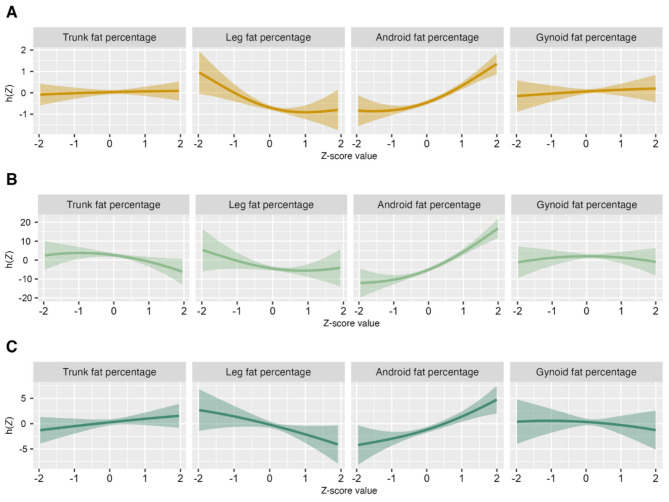
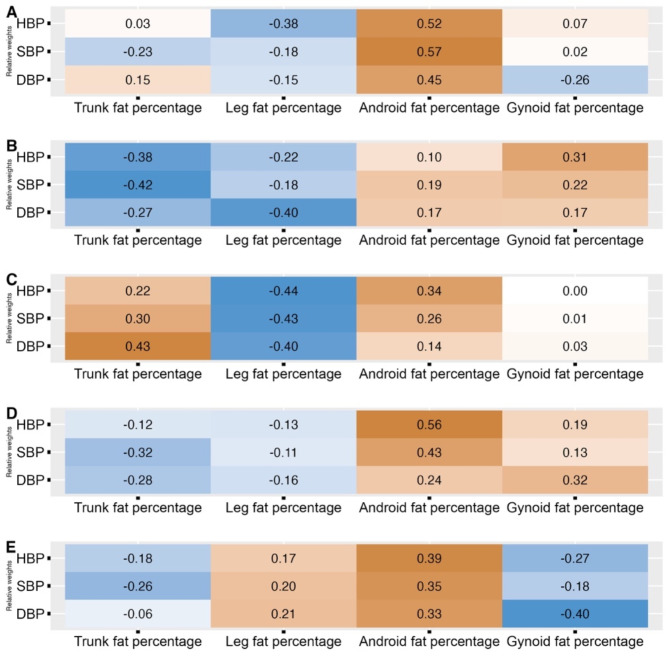
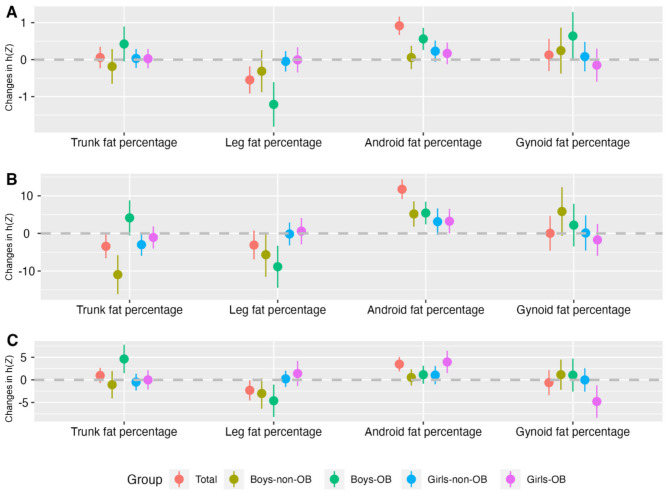
HBP prevalence was 46.86% and 35.10% for overweight and obese (OB) boys and girls, and was 17.96% and 17.28% for non-overweight and obese (non-OB) boys and girls, respectively. Increased fat percentages of trunk, android, and gynoid parts are associated with a higher risk of HBP, while increased fat percentage of the leg was associated with lower HBP risk. Android fat percentage contributed the most HBP risk in OB boys (weight = 0.34), OB girls (weight = 0.39), and non-OB girls (weight = 0.56). Leg fat percentage had significant protective effect on HBP for non-OB boys (weight=-0.22) and OB boys (weight=-0.44), while gynoid fat percentage had significant protective effect for OB girls (weight=-0.27).
Fat distribution of various body parts have inconsistent roles and directions in their association with HBP risk in children of different sex and weight status. We recommend that children of different sexes and weight statuses be provided with body-part-specific exercise recommendations for optimal chronic disease prevention and control benefits.
采用贝叶斯核机器回归(BKMR)模型研究学龄儿童各种体脂分布参数与高血压(HBP)之间的联合关联。
本研究招募了7至17岁的多样化样本(N = 1423;50.25%为男孩)。测量了多个身体部位的脂肪分布参数,包括躯干、腿部、男性化区域和女性化区域的脂肪百分比。HBP定义为收缩压或舒张压超过年龄、性别和身高特定的第95百分位数。采用卡方检验比较组间差异。BKMR模型用于分析体脂指标对HBP的联合效应,同时考虑潜在的混杂因素。加权分位数和(WQS)模型用于表征每个体脂分布参数对HBP的相对权重。此外,按性别和超重/非超重组进行分层分析。
超重和肥胖(OB)男孩和女孩的HBP患病率分别为46.86%和35.10%,非超重和肥胖(非OB)男孩和女孩的患病率分别为17.96%和17.28%。躯干、男性化和女性化部位的脂肪百分比增加与HBP风险较高相关,而腿部脂肪百分比增加与HBP风险较低相关。男性化脂肪百分比在OB男孩(权重 = 0.34)、OB女孩(权重 = 0.39)和非OB女孩(权重 = 0.56)中对HBP风险的贡献最大。腿部脂肪百分比对非OB男孩(权重 = -0.22)和OB男孩(权重 = -0.44)的HBP有显著保护作用,而女性化脂肪百分比对OB女孩(权重 = -0.27)的HBP有显著保护作用。
不同身体部位的脂肪分布在与不同性别和体重状况儿童的HBP风险关联中具有不一致的作用和方向。我们建议为不同性别和体重状况的儿童提供针对身体部位的运动建议,以获得最佳的慢性病预防和控制效果。