Huang Wen-Can, Zhao Dandan, Xue Changhu, Mao Xiangzhao
College of Food Science and Engineering, Ocean University of China, Qingdao, 266003 China.
Laboratory for Marine Drugs and Bioproducts of Qingdao, Pilot National Laboratory for Marine Science and Technology (Qingdao), Qingdao, 266200 China.
Mar Life Sci Technol. 2022 Apr 19;4(3):384-388. doi: 10.1007/s42995-022-00129-y. eCollection 2022 Aug.
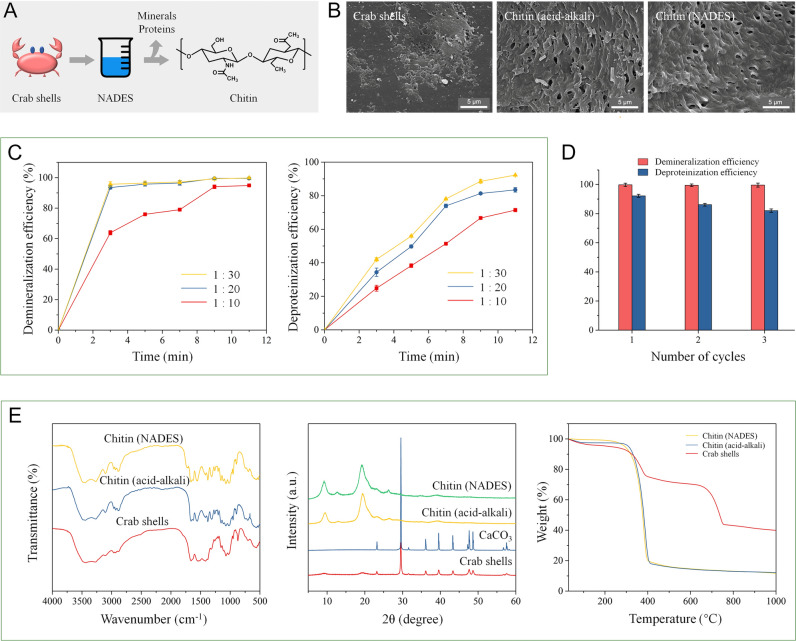
Crab shells are an important feedstock for chitin production. However, their highly compact structure significantly limits their use for the production of chitin under mild conditions. Here, a green and efficient approach using a natural deep eutectic solvent (NADES) to produce chitin from crab shells was developed. Its effectiveness in isolating chitin was investigated. The results showed that most proteins and minerals were removed from crab shells and the relative crystallinity of the isolated chitin reached 76%. The quality of the obtained chitin was comparable to chitin isolated by the acid-alkali method. This is the first report on a green method for efficient chitin production from crab shells. This study is expected to open new avenues for green and efficient production of chitin from crab shells.
蟹壳是生产甲壳素的重要原料。然而,其高度致密的结构严重限制了在温和条件下将其用于生产甲壳素。在此,开发了一种使用天然低共熔溶剂(NADES)从蟹壳生产甲壳素的绿色高效方法。研究了其分离甲壳素的有效性。结果表明,蟹壳中的大部分蛋白质和矿物质被去除,分离得到的甲壳素的相对结晶度达到76%。所获得的甲壳素的质量与通过酸碱法分离得到的甲壳素相当。这是关于从蟹壳高效生产甲壳素的绿色方法的首次报道。该研究有望为从蟹壳绿色高效生产甲壳素开辟新途径。