Department of Endocrinology, the First Affiliated Hospital of Nanjing Medical University, Nanjing, China.
Department of Clinical Nutrition, the Second Affiliated Hospital of Soochow University, Suzhou, China.
Front Endocrinol (Lausanne). 2023 Apr 3;14:1143919. doi: 10.3389/fendo.2023.1143919. eCollection 2023.
Abnormal iron metabolism is related to the risk of diabetes, but the underlying mechanism of this association remains uncertain. This study was conducted to evaluate the contributions of systemic iron status to β-cell function and insulin sensitivity of patients with newly diagnosed T2DM.
A total of 162 patients with newly diagnosed T2DM and 162 healthy controls were enrolled in the study. Basic characteristics, biochemical indicators, and iron metabolism biomarkers, including serum iron (SI), ferritin (SF), transferrin (Trf), and transferrin saturation (TS), were collected. All patients underwent a 75 g oral glucose tolerance test. A series of parameters for assessing β-cell function and insulin sensitivity were calculated. The multivariate stepwise linear regression model was used to investigate the contributions of iron metabolism to β-cell function and insulin sensitivity.
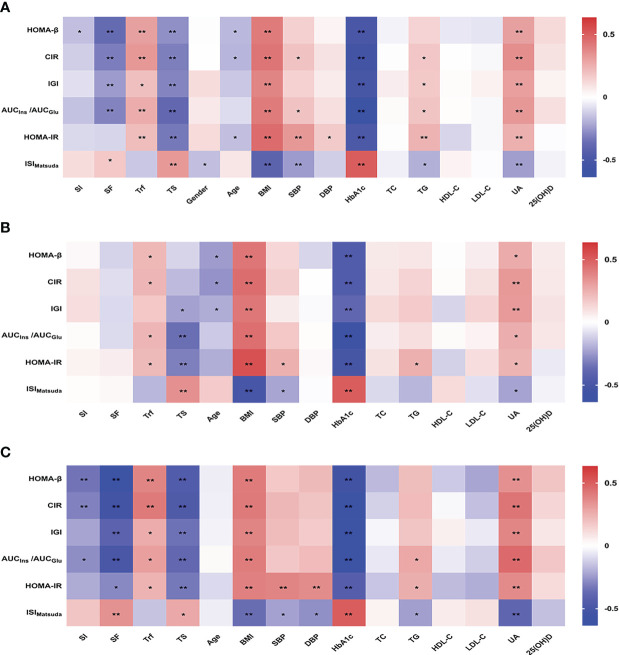
Compared with healthy controls, patients with newly diagnosed T2DM had significantly higher levels of SF. Among the diabetic patients, the SI and TS levels were higher, and the percentage of Trf levels below normal values was lower in men than in women. In all diabetic patients, SF was the independent risk factor associated with impaired β-cell function. Further stratification analysis showed that Trf was an independent protective factor for β-cell function in male patients, while SF was an independent risk factor for impaired β-cell function in female patients. However, systemic iron status did not affect insulin sensitivity.
Elevated SF levels and decreased Trf levels had a profound effect on impaired β-cell function in Chinese patients with newly diagnosed T2DM.
铁代谢异常与糖尿病风险相关,但这种关联的潜在机制尚不清楚。本研究旨在评估系统铁状态对新诊断 2 型糖尿病患者β细胞功能和胰岛素敏感性的影响。
共纳入 162 例新诊断的 2 型糖尿病患者和 162 例健康对照者。收集基本特征、生化指标和铁代谢生物标志物,包括血清铁(SI)、铁蛋白(SF)、转铁蛋白(Trf)和转铁蛋白饱和度(TS)。所有患者均行 75g 口服葡萄糖耐量试验,计算一系列评估β细胞功能和胰岛素敏感性的参数。采用多元逐步线性回归模型分析铁代谢对β细胞功能和胰岛素敏感性的影响。
与健康对照组相比,新诊断的 2 型糖尿病患者的 SF 水平显著升高。在糖尿病患者中,男性的 SI 和 TS 水平较高,Trf 水平低于正常值的比例较低。在所有糖尿病患者中,SF 是与β细胞功能受损相关的独立危险因素。进一步的分层分析显示,在男性患者中,Trf 是β细胞功能的独立保护因素,而 SF 是女性患者β细胞功能受损的独立危险因素。然而,系统铁状态并不影响胰岛素敏感性。
在中国新诊断的 2 型糖尿病患者中,SF 水平升高和 Trf 水平降低对β细胞功能受损有显著影响。