Lia Annamaria, Di Spiezio Alessandro, Speggiorin Michele, Zonta Micaela
Neuroscience Institute, National Research Council (CNR), Padua, Italy.
Department of Biomedical Sciences, University of Padua, Padua, Italy.
Front Netw Physiol. 2023 Apr 3;3:1162757. doi: 10.3389/fnetp.2023.1162757. eCollection 2023.
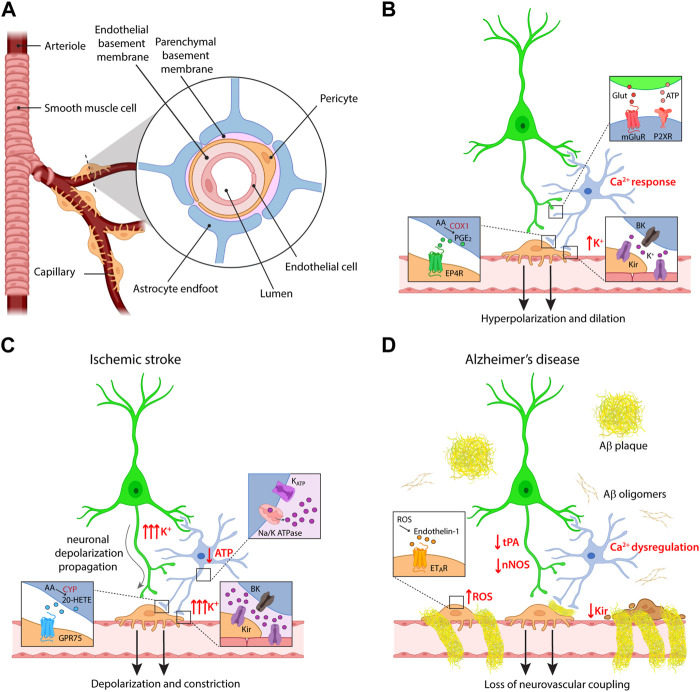
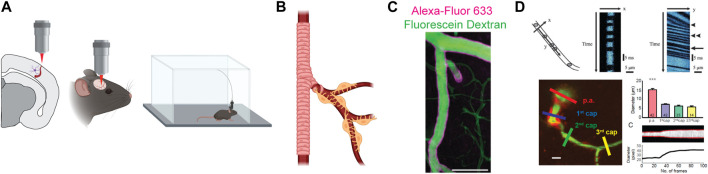
The brain is a highly energy demanding organ, which accounts in humans for the 20% of total energy consumption at resting state although comprising only 2% of the body mass. The necessary delivery of nutrients to brain parenchyma is ensured by the cerebral circulatory system, through the exchange of glucose and oxygen (O) at the capillary level. Notably, a tight spatial and temporal correlation exists between local increases in neuronal activity and the subsequent changes in regional cerebral blood flow. The recognized concept of neurovascular coupling (NVC), also named functional hyperemia, expresses this close relationship and stands at the basis of the modern functional brain imaging techniques. Different cellular and molecular mechanisms have been proposed to mediate this tight coupling. In this context, astrocytes are ideally positioned to act as relay elements that sense neuronal activity through their perisynaptic processes and release vasodilator agents at their endfeet in contact with brain parenchymal vessels. Two decades after the astrocyte involvement in neurovascular coupling has been proposed, we here review the experimental evidence that contributed to unraveling the molecular and cellular mechanisms underlying cerebral blood flow regulation. While traveling through the different controversies that moved the research in this field, we keep a peculiar focus on those exploring the role of astrocytes in neurovascular coupling and conclude with two sections related to methodological aspects in neurovascular research and to some pathological conditions resulting in altered neurovascular coupling.
大脑是一个对能量需求极高的器官,在人类静息状态下,它虽仅占体重的2%,却消耗了总能量的20%。脑循环系统通过在毛细血管水平交换葡萄糖和氧气(O₂),确保了向脑实质输送必需的营养物质。值得注意的是,神经元活动的局部增加与随后局部脑血流的变化之间存在紧密的时空相关性。公认的神经血管耦合(NVC)概念,也称为功能性充血,表达了这种密切关系,并且是现代功能性脑成像技术的基础。人们提出了不同的细胞和分子机制来介导这种紧密耦合。在这种情况下,星形胶质细胞处于理想位置,可作为中继元件,通过其突触周围过程感知神经元活动,并在其与脑实质血管接触的终足处释放血管舒张剂。在星形胶质细胞参与神经血管耦合的提议提出二十年后,我们在此回顾有助于揭示脑血流调节潜在分子和细胞机制的实验证据。在梳理该领域研究过程中的不同争议时,我们特别关注那些探索星形胶质细胞在神经血管耦合中作用的研究,并在最后两部分讨论神经血管研究的方法学方面以及一些导致神经血管耦合改变的病理状况。