Poliseno Amanda, Ferguson Ella, Perry Rose, Munson Alexandra, Davis Alexandra, Hill Lauren, Keys Jessica, White Nicole, Farel Claire, Gay Cynthia, Golin Carol, Rosen Elias, Kashuba Angela
University of North Carolina at Chapel Hill, Chapel Hill, NC, United States.
Division of General Internal Medicine, School of Medicine, University of North Carolina at Chapel Hill, Chapel Hill, NC, United States.
JMIR Res Protoc. 2023 Apr 21;12:e41188. doi: 10.2196/41188.
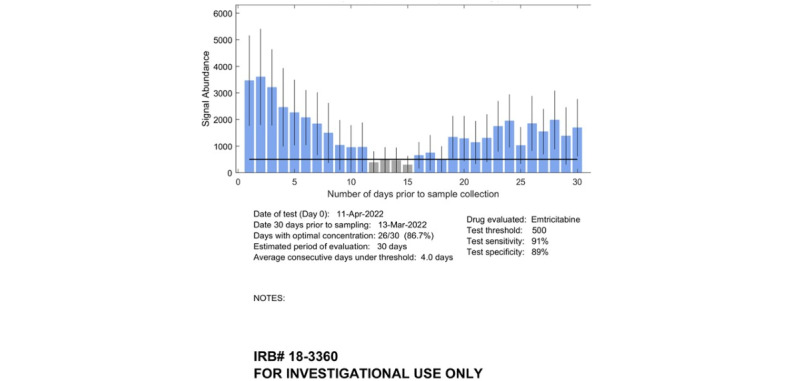
Adherence to antiretroviral (ARV) therapy is critical for achieving HIV RNA suppression in people living with HIV and for preventing HIV infection in uninfected individuals using preexposure prophylaxis. However, a high level of adherence can be challenging to achieve for people living with HIV on lifelong ARVs and for HIV-negative individuals using daily preexposure prophylaxis who are not at daily risk for HIV infection. Current biological measures of adherence are invasive and use bioanalytical methods that do not allow for real-time feedback during a clinic visit. This study was designed to test the feasibility and acceptability of using MedViewer, a novel, minimally invasive, hair-based assay that measures longitudinal ARV drug adherence in real time and provides an output for provider-patient discussion.
The primary objectives were to investigate the feasibility of delivering the MedViewer results as planned, the acceptability of participation in a discussion of the MedViewer results, and the appropriateness of using MedViewer for adherence counseling. The secondary objectives were to investigate additional dimensions of feasibility, acceptability, and appropriateness of using the MedViewer test during a routine clinic visit for people with HIV.
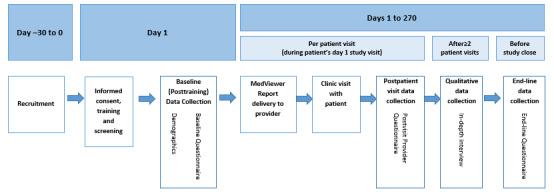
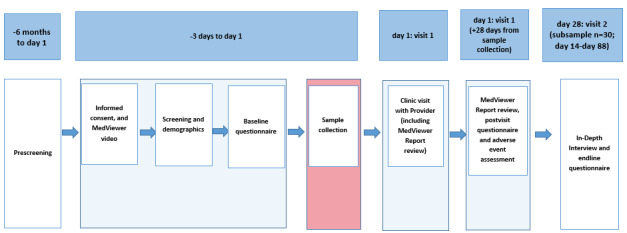
The proposed study was a single-arm cross-sectional study among patients receiving HIV care and providers of HIV care in a southeastern infectious disease clinic. The study originally planned to implement the MedViewer test with 50 eligible patients who were living with HIV across 2 viral load strata (undetectable or detectable plasma HIV RNA over the previous 2 years), administer brief visit-specific questionnaires to all patient and provider participants, and conduct qualitative in-depth interviews and quantitative end-line questionnaires with a subsample of patient participants (n=30) and all provider participants.
The Establishing Novel Antiretroviral Imaging for Hair to Elucidate Nonadherence study was funded by the National Institute of Allergy and Infectious Diseases and approved by the local institutional review board on November 4, 2019. Provider participant enrollment began on January 17, 2020, and patient participant enrollment began on January 22, 2020. Participant enrollment was halted on March 16, 2020, because of the COVID-19 pandemic (16 providers and 10 patients on study). Study activities resumed on February 2, 2021, with COVID-19 modifications approved by the local institutional review board. Participant enrollment closed on October 8, 2021, and data collection closed on November 15, 2021. In total, 36 unique patient participants, representing 37 samples, and 20 provider participants were enrolled. Data analysis and manuscript writing will take place throughout 2023.
We anticipate that the data collected through this study will provide important insights regarding the feasibility, acceptability, and appropriateness of incorporating new real-time longitudinal, minimally invasive adherence tests into routine clinical care and identify potential barriers to medication adherence among patients.
ClinicalTrials.gov NCT04232540; https://clinicaltrials.gov/ct2/show/NCT04232540.
INTERNATIONAL REGISTERED REPORT IDENTIFIER (IRRID): RR1-10.2196/41188.
坚持抗逆转录病毒(ARV)治疗对于实现HIV感染者的HIV RNA抑制以及使用暴露前预防措施预防未感染个体的HIV感染至关重要。然而,对于终身接受抗逆转录病毒治疗的HIV感染者以及并非每日都有HIV感染风险却每日使用暴露前预防措施的HIV阴性个体而言,要实现高度依从性具有挑战性。当前的依从性生物学检测方法具有侵入性,且所使用的生物分析方法无法在门诊就诊期间提供实时反馈。本研究旨在测试MedViewer的可行性和可接受性,MedViewer是一种新型的、微创的基于头发的检测方法,可实时测量纵向抗逆转录病毒药物依从性,并为医患讨论提供结果输出。
主要目标是调查按计划提供MedViewer结果的可行性、参与MedViewer结果讨论的可接受性以及使用MedViewer进行依从性咨询的适当性。次要目标是调查在HIV感染者的常规门诊就诊期间使用MedViewer检测的可行性、可接受性和适当性的其他方面。
拟进行的研究是在东南部一家传染病诊所中对接受HIV治疗的患者及其医护人员开展的单臂横断面研究。该研究最初计划对50名符合条件的HIV感染者进行MedViewer检测,这些感染者分属2个病毒载量分层(过去2年血浆HIV RNA不可检测或可检测),向所有患者和医护人员参与者发放特定就诊简短问卷,并对部分患者参与者(n = 30)和所有医护人员参与者进行定性深入访谈和定量终末问卷调查。
“建立新型抗逆转录病毒头发成像以阐明不依从性”研究由美国国立过敏与传染病研究所资助,并于2019年11月4日获得当地机构审查委员会批准。医护人员参与者招募于2020年1月17日开始,患者参与者招募于2020年1月22日开始。由于COVID-19大流行,参与者招募于2020年3月16日停止(16名医护人员和10名患者参与研究)。研究活动于2021年2月2日恢复,经当地机构审查委员会批准进行了COVID-19相关调整。参与者招募于2021年10月8日结束,数据收集于2021年11月15日结束。总共招募了36名独特的患者参与者(代表37个样本)和20名医护人员参与者。数据分析和论文撰写将在2023年全年进行。
我们预计通过本研究收集的数据将为把新的实时纵向、微创依从性检测纳入常规临床护理的可行性、可接受性和适当性提供重要见解,并识别患者用药依从性的潜在障碍。
ClinicalTrials.gov NCT04232540;https://clinicaltrials.gov/ct2/show/NCT04232540。
国际注册报告识别码(IRRID):RR1-10.2196/41188。