Center for Global Health, Weill Cornell Medicine, New York, New York, USA.
Department of Internal Medicine, Weill Bugando School of Medicine, Mwanza, Tanzania.
Am J Hypertens. 2023 Jul 14;36(8):446-454. doi: 10.1093/ajh/hpad037.
Worldwide, people with hypertensive urgency experience high rates of hospitalization and death due to medication non-adherence. Interventions to improve medication adherence and health outcomes after hypertensive urgency are urgently needed.
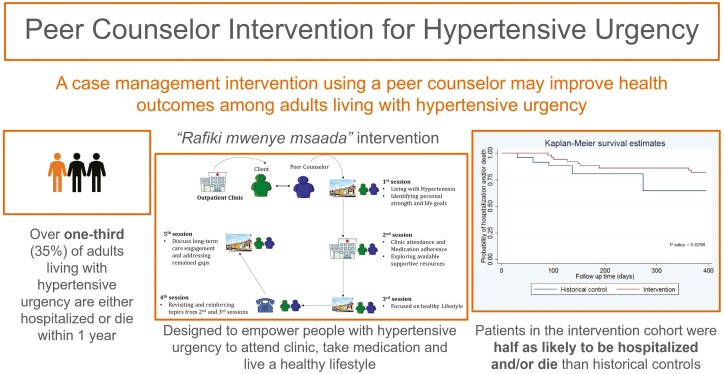
This prospective cohort assessed the effect of a peer counselor intervention-named Rafiki mwenye msaada-on the 1-year incidence of hospitalization and/or death among adults with hypertensive urgency in Mwanza, Tanzania. We enrolled 50 patients who presented with hypertensive urgency to 2 hospitals in Mwanza, Tanzania. All 50 patients received a Rafiki mwenye msaada an individual-level, time-limited case management intervention. Rafiki mwenye msaada aims to empower adult patients with hypertensive urgency to manage their high blood pressure. It consists of 5 sessions delivered over 3 months by a peer counselor. Outcomes were compared to historical controls.
Of the 50 patients (median age, 61 years), 34 (68%) were female, and 19 (38%) were overweight. In comparison to the historical controls, the intervention cohort had a significantly lower proportion of patients with a secondary level of education (22% vs. 35%) and health insurance (40% vs. 87%). Nonetheless, the 1-year cumulative incidence of hospitalization and/or death was 18% in the intervention cohort vs. 35% in the control cohort (adjusted Hazard Ratio, 0.48, 95% CI 0.24-0.97; P = 0.041). Compared to historical controls, intervention participants maintained higher rates of medication use and clinic attendance at both 3- and 6-months but not at 12 months. Of intervention participants who survived and remained in follow-up, >90% reported good medication adherence at all follow-up time points.
Our findings support the hypothesis that a peer counselor intervention may improve health outcomes among adults living with hypertensive urgency. A randomized clinical trial is needed to evaluate the intervention's effectiveness.
在全球范围内,患有高血压急症的人由于药物治疗不依从而住院和死亡的比例很高。迫切需要采取干预措施来提高高血压急症患者的药物治疗依从性和改善健康结局。
这项前瞻性队列研究评估了同伴咨询师干预措施(名为 Rafiki mwenye msaada)对坦桑尼亚姆万扎高血压急症患者 1 年住院和/或死亡发生率的影响。我们招募了 50 名在坦桑尼亚姆万扎的 2 家医院就诊的高血压急症患者。所有 50 名患者均接受了 Rafiki mwenye msaada 作为个体水平、限时的病例管理干预措施。Rafiki mwenye msaada 旨在增强高血压急症成年患者管理其高血压的能力。它由一名同伴咨询师在 3 个月内提供 5 次课程组成。将结果与历史对照进行比较。
在 50 名患者(中位数年龄为 61 岁)中,34 名(68%)为女性,19 名(38%)超重。与历史对照组相比,干预组中具有中等教育程度(22%对 35%)和医疗保险(40%对 87%)的患者比例明显较低。尽管如此,干预组患者在 1 年内的住院和/或死亡累积发生率为 18%,而对照组为 35%(调整后的风险比,0.48;95%置信区间,0.24-0.97;P=0.041)。与历史对照组相比,干预组患者在 3 个月和 6 个月时药物使用和就诊的比例保持较高,但在 12 个月时则不然。在幸存并继续接受随访的干预组参与者中,超过 90%的人在所有随访时间点都报告了良好的药物依从性。
我们的研究结果支持这样一种假设,即同伴咨询师干预可能会改善高血压急症患者的健康结局。需要进行随机临床试验来评估该干预措施的有效性。