School of Energy and Chemical Engineering/Center for Dimension-Controllable Organic Frameworks, Ulsan National Institute of Science and Technology (UNIST), Ulsan, South Korea.
Key Laboratory of Automobile Materials (Jilin University), Ministry of Education, and School of Materials Science and Engineering, Jilin University, Changchun, P. R. China.
Nat Commun. 2023 Apr 22;14(1):2319. doi: 10.1038/s41467-023-38050-2.
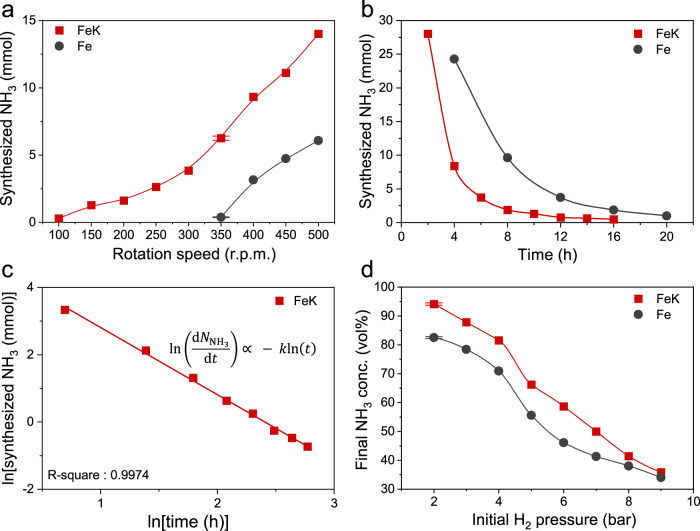
Potassium oxide (KO) is used as a promotor in industrial ammonia synthesis, although metallic potassium (K) is better in theory. The reason KO is used is because metallic K, which volatilizes around 400 °C, separates from the catalyst in the harsh ammonia synthesis conditions of the Haber-Bosch process. To maximize the efficiency of ammonia synthesis, using metallic K with low temperature reaction below 400 °C is prerequisite. Here, we synthesize ammonia using metallic K and Fe as a catalyst via mechanochemical process near ambient conditions (45 °C, 1 bar). The final ammonia concentration reaches as high as 94.5 vol%, which was extraordinarily higher than that of the Haber-Bosch process (25.0 vol%, 450 °C, 200 bar) and our previous work (82.5 vol%, 45 °C, 1 bar).
氧化钾(KO)在工业合成氨中用作促进剂,尽管理论上金属钾(K)更好。之所以使用 KO,是因为金属 K 在 400°C 左右挥发,在哈伯-博世工艺苛刻的氨合成条件下会从催化剂中分离出来。为了最大限度地提高氨合成的效率,使用低温反应在 400°C 以下的金属 K 是前提。在这里,我们通过机械化学过程在近环境条件(45°C,1bar)下使用金属 K 和 Fe 作为催化剂合成氨。最终的氨浓度高达 94.5%,远高于哈伯-博世工艺(25.0%,450°C,200bar)和我们之前的工作(82.5%,45°C,1bar)。