Haritay Shivani, Patil Rithia, Maldar Arif, Kumar Anil, Reddy Vikrama, Oswal Deshna, Tahashildar Masood Ahmed, Kolakar Akshay, Kabbur Satish, Prasad Jang Bahadur, Shivaswamy M S, Paranjape Ramesh, Angolkar Mubashir
Department of Public Health, KLE Academy of Higher Education and Research, Belgaum, Karnataka, India.
Dr. Prabhakar Kore BSRC, KLE Academy of Higher Education and Research, Belgaum, Karnataka, India.
J Glob Infect Dis. 2023 Feb 28;15(1):19-22. doi: 10.4103/jgid.jgid_128_22. eCollection 2023 Jan-Mar.
There are limited data available on the long-term presence of SARS-CoV-2-specific binding antibodies and neutralizing antibodies in circulation among the elderly population. This study aims to examine levels of anti-SARS-CoV-2 antibodies in vaccines who have completed at least 6 months since the second vaccine dose. A cross-sectional study was conducted from November 2021 to January 2022 among 199 vaccines aged 60 years and above residing in Belagavi city, who received two doses of the Covishield vaccine.
Antibody response to SARS-COV-2 virus whole cell antigen was measured by a kit COVID KAWACH IgG Micro LISA (J Mitra and Company, India) in 199 participants who had completed at least 6 months after receiving the second dose of Covishield vaccine. The antibody response was measured as a ratio of optical density (OD) in the participant's sample to the mean OD in negative control test by normal (T/N). Independent Kruskal-Wallis test was applied to test the difference between the T/N ratio by months of vaccination since the second dose and by the age group strata.
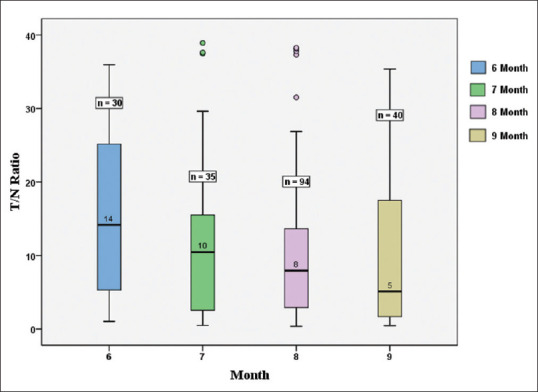
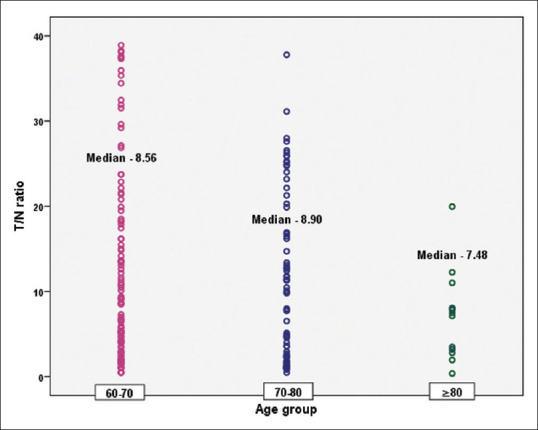
The median T/N values among participants who completed 6, 7, 8, and 9 months since the second vaccine dose were 14.17, 10.46, 7.93, and 5.11, respectively, and this decline in T/N values was statistically significant. Antibody response values showed a decline with increasing age for participants in the age strata 60-69, 70-79, and 80 and above, respectively.
A significant decline was observed in antibody response over 9 months supporting the administration of booster dose of vaccine.
关于严重急性呼吸综合征冠状病毒2(SARS-CoV-2)特异性结合抗体和中和抗体在老年人群体循环中的长期存在情况,现有数据有限。本研究旨在检测自第二次接种疫苗至少6个月后的疫苗接种者体内抗SARS-CoV-2抗体水平。2021年11月至2022年1月,对居住在贝拉尔加维市的199名60岁及以上接种了两剂科维希德疫苗的疫苗接种者进行了一项横断面研究。
采用COVID KAWACH IgG Micro LISA试剂盒(印度J Mitra公司),对199名在接种第二剂科维希德疫苗至少6个月后完成接种的参与者,检测其对SARS-CoV-2病毒全细胞抗原的抗体反应。抗体反应以参与者样本中的光密度(OD)与阴性对照测试中的平均OD之比(T/N)来衡量。应用独立的克鲁斯卡尔-沃利斯检验来测试自第二剂疫苗接种后的月份以及年龄组分层情况下T/N比值之间的差异。
自第二次接种疫苗后6、7、8和9个月的参与者中,T/N值中位数分别为14.17、10.46、7.93和5.11,T/N值的这种下降具有统计学意义。在60 - 69岁、70 - 79岁以及80岁及以上年龄组的参与者中,抗体反应值均随年龄增长而下降。
观察到9个月内抗体反应显著下降,这支持了疫苗加强针的接种。