Bajaj Varnica, Gadi Nirupa, Spihlman Allison P, Wu Samantha C, Choi Christopher H, Moulton Vaishali R
Division of Rheumatology and Clinical Immunology, Department of Medicine, Beth Israel Deaconess Medical Center, Harvard Medical School, Boston, MA, United States.
School of Medicine, Boston University, Boston, MA, United States.
Front Physiol. 2021 Jan 12;11:571416. doi: 10.3389/fphys.2020.571416. eCollection 2020.
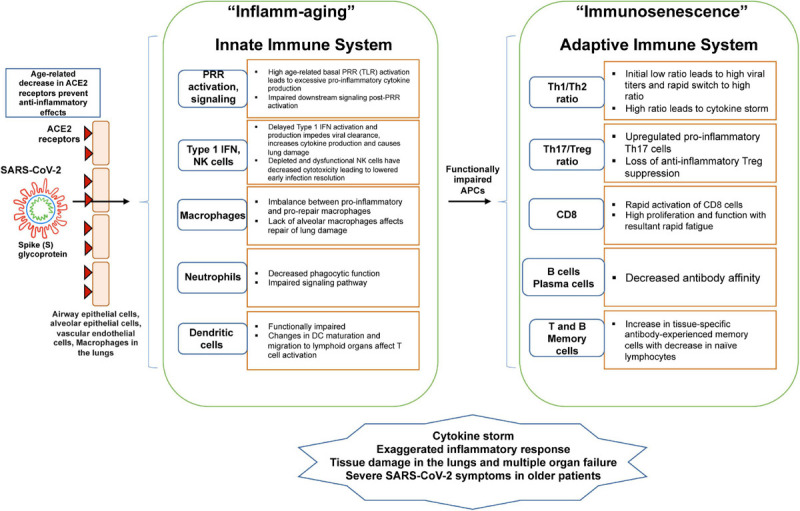
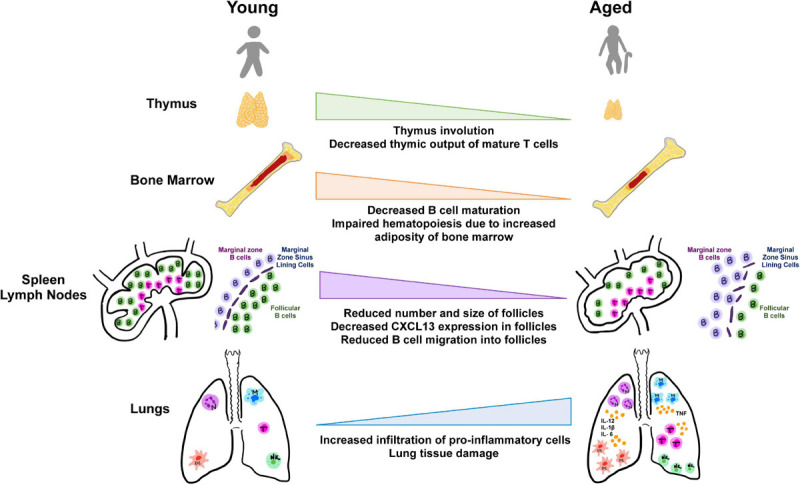
The novel coronavirus severe acute respiratory syndrome coronavirus 2 causing the Coronavirus disease (COVID-19) pandemic has ravaged the world with over 72 million total cases and over 1.6 million deaths worldwide as of early December 2020. An overwhelming preponderance of cases and deaths is observed within the elderly population, and especially in those with pre-existing conditions and comorbidities. Aging causes numerous biological changes in the immune system, which are linked to age-related illnesses and susceptibility to infectious diseases. Age-related changes influence the host immune response and therefore not only weaken the ability to fight respiratory infections but also to mount effective responses to vaccines. Immunosenescence and inflamm-aging are considered key features of the aging immune system wherein accumulation of senescent immune cells contribute to its decline and simultaneously increased inflammatory phenotypes cause immune dysfunction. Age-related quantitative and qualitative changes in the immune system affect cells and soluble mediators of both the innate and adaptive immune responses within lymphoid and non-lymphoid peripheral tissues. These changes determine not only the susceptibility to infections, but also disease progression and clinical outcomes thereafter. Furthermore, the response to therapeutics and the immune response to vaccines are influenced by age-related changes within the immune system. Therefore, better understanding of the pathophysiology of aging and the immune response will not only help understand age-related diseases but also guide targeted management strategies for deadly infectious diseases like COVID-19.
导致新型冠状病毒肺炎(COVID-19)大流行的新型冠状病毒严重急性呼吸综合征冠状病毒2已肆虐全球,截至2020年12月初,全球累计病例超过7200万例,死亡人数超过160万例。在老年人群中,尤其是那些有基础疾病和合并症的人群中,观察到病例和死亡人数占压倒性多数。衰老会导致免疫系统发生许多生物学变化,这些变化与年龄相关疾病和对传染病的易感性有关。年龄相关变化会影响宿主免疫反应,因此不仅会削弱抵抗呼吸道感染的能力,还会削弱对疫苗产生有效反应的能力。免疫衰老和炎症衰老被认为是衰老免疫系统的关键特征,其中衰老免疫细胞的积累导致其功能衰退,同时炎症表型增加会导致免疫功能障碍。免疫系统中与年龄相关的数量和质量变化会影响淋巴和非淋巴外周组织中固有免疫反应和适应性免疫反应的细胞及可溶性介质。这些变化不仅决定了对感染的易感性,还决定了疾病的进展及随后的临床结局。此外,免疫系统中与年龄相关的变化会影响对治疗的反应以及对疫苗的免疫反应。因此,更好地了解衰老的病理生理学和免疫反应不仅有助于理解与年龄相关的疾病,还能指导针对COVID-19等致命传染病的靶向管理策略。