Metabolic and Renal Research Group, UiT- The Arctic University of Norway, Tromsø, Norway.
Section of Nephrology, Clinic of Internal Medicine, University Hospital of North Norway, Tromsø, Norway.
J Am Soc Nephrol. 2023 Aug 1;34(8):1409-1420. doi: 10.1681/ASN.0000000000000147. Epub 2023 Apr 24.
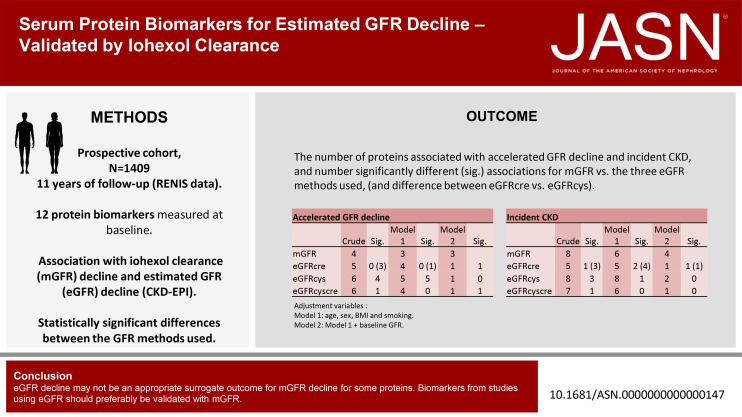
eGFR from creatinine, cystatin C, or both has been primarily used in search of biomarkers for GFR decline. Whether the relationships between biomarkers and eGFR decline are similar to associations with measured GFR (mGFR) decline has not been investigated. This study revealed that some biomarkers showed statistically significant different associations with eGFR decline compared with mGFR decline, particularly for eGFR from cystatin C. The findings indicate that non-GFR-related factors, such as age, sex, and body mass index, influence the relationship between biomarkers and eGFR decline. Therefore, the results of biomarker studies using eGFR, particularly eGFRcys, should be interpreted with caution and perhaps validated with mGFR.
Several serum protein biomarkers have been proposed as risk factors for GFR decline using eGFR from creatinine or cystatin C. We investigated whether eGFR can be used as a surrogate end point for measured GFR (mGFR) when searching for biomarkers associated with GFR decline.
In the Renal Iohexol Clearance Survey, GFR was measured with plasma iohexol clearance in 1627 individuals without diabetes, kidney, or cardiovascular disease at baseline. After 11 years of follow-up, 1409 participants had one or more follow-up GFR measurements. Using logistic regression and interval-censored Cox regression, we analyzed the association between baseline levels of 12 serum protein biomarkers with the risk of accelerated GFR decline and incident CKD for both mGFR and eGFR.
Several biomarkers exhibited different associations with eGFR decline compared with their association with mGFR decline. More biomarkers showed different associations with eGFRcys decline than with eGFRcre decline. Most of the different associations of eGFR decline versus mGFR decline remained statistically significant after adjustment for age, sex, and body mass index, but several were attenuated and not significant after adjusting for the corresponding baseline mGFR or eGFR.
In studies of some serum protein biomarkers, eGFR decline may not be an appropriate surrogate outcome for mGFR decline. Although the differences from mGFR decline are attenuated by adjustment for confounding factors in most cases, some persist. Therefore, proposed biomarkers from studies using eGFR should preferably be validated with mGFR.
肌酐、胱抑素 C 或两者的 eGFR 主要用于寻找 GFR 下降的生物标志物。生物标志物与 eGFR 下降之间的关系是否与与实测 GFR(mGFR)下降的关系相似尚未得到研究。本研究表明,一些生物标志物与 eGFR 下降的相关性与 mGFR 下降的相关性存在统计学差异,尤其是胱抑素 C 的 eGFR。研究结果表明,非 GFR 相关因素,如年龄、性别和体重指数,会影响生物标志物与 eGFR 下降之间的关系。因此,使用 eGFR,特别是 eGFRcys 的生物标志物研究结果应谨慎解释,并可能需要用 mGFR 进行验证。
一些血清蛋白生物标志物已被提出作为使用肌酐或胱抑素 C 的 eGFR 估算的 GFR 下降的危险因素。我们研究了当寻找与 GFR 下降相关的生物标志物时,eGFR 是否可以用作 mGFR 的替代终点。
在肾脏碘海醇清除率研究中,1627 名无糖尿病、肾脏或心血管疾病的个体在基线时使用血浆碘海醇清除率测量 GFR。在 11 年的随访后,1409 名参与者进行了一次或多次随访 GFR 测量。使用逻辑回归和区间 censored Cox 回归分析,我们分析了基线时 12 种血清蛋白生物标志物与 mGFR 和 eGFR 的加速 GFR 下降和 CKD 事件风险之间的关系。
与 mGFR 下降相比,一些生物标志物与 eGFR 下降的相关性不同。与 eGFRcre 下降相比,更多的生物标志物与 eGFRcys 下降的相关性不同。在调整年龄、性别和体重指数后,大多数 eGFR 下降与 mGFR 下降的不同相关性仍然具有统计学意义,但在调整相应的基线 mGFR 或 eGFR 后,一些相关性减弱且不再显著。
在一些血清蛋白生物标志物的研究中,eGFR 下降可能不是 mGFR 下降的合适替代终点。虽然在大多数情况下,通过调整混杂因素可以减弱与 mGFR 下降的差异,但有些差异仍然存在。因此,使用 eGFR 进行研究提出的生物标志物最好用 mGFR 进行验证。