From the Department of Neurology (W.-S.R., S.-W.J., H.-R.K., J.E.P., D.-E.K.), Dongguk University Ilsan Hospital; National Priority Research Center for Stroke (W.-S.R., J.C., D.-E.K.), Goyang, South Korea; Departments of Neuroradiology and Imaging Physics (D.S.), University of Texas MD Anderson Cancer Center, Houston; Department of Neurology (B.J.K., M.-K.H., H.-J.B.), Seoul National University College of Medicine, Seoul National University Bundang Hospital, Seongnam; Department of Neurology (J.-T.K., M.S.P., K.-H.C.), Chonnam National University Hospital, Gwangju; Department of Neurology (K.-S.H., Y.-J.C., H.-K.P.), Inje University Ilsan Paik Hospital, Goyang; Department of Neurology (K.L.), Soonchunhyang University Hospital, Seoul; Department of Neurology (T.H.P., S.-S.P.), Seoul Medical Center; Department of Neurology (J.-M.P.), Uijeongbu Eulji Medical Center; Department of Neurology (K.K.), Nowon Eulji Medical Center, Eulji University School of Medicine, Seoul; Department of Neurology (B.-C.L., K.-H.Y., M.S.O.), Hallym University Sacred Heart Hospital, Anyang; Department of Neurology (S.J.L., J.G.K.), Eulji University Hospital, Daejeon; Department of Neurology (J.-K.C., D.-H.K.), Dong-A University Hospital, Busan; Department of Neurology (Jun Lee), Yeungnam University Hospital, Daegu; and Department of Biostatistics (Juneyoung Lee), Korea University, Seoul, South Korea.
Neurology. 2023 Jun 13;100(24):e2490-e2503. doi: 10.1212/WNL.0000000000207346. Epub 2023 Apr 24.
Female patients tend to have greater disability and worse long-term outcomes after stroke than male patients. To date, the biological basis of sex difference in ischemic stroke remains unclear. We aimed to (1) assess sex differences in clinical manifestation and outcomes of acute ischemic stroke and (2) investigate whether the sex disparity is due to different infarct locations or different impacts of infarct in the same location.
This MRI-based multicenter study included 6,464 consecutive patients with acute ischemic stroke (<7 days) from 11 centers in South Korea (May 2011-January 2013). Multivariable statistical and brain mapping methods were used to analyze clinical and imaging data collected prospectively: admission NIH Stroke Scale (NIHSS) score, early neurologic deterioration (END) within 3 weeks, modified Rankin Scale (mRS) score at 3 months, and culprit cerebrovascular lesion (symptomatic large artery steno-occlusion and cerebral infarction) locations.
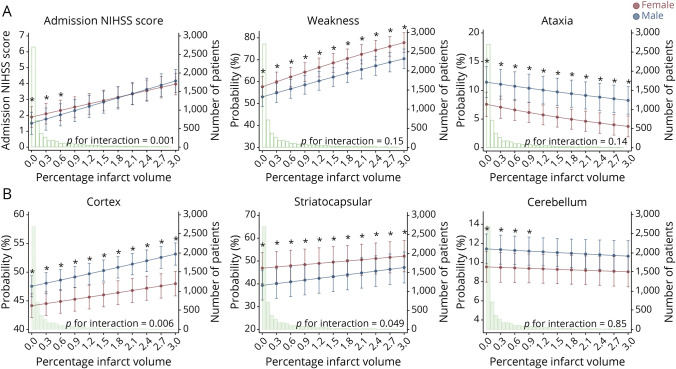
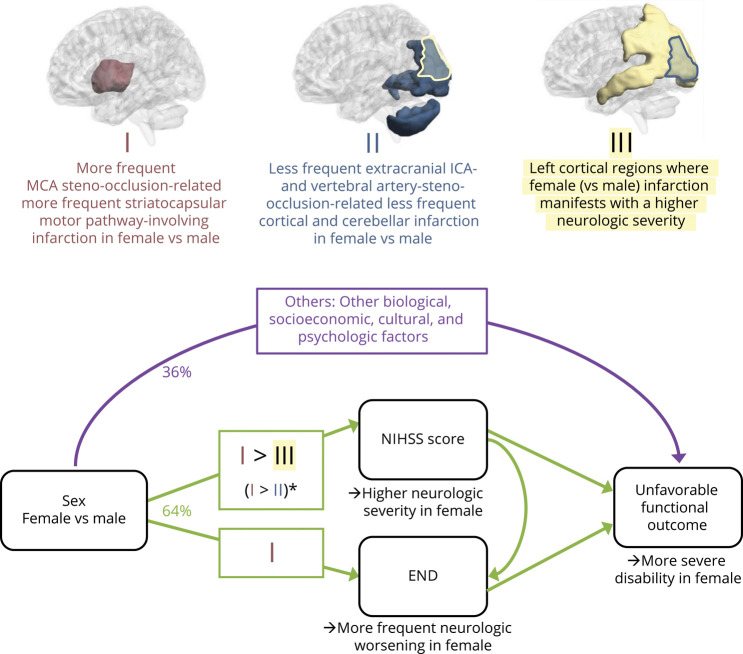
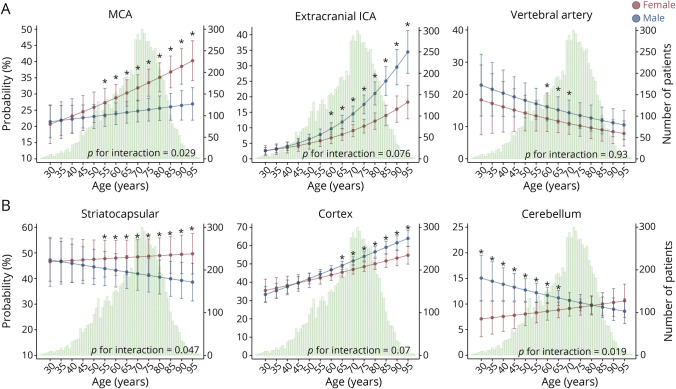
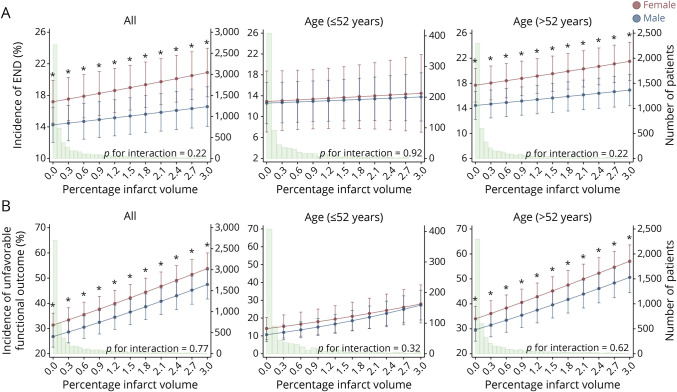
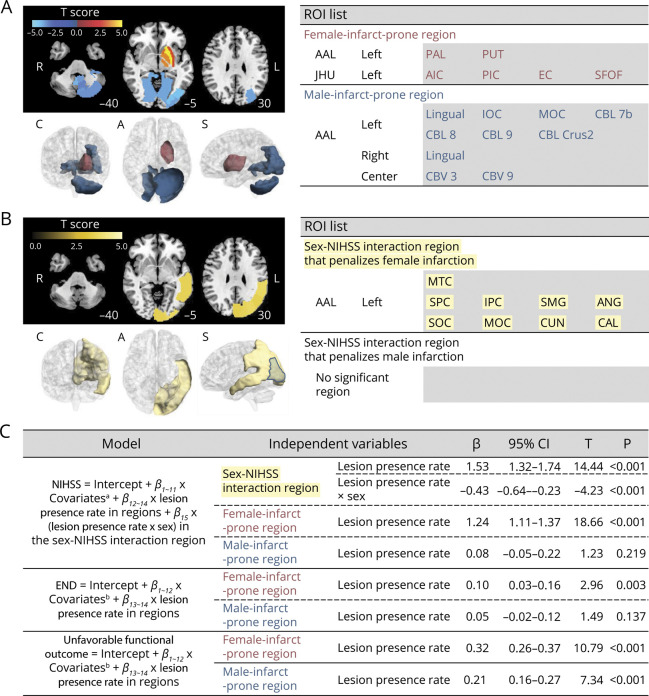
The mean (SD) age was 67.5 (12.6) years, and 2,641 (40.9%) were female patients. Percentage infarct volumes on diffusion-weighted MRI did not differ between female patients and male patients (median 0.14% vs 0.14%, = 0.35). However, female patients showed higher stroke severity (NIHSS score, median 4 vs 3, < 0.001) and had more frequent END (adjusted difference 3.5%; = 0.002) than male patients. Female patients had more frequent striatocapsular lesions (43.6% vs 39.8%, = 0.001) and less frequent cerebrocortical (48.2% vs. 50.7% in patients older than 52 years, = 0.06) and cerebellar (9.1% vs. 11.1%, = 0.009) lesions than male patients, which aligned with angiographic findings: female patients had more prevalent symptomatic steno-occlusion of the middle cerebral artery (MCA) (31.1% vs 25.3%; < 0.001) compared with male patients, who had more frequent symptomatic steno-occlusion of the extracranial internal carotid artery (14.2% vs 9.3%; < 0.001) and vertebral artery (6.5% vs 4.7%; = 0.001). Cortical infarcts in female patients, specifically left-sided parieto-occipital regions, were associated with higher NIHSS scores than expected for similar infarct volumes in male patients. Consequently, female patients had a higher likelihood of unfavorable functional outcome (mRS score >2) than male patients (adjusted absolute difference 4.5%; 95% CI 2.0-7.0; < 0.001).
Female patients have more frequent MCA disease and striatocapsular motor pathway involvement with acute ischemic stroke, along with left parieto-occipital cortical infarcts showing greater severity for equivalent infarct volumes than in male patients. This leads to more severe initial neurologic symptoms, higher susceptibility to neurologic worsening, and less 3-month functional independence, when compared with male patients.
相较于男性患者,女性患者在中风后往往会出现更大的残疾和更差的长期预后。迄今为止,缺血性中风中性别差异的生物学基础仍不清楚。我们旨在:(1)评估急性缺血性中风的临床表现和结局中的性别差异;(2)探究这种性别差异是否是由于梗死部位不同,或者同一部位梗死的影响不同所致。
这项基于 MRI 的多中心研究纳入了来自韩国 11 个中心的 6464 例急性缺血性中风患者(<7 天)(2011 年 5 月至 2013 年 1 月)。采用多变量统计和脑映射方法分析前瞻性收集的临床和影像学数据:入院 NIH 中风量表(NIHSS)评分、3 周内早期神经功能恶化(END)、3 个月时改良 Rankin 量表(mRS)评分和责任性脑血管病变(症状性大动脉狭窄-闭塞和脑梗死)部位。
患者平均(SD)年龄为 67.5(12.6)岁,2641 例(40.9%)为女性。扩散加权 MRI 上的梗死体积百分比在女性患者和男性患者之间没有差异(中位数 0.14%比 0.14%, = 0.35)。然而,女性患者的中风严重程度更高(NIHSS 评分,中位数 4 分比 3 分, < 0.001),且 END 更常见(调整差异 3.5%, = 0.002)。女性患者更常发生纹状体-皮质病变(43.6%比 39.8%, = 0.001),而较少发生皮质(52 岁以上患者中,48.2%比 50.7%, = 0.06)和小脑(9.1%比 11.1%, = 0.009)病变,与血管造影结果一致:女性患者大脑中动脉(MCA)症状性狭窄-闭塞的发生率(31.1%比 25.3%; < 0.001)高于男性患者,而男性患者颅外颈内动脉(14.2%比 9.3%; < 0.001)和椎动脉(6.5%比 4.7%; = 0.001)症状性狭窄-闭塞的发生率更高。女性患者的皮质梗死,特别是左侧顶枕叶区域的梗死,与男性患者相似的梗死体积相比,NIHSS 评分更高。因此,女性患者的不良功能结局(mRS 评分>2)的可能性高于男性患者(调整绝对差异 4.5%;95%CI 2.0-7.0; < 0.001)。
女性患者在急性缺血性中风中更常发生 MCA 疾病和纹状体-皮质运动通路受累,以及左侧顶枕叶皮质梗死,其梗死体积相同,但严重程度更高。与男性患者相比,这导致了更严重的初始神经症状、更高的神经恶化易感性和更低的 3 个月功能独立性。