Obstetrics and Gynaecology Department, Somali-Mogadishu Recep Tayyip Erdoğan Research and Training Hospital, Mogadishu, Somalia.
BMC Womens Health. 2023 Apr 25;23(1):193. doi: 10.1186/s12905-023-02382-4.
Anaemia in pregnant women is one of the most common public health problems, especially in low- and middle-income countries, such as Somalia. This study aimed to examine the association between the severity of anaemia during pregnancy and the risk of adverse maternal and foetal outcomes in Somali women.
We prospectively enrolled pregnant women who had deliveries from May 1 to December 1, 2022, at Mogadishu Somali Turkey Recep Tayyip Erdoğan Training and Research Hospital. Blood haemoglobin levels were measured for each participant at admission for delivery. Anaemia was defined as a haemoglobin level of less than 11 g/dL, with mild (10 to 10.9 g/dL), moderate (7 to 9.9 g/dL), and severe (< 7 g/dL) forms. The associations between maternal anaemia and maternal-foetal outcomes were investigated.
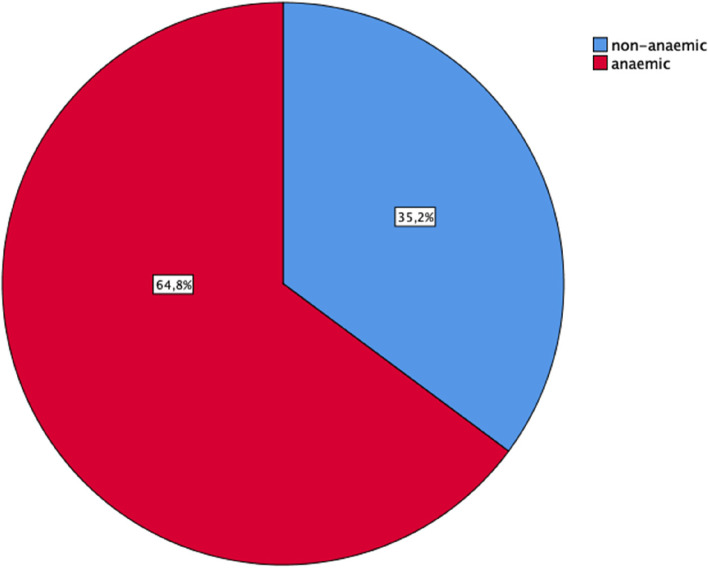
The study included 1186 consecutive pregnant women (mean age 26.9 years, range 16-47). The incidence of maternal anaemia at delivery was 64.8%, with 33.8%, 59.8%, and 6.4% of women having mild, moderate and severe forms, respectively. Anaemia at delivery was associated with increased oxytocin administration to prompt labour (OR, 2.25, 95% CI, 1.34-3.78). Both moderate and severe anaemia were associated with increased risks for postpartum haemorrhage (moderate, OR, 4.93; severe, OR, 41.30) and the need for maternal blood transfusions (moderate, OR, 9.66; severe, OR, 301.50). In addition, severe anaemia was associated with increased risks for preterm delivery (OR, 2.50, 95% CI, 1.35-4.63), low birth weight (OR, 3.45, 95% CI, 1.87-6.35), stillbirths (OR, 4.02, 95% CI, 1.79-8.98), placental abruption (OR, 58.04,95% CI, 6.83-493.27) and maternal ICU admission (OR, 8.33, 95% CI, 3.53-19.63).
Our findings suggest that anaemia in pregnancy is associated with adverse maternal and foetal outcomes, with moderate or severe anaemia leading to increased risks for peri-, intra- and postpartum complications and that treatment of severe anaemia in pregnant women should be given particular consideration in our efforts to prevent preterm births, LBW and stillbirths.
孕妇贫血是最常见的公共卫生问题之一,尤其是在中低收入国家,如索马里。本研究旨在探讨孕妇贫血严重程度与索马里妇女母婴不良结局风险之间的关系。
我们前瞻性地招募了 2022 年 5 月 1 日至 12 月 1 日在摩加迪沙索马里土耳其雷杰普·塔伊普·埃尔多安培训和研究医院分娩的孕妇。每位参与者入院时均测量血液血红蛋白水平。贫血定义为血红蛋白水平低于 11g/dL,轻度(10-10.9g/dL)、中度(7-9.9g/dL)和重度(<7g/dL)。研究了母亲贫血与母婴结局之间的关系。
本研究共纳入 1186 例连续孕妇(平均年龄 26.9 岁,范围 16-47 岁)。分娩时母亲贫血的发生率为 64.8%,其中 33.8%、59.8%和 6.4%的女性分别患有轻度、中度和重度贫血。分娩时贫血与催产素促分娩的使用增加相关(OR,2.25;95%CI,1.34-3.78)。中度和重度贫血均与产后出血风险增加相关(中度,OR,4.93;重度,OR,41.30)和需要母亲输血(中度,OR,9.66;重度,OR,301.50)相关。此外,严重贫血与早产风险增加相关(OR,2.50;95%CI,1.35-4.63)、低出生体重(OR,3.45;95%CI,1.87-6.35)、死产(OR,4.02;95%CI,1.79-8.98)、胎盘早剥(OR,58.04;95%CI,6.83-493.27)和产妇 ICU 入院(OR,8.33;95%CI,3.53-19.63)相关。
我们的研究结果表明,妊娠贫血与母婴不良结局相关,中度或重度贫血导致围产期、产时和产后并发症风险增加,应特别考虑治疗孕妇严重贫血,以预防早产、低出生体重儿和死产。