Department of Neurosurgery, University of Illinois at Chicago, Chicago, IL, USA.
Chicago Medical School, Rosalind Franklin University of Medicine and Science, North Chicago, IL, USA.
Childs Nerv Syst. 2023 Jul;39(7):1813-1819. doi: 10.1007/s00381-023-05945-w. Epub 2023 Apr 26.
In 1996, the US Food and Drug Administration (FDA) mandated folic acid fortification for all enriched cereal grains. This resulted in a reduction of neural tube defect (NTD)-affected pregnancies. However, Hispanic women continued to be twice as likely to give birth to a child affected by NTD compared to non-Hispanic White women. Some hypotheses explaining this difference focus on cultural variation in dietary intake of cereal grains. In 2016, the FDA approved voluntary folic acid fortification for corn masa flour products to focus on the Hispanic diet staple. This study investigates rates of NTDs in predominantly Hispanic-populated zip codes before and after the voluntary fortification of corn masa flour with folic acid.
Normal pregnancies and those complicated by NTDs between 1/1/2016 and 9/30/2020 were identified using ICD-9 and ICD-10 codes in an all-payor claims database. The post-fortification period began 12 months after the fortification recommendation. The US Census data was used to stratify pregnancies in predominantly Hispanic zip codes (≥ 75% of households) vs. non-Hispanic zip codes. The causal impact of the FDA's recommendation was assessed by means of a Bayesian structural time series model.
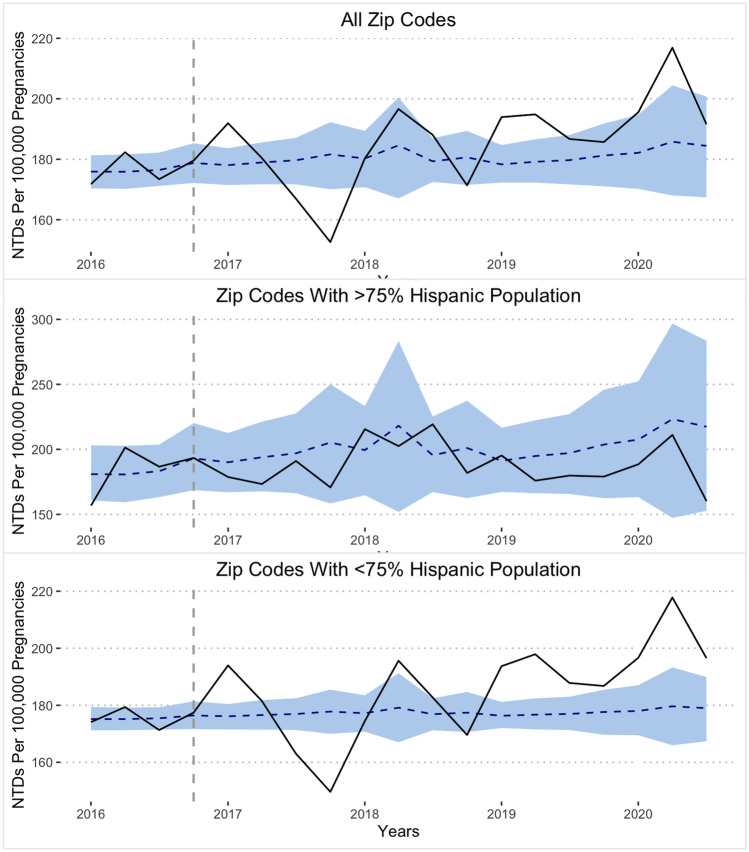
A total of 2,584,366 pregnancies were identified among females aged 15-50 years. Of these, 365,983 took place in predominantly Hispanic zip codes. Mean quarterly NTDs per 100,000 pregnancies did not significantly differ between predominantly Hispanic zip codes and predominantly non-Hispanic zip codes pre-FDA recommendation (184.5 vs. 175.6; p = 0.427), nor post-recommendation (188.2 vs. 185.9; p = 0.713). Rates of NTDs predicted to occur if no FDA recommendation had been made were compared to the actual rate post-recommendation: no significant difference was observed in predominantly Hispanic zip codes (p = 0.245) or overall (p = 0.116).
Rates of neural tube defects were not significantly reduced in predominantly Hispanic zip codes following the 2016 FDA approval of voluntary folic acid fortification of corn masa flour. Further research and implementation of comprehensive approaches to advocacy, policy, and public health are necessary to decrease preventable congenital disease rates. Mandatory rather than voluntary fortification of corn masa flour products may achieve more substantial prevention of neural tube defects in at-risk US populations.
1996 年,美国食品和药物管理局(FDA)要求对所有强化谷物进行叶酸强化。这导致神经管缺陷(NTD)受影响的妊娠减少。然而,西班牙裔妇女出生的 NTD 患儿数量仍然是非西班牙裔白人妇女的两倍。一些解释这种差异的假设集中在饮食中谷物摄入量的文化差异上。2016 年,FDA 批准了玉米粉中叶酸的自愿强化,以专注于西班牙裔的饮食主食。本研究调查了在玉米粉中添加叶酸进行自愿强化前后,以西班牙裔为主的邮政编码中 NTD 的发生率。
使用全支付者索赔数据库中的 ICD-9 和 ICD-10 代码,确定 2016 年 1 月 1 日至 2020 年 9 月 30 日之间的正常妊娠和伴有 NTD 的妊娠。强化建议后 12 个月开始后强化期。使用美国人口普查数据将以西班牙裔为主的邮政编码(≥75%的家庭)与非西班牙裔邮政编码分层。通过贝叶斯结构时间序列模型评估 FDA 建议的因果影响。
在 15-50 岁的女性中,共确定了 2584366 例妊娠。其中,365983 例发生在以西班牙裔为主的邮政编码中。在 FDA 建议之前,以西班牙裔为主的邮政编码和以非西班牙裔为主的邮政编码中每 100000 例妊娠的平均季度 NTD 发生率没有显著差异(184.5 比 175.6;p=0.427),建议后也没有显著差异(188.2 比 185.9;p=0.713)。如果没有 FDA 的建议,预计会发生 NTD 的发生率与建议后的实际发生率进行了比较:在以西班牙裔为主的邮政编码中没有观察到显著差异(p=0.245),总体上也没有显著差异(p=0.116)。
在 2016 年 FDA 批准玉米粉中叶酸的自愿强化后,以西班牙裔为主的邮政编码中 NTD 的发生率并没有显著降低。需要进一步研究并实施综合的倡导、政策和公共卫生方法,以降低可预防的先天性疾病发生率。对玉米粉产品进行强制性而不是自愿性的强化可能会在美国高危人群中更有效地预防神经管缺陷。