
在成年人中,由灭活的 SARS-CoV-2 疫苗的第二次加强针诱导的体液和细胞反应。
Humoral and cellular response induced by a second booster of an inactivated SARS-CoV-2 vaccine in adults.
机构信息
Millennium Institute on Immunology and Immunotherapy, Santiago, Chile; Departamento de Genética Molecular y Microbiología, Facultad de Ciencias Biológicas, Pontificia Universidad Católica de Chile, Santiago, Chile.
Millennium Institute on Immunology and Immunotherapy, Santiago, Chile; Departamento de Genética Molecular y Microbiología, Facultad de Ciencias Biológicas, Pontificia Universidad Católica de Chile, Santiago, Chile; Departamento de Ciencias Biológicas, Facultad de Ciencias de la Vida, Universidad Andrés Bello, Santiago, Chile.
出版信息
EBioMedicine. 2023 May;91:104563. doi: 10.1016/j.ebiom.2023.104563. Epub 2023 Apr 24.
BACKGROUND
The Omicron variant has challenged the control of the COVID-19 pandemic due to its immuno-evasive properties. The administration of a booster dose of a SARS-CoV-2 vaccine showed positive effects in the immunogenicity against SARS-CoV-2, effect that is even enhanced after the administration of a second booster.
METHODS
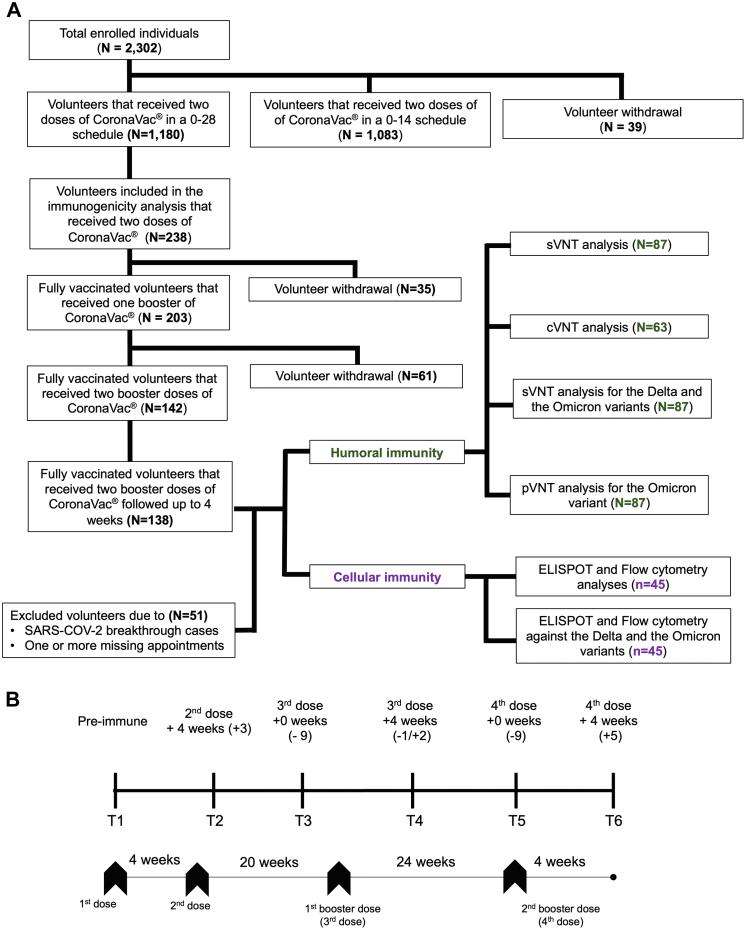
During a phase-3 clinical trial, we evaluated the effect of a second booster of CoronaVac®, an inactivated vaccine administered 6 months after the first booster, in the neutralization of SARS-CoV-2 (n = 87). In parallel, cellular immunity (n = 45) was analyzed in stimulated peripheral mononuclear cells by flow cytometry and ELISPOT.
FINDINGS
Although a 2.5-fold increase in neutralization of the ancestral SARS-CoV-2 was observed after the second booster when compared with prior its administration (Geometric mean units p < 0.0001; Geometric mean titer p = 0.0002), a poor neutralization against the Omicron variant was detected. Additionally, the activation of specific CD4 T lymphocytes remained stable after the second booster and, importantly, equivalent activation of CD4 T lymphocytes against the Omicron variant and the ancestral SARS-CoV-2 were found.
INTERPRETATION
Although the neutralizing response against the Omicron variant after the second booster of CoronaVac® was slightly increased, these levels are far from those observed against the ancestral SARS-CoV-2 and could most likely fail to neutralize the virus. In contrast, a robust CD4T cell response may confer protection against the Omicron variant.
FUNDING
The Ministry of Health, Government of Chile, the Confederation of Production and Commerce, Chile and SINOVAC Biotech.NIHNIAID. The Millennium Institute on Immunology and Immunotherapy.
背景
由于其免疫逃避特性,Omicron 变体对 COVID-19 大流行的控制构成了挑战。SARS-CoV-2 疫苗加强针的接种显示出对 SARS-CoV-2 的免疫原性产生了积极影响,而在接种第二针加强针后,这种效果甚至会增强。
方法
在一项 3 期临床试验中,我们评估了 CoronaVac®(一种灭活疫苗)的第二针加强针在中和 SARS-CoV-2 方面的效果(n=87)。同时,通过流式细胞术和 ELISPOT 分析了刺激后的外周血单核细胞中的细胞免疫(n=45)。
结果
与接种前相比,第二针加强针后观察到对原始 SARS-CoV-2 的中和作用增加了 2.5 倍(几何平均单位 p<0.0001;几何平均滴度 p=0.0002),但对 Omicron 变体的中和作用较差。此外,第二针加强针后特异性 CD4 T 淋巴细胞的激活仍然稳定,重要的是,发现针对 Omicron 变体和原始 SARS-CoV-2 的 CD4 T 淋巴细胞的激活是等效的。
结论
尽管 CoronaVac®第二针加强针后的中和反应对 Omicron 变体略有增加,但这些水平远低于对原始 SARS-CoV-2 的中和反应,很可能无法中和该病毒。相比之下,强大的 CD4 T 细胞反应可能提供对 Omicron 变体的保护。
资助
智利卫生部、智利生产和商业联合会、智利 SINOVAC 生物技术公司、美国国立卫生研究院过敏和传染病研究所。千年免疫学和免疫治疗研究所。


 Zotero 插件