Department of Preventive Medicine and Institute for Global Health, Northwestern University, Chicago, IL, USA.
Institute for Disease Modeling, Seattle, WA, USA.
Malar J. 2023 Apr 26;22(1):137. doi: 10.1186/s12936-023-04563-w.
For their 2021-2025 National Malaria Strategic Plan (NMSP), Nigeria's National Malaria Elimination Programme (NMEP), in partnership with the World Health Organization (WHO), developed a targeted approach to intervention deployment at the local government area (LGA) level as part of the High Burden to High Impact response. Mathematical models of malaria transmission were used to predict the impact of proposed intervention strategies on malaria burden.
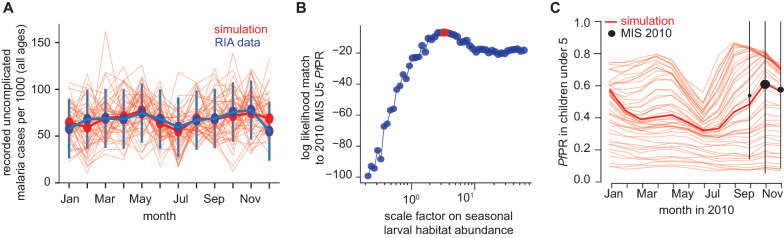
An agent-based model of Plasmodium falciparum transmission was used to simulate malaria morbidity and mortality in Nigeria's 774 LGAs under four possible intervention strategies from 2020 to 2030. The scenarios represented the previously implemented plan (business-as-usual), the NMSP at an 80% or higher coverage level and two prioritized plans according to the resources available to Nigeria. LGAs were clustered into 22 epidemiological archetypes using monthly rainfall, temperature suitability index, vector abundance, pre-2010 parasite prevalence, and pre-2010 vector control coverage. Routine incidence data were used to parameterize seasonality in each archetype. Each LGA's baseline malaria transmission intensity was calibrated to parasite prevalence in children under the age of five years measured in the 2010 Malaria Indicator Survey (MIS). Intervention coverage in the 2010-2019 period was obtained from the Demographic and Health Survey, MIS, the NMEP, and post-campaign surveys.
Pursuing a business-as-usual strategy was projected to result in a 5% and 9% increase in malaria incidence in 2025 and 2030 compared with 2020, while deaths were projected to remain unchanged by 2030. The greatest intervention impact was associated with the NMSP scenario with 80% or greater coverage of standard interventions coupled with intermittent preventive treatment in infants and extension of seasonal malaria chemoprevention (SMC) to 404 LGAs, compared to 80 LGAs in 2019. The budget-prioritized scenario with SMC expansion to 310 LGAs, high bed net coverage with new formulations, and increase in effective case management rate at the same pace as historical levels was adopted as an adequate alternative for the resources available.
Dynamical models can be applied for relative assessment of the impact of intervention scenarios but improved subnational data collection systems are required to allow increased confidence in predictions at sub-national level.
尼日利亚国家消除疟疾规划(NMEP)与世界卫生组织(WHO)合作,为其 2021-2025 年国家疟疾战略计划(NMSP)制定了在地方政府区域(LGA)层面开展干预措施的针对性方法,作为高负担高影响应对措施的一部分。疟疾传播的数学模型被用于预测拟议干预策略对疟疾负担的影响。
使用基于代理的恶性疟原虫传播模型,模拟了尼日利亚 774 个 LGA 在四种可能的干预策略下,从 2020 年到 2030 年的疟疾发病率和死亡率。该情景代表了之前实施的计划(按部就班)、NMSP 达到 80%或更高的覆盖率以及根据尼日利亚可用资源制定的两个优先计划。根据每月降雨量、温度适宜指数、媒介丰度、2010 年前寄生虫流行率和 2010 年前媒介控制覆盖率,将 LGA 聚类为 22 种流行病学原型。在每个原型中,使用常规发病率数据来参数化季节性。根据 2010 年疟疾指标调查(MIS)中测量的五岁以下儿童中的寄生虫流行率,对每个 LGA 的基线疟疾传播强度进行校准。2010-2019 年期间的干预覆盖率来自人口与健康调查、MIS、NMEP 和运动后调查。
按照按部就班的策略,与 2020 年相比,预计 2025 年和 2030 年疟疾发病率将分别增加 5%和 9%,而到 2030 年,疟疾死亡人数预计将保持不变。与 2019 年相比,与 80%或更高的标准干预措施覆盖率相结合的 NMSP 情景以及婴儿间歇性预防治疗和季节性疟疾化学预防(SMC)扩展到 404 个 LGA,而不是 80 个 LGA,对干预措施的影响最大。采用预算优先的情景,将 SMC 扩展到 310 个 LGA,使用新配方提供高蚊帐覆盖率,并以与历史水平相同的速度提高有效病例管理率,作为可用资源的适当替代方案。
动态模型可用于相对评估干预情景的影响,但需要改进国家以下数据收集系统,以提高国家以下层面预测的可信度。