Mylavarapu Ramanamurthy V, Kanumuri Vivek V, de Rivero Vaccari Juan Pablo, Misra Amrit, McMillan David W, Ganzer Patrick D
Department of Biomedical Engineering, University of Miami, Miami, FL, USA.
Department of Otolaryngology, University of Miami, Miami, FL, USA.
Bioelectron Med. 2023 Apr 27;9(1):8. doi: 10.1186/s42234-023-00110-9.
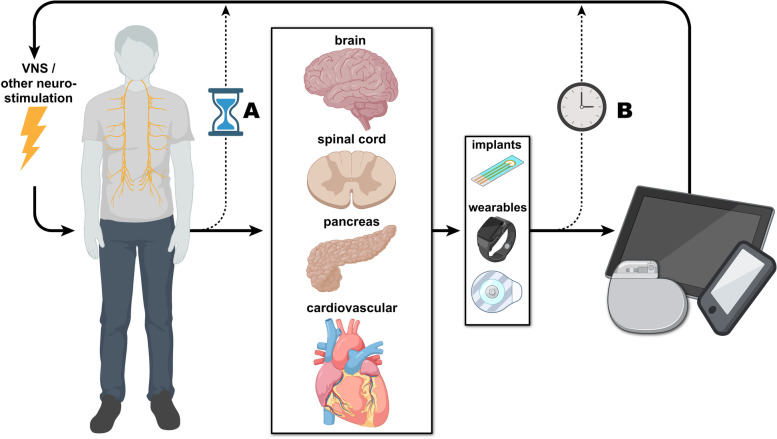
In recent decades, vagus nerve stimulation (VNS) therapy has become widely used for clinical applications including epilepsy, depression, and enhancing the effects of rehabilitation. However, several questions remain regarding optimization of this therapy to maximize clinical outcomes. Although stimulation parameters such as pulse width, amplitude, and frequency are well studied, the timing of stimulation delivery both acutely (with respect to disease events) and chronically (over the timeline of a disease's progression) has generally received less attention. Leveraging such information would provide a framework for the implementation of next generation closed-loop VNS therapies. In this mini-review, we summarize a number of VNS therapies and discuss (1) general timing considerations for these applications and (2) open questions that could lead to further therapy optimization.
近几十年来,迷走神经刺激(VNS)疗法已广泛应用于包括癫痫、抑郁症以及增强康复效果等临床领域。然而,关于如何优化这种疗法以实现最佳临床效果仍存在一些问题。尽管诸如脉宽、幅度和频率等刺激参数已得到充分研究,但无论是急性刺激(相对于疾病事件而言)还是慢性刺激(在疾病进展的时间轴上)的给药时机,总体上受到的关注较少。利用这些信息将为下一代闭环VNS疗法的实施提供一个框架。在本综述中,我们总结了多种VNS疗法,并讨论了(1)这些应用的一般时机考量以及(2)可能导致进一步疗法优化的未解决问题。