Zhan Yidi, Wang Jiaojiao, Kong Xiaona, Liu Yong
College of Plant Protection, Shandong Agricultural University, Taian, Shandong, China.
Front Physiol. 2023 Apr 10;14:1167174. doi: 10.3389/fphys.2023.1167174. eCollection 2023.
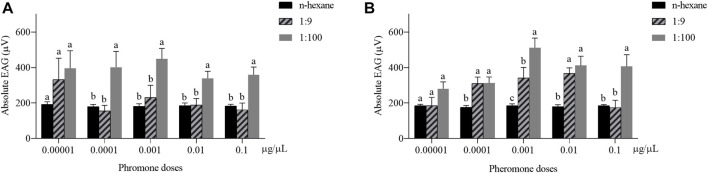
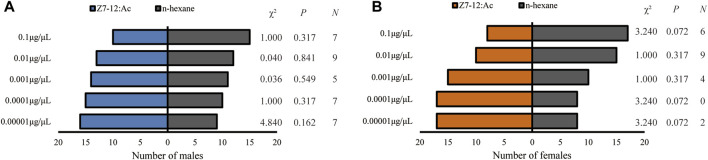
Pheromone cues released from hosts or prey are of crucial importance to natural enemies for prey and habitat location. The use of herbivorous insect sex pheromones has long been considered as a potential pest control alternative that is non-toxic and harmless to beneficials. We hypothesized that (Pallas) (Coleoptera: Coccinellidae), a major predatory coccinellid beetle of the devastating migratory pest (Smith) (Lepidoptera: Noctuidae), could perceive and use the sex pheromone of to locate its habitat. Here we tested the electrophysiological and behavioral responses of to the two components Z7-12:Ac and Z9-14:Ac of sex pheromone by using electroantennography (EAG) and Y-tube bioassay. The 3D modeling of odorant-binding proteins (HaxyOBPs) and molecular docking were also performed. The results showed that both female and male exhibited significantly higher electrophysiological and behavioral responses to Z9-14:Ac at the concentrations of 0.001, 0.01, and 0.1 μg/μL, while no significant electrophysiological and behavioral responses of were observed to Z7-12:Ac. The blend of Z7-12:Ac and Z9-14:Ac at the ratio of 1:100 had a significant attraction to both male and female at the concentrations of 0.01 and 0.1 μg/μL based on electrophysiological and behavioral assays, but no significant behavioral responses were observed at the ratios of 1:9. According to the 3D modeling of HaxyOBPs and molecular docking, HaxyOBP12 has a good affinity with Z9-14:Ac. Z9-14:Ac is bound to the HaxyOBP12 by hydrogen bonding and hydrophobic interactions. However, there were no credible docking results between HaxyOBPs and Z7-12:Ac. Our findings revealed that can perceive Z9-14:Ac and could use it as a chemical cue to locate prey habitat. We speculated that Z7-12:Ac, which showed some antagonistic effect toward the response of to Z9-14:Ac, could improve the adaptability of in the presence of predators. This study provides new insights into the application of pheromones to manipulate natural enemy behavior for pest control.
宿主或猎物释放的信息素线索对于天敌寻找猎物和栖息地至关重要。长期以来,植食性昆虫性信息素的使用一直被视为一种潜在的害虫防治替代方法,该方法对有益生物无毒无害。我们推测,作为毁灭性迁飞害虫粘虫(史密斯)(鳞翅目:夜蛾科)的主要捕食性瓢虫类甲虫龟纹瓢虫(帕拉斯)(鞘翅目:瓢虫科)能够感知并利用粘虫的性信息素来定位其栖息地。在此,我们通过使用触角电位(EAG)和Y型管生物测定法,测试了龟纹瓢虫对粘虫性信息素的两种成分Z7 - 12:Ac和Z9 - 14:Ac的电生理和行为反应。还进行了龟纹瓢虫气味结合蛋白(HaxyOBPs)的三维建模和分子对接。结果表明,在0.001、0.01和0.1μg/μL浓度下,雌性和雄性龟纹瓢虫对Z9 - 14:Ac均表现出显著更高的电生理和行为反应,而对Z7 - 12:Ac未观察到显著的电生理和行为反应。基于电生理和行为测定,在0.01和0.1μg/μL浓度下,Z7 - 12:Ac与Z9 - 14:Ac以1:100的比例混合对雄性和雌性龟纹瓢虫均具有显著吸引力,但在1:9的比例下未观察到显著的行为反应。根据HaxyOBPs的三维建模和分子对接,HaxyOBP12与Z9 - 14:Ac具有良好的亲和力。Z9 - 14:Ac通过氢键和疏水相互作用与HaxyOBP12结合。然而,HaxyOBPs与Z7 - 12:Ac之间没有可靠的对接结果。我们的研究结果表明,龟纹瓢虫能够感知Z9 - 14:Ac,并可将其用作定位猎物栖息地的化学线索。我们推测,对龟纹瓢虫对Z9 - 14:Ac的反应表现出某种拮抗作用的Z7 - 12:Ac可能会提高龟纹瓢虫在有捕食者存在时的适应性。本研究为利用信息素操纵天敌行为进行害虫防治提供了新的见解。