Department of Orthopaedics, Rehabilitation and Physical Therapy, Leiden University Medical Center (LUMC), Albinusdreef 2, P.O.Box 9600, 2300 RC, Leiden, The Netherlands.
Directorate of Research Policy, Leiden University Medical Center, Leiden, The Netherlands.
Qual Life Res. 2023 Oct;32(10):2731-2749. doi: 10.1007/s11136-023-03422-0. Epub 2023 Apr 27.
Although the use of Patient-Reported Outcomes Measurement Information System (PROMIS) measures is widely advocated, little is known on their use in patients with inflammatory arthritis. We systematically describe the use and outcomes of PROMIS measures in clinical studies involving people with rheumatoid arthritis (RA) or axial spondyloarthritis (axSpA).
A systematic review was conducted according to the PRISMA guidelines. Through a systematic search of nine electronic databases, clinical studies including patients with RA or axSpA and reporting the use of PROMIS measure were selected. Study characteristics, details of PROMIS measures and their outcomes, if available, were extracted.
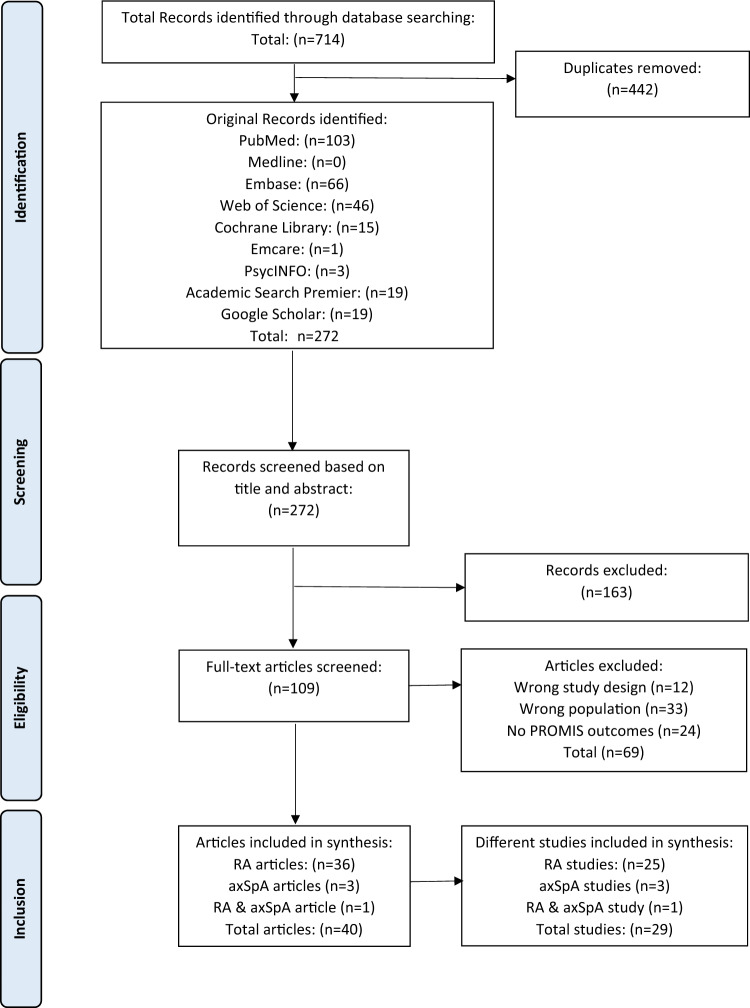
In total, 29 studies described in 40 articles met the inclusion criteria, of which 25 studies included RA patients, three studies included axSpA patients and one study included both RA and axSpA patients. The use of two general PROMIS measures (PROMIS Global Health, PROMIS-29) and 13 different domain-specific PROMIS measures was reported, of which the PROMIS Pain Interference (n = 17), Physical Function (n = 14), Fatigue (n = 13), and Depression (n = 12) measures were most frequently used. Twenty-one studies reported their results in terms of T-scores. Most T-scores were worse than the general population mean, indicating impairments of health status. Eight studies did not report actual data but rather measurement properties of the PROMIS measures.
There was considerable variety regarding the different PROMIS measures used, with the PROMIS Pain interference, Physical function, Fatigue, and Depression measures being the most frequently used. In order to facilitate the comparisons across studies, more standardization of the selection of PROMIS measures is needed.
尽管广泛提倡使用患者报告结局测量信息系统(PROMIS)测量,但对于炎症性关节炎患者中使用 PROMIS 测量的情况知之甚少。我们系统地描述了在涉及类风湿关节炎(RA)或轴性脊柱关节炎(axSpA)患者的临床研究中使用 PROMIS 测量的情况和结果。
根据 PRISMA 指南进行系统综述。通过对九个电子数据库的系统搜索,选择了包括 RA 或 axSpA 患者并报告使用 PROMIS 测量的临床研究。提取了研究特征、PROMIS 测量的详细信息及其结果(如果有)。
共有 29 项研究在 40 篇文章中进行了描述,符合纳入标准,其中 25 项研究包括 RA 患者,3 项研究包括 axSpA 患者,1 项研究包括 RA 和 axSpA 患者。报告了两种通用的 PROMIS 测量(PROMIS 全球健康,PROMIS-29)和 13 种不同的特定领域的 PROMIS 测量,其中 PROMIS 疼痛干扰(n=17)、身体功能(n=14)、疲劳(n=13)和抑郁(n=12)测量使用最频繁。21 项研究以 T 分数报告了他们的结果。大多数 T 分数均低于一般人群平均值,表明健康状况受损。8 项研究没有报告实际数据,而是报告了 PROMIS 测量的测量特性。
使用的不同 PROMIS 测量方法存在很大差异,PROMIS 疼痛干扰、身体功能、疲劳和抑郁测量使用最频繁。为了促进研究之间的比较,需要对 PROMIS 测量的选择进行更多的标准化。