Zupo Roberta, Moroni Alessia, Castellana Fabio, Gasparri Clara, Catino Feliciana, Lampignano Luisa, Perna Simone, Clodoveo Maria Lisa, Sardone Rodolfo, Rondanelli Mariangela
Department of Interdisciplinary Medicine, University "Aldo Moro", Piazza Giulio Cesare 11, 70100 Bari, Italy.
Endocrinology and Nutrition Unit, Azienda di Servizi alla Persona "Istituto Santa Margherita", University of Pavia, 27100 Pavia, Italy.
Metabolites. 2023 Apr 17;13(4):565. doi: 10.3390/metabo13040565.
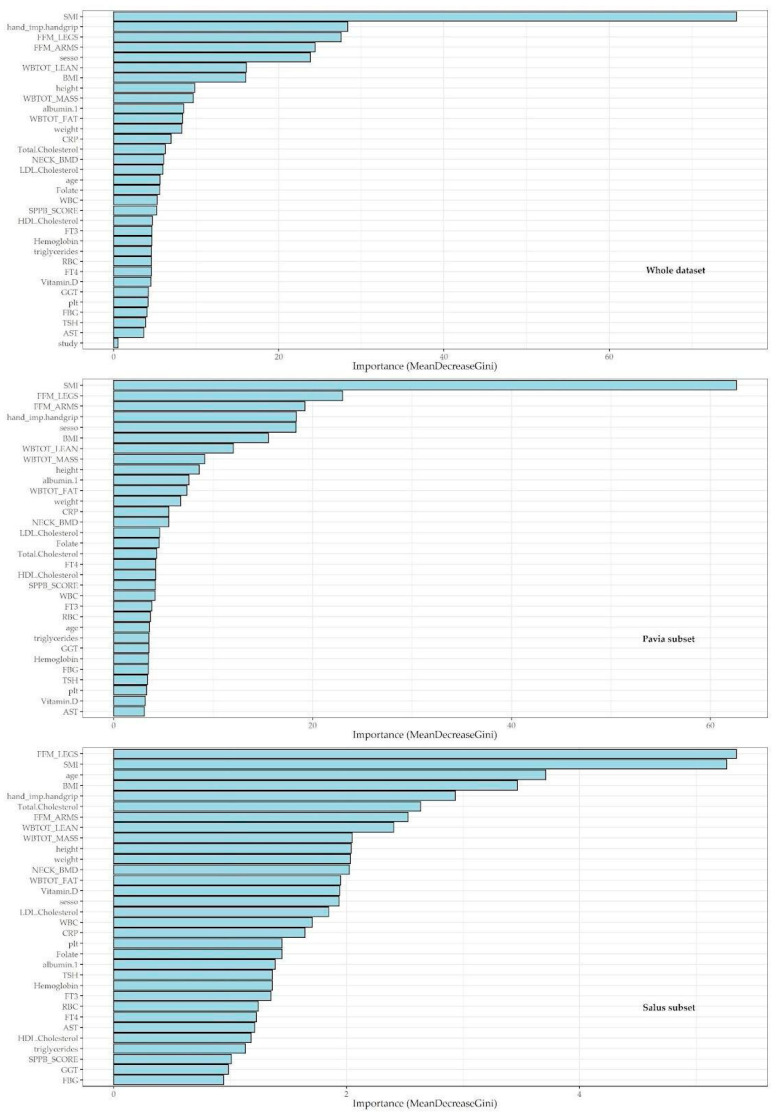
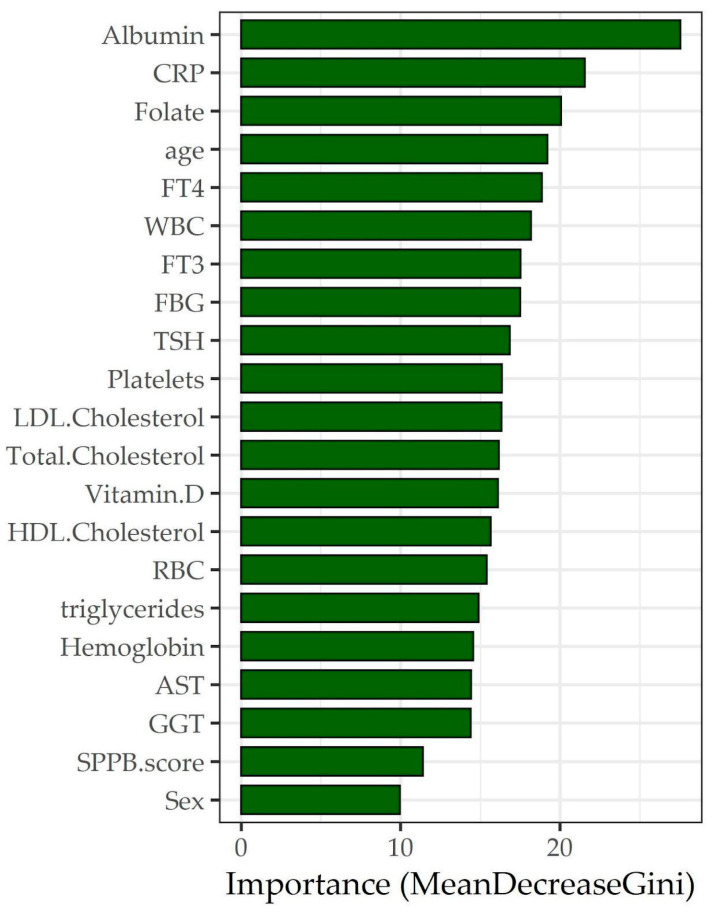
Epidemiological and public health resonance of sarcopenia in late life requires further research to identify better clinical markers useful for seeking proper care strategies in preventive medicine settings. Using a machine-learning approach, a search for clinical and fluid markers most associated with sarcopenia was carried out across older populations from northern and southern Italy. A dataset of adults >65 years of age ( = 1971) made up of clinical records and fluid markers from either a clinical-based subset from northern Italy (Pavia) and a population-based subset from southern Italy (Apulia) was employed ( = 1312 and = 659, respectively). Body composition data obtained by dual-energy X-ray absorptiometry (DXA) were used for the diagnosis of sarcopenia, given by the presence of either low muscle mass (i.e., an SMI < 7.0 kg/m for males or <5.5 kg/m for females) and of low muscle strength (i.e., an HGS < 27 kg for males or <16 kg for females) or low physical performance (i.e., an SPPB ≤ 8), according to the EWGSOP2 panel guidelines. A machine-learning feature-selection approach, the random forest (RF), was used to identify the most predictive features of sarcopenia in the whole dataset, considering every possible interaction among variables and taking into account nonlinear relationships that classical models could not evaluate. Then, a logistic regression was performed for comparative purposes. Leading variables of association to sarcopenia overlapped in the two population subsets and included SMI, HGS, FFM of legs and arms, and sex. Using parametric and nonparametric whole-sample analysis to investigate the clinical variables and biological markers most associated with sarcopenia, we found that albumin, CRP, folate, and age ranked high according to RF selection, while sex, folate, and vitamin D were the most relevant according to logistics. Albumin, CRP, vitamin D, and serum folate should not be neglected in screening for sarcopenia in the aging population. Better preventive medicine settings in geriatrics are urgently needed to lessen the impact of sarcopenia on the general health, quality of life, and medical care delivery of the aging population.
肌肉减少症在晚年的流行病学和公共卫生影响仍需进一步研究,以确定更好的临床标志物,从而在预防医学环境中寻求适当的护理策略。采用机器学习方法,对意大利北部和南部老年人群中与肌肉减少症最相关的临床和血液标志物进行了搜索。使用了一个由年龄大于65岁的成年人(n = 1971)组成的数据集,该数据集由来自意大利北部基于临床的子集(帕维亚)和意大利南部基于人群的子集(阿普利亚)的临床记录和血液标志物组成(分别为n = 1312和n = 659)。通过双能X线吸收法(DXA)获得的身体成分数据用于诊断肌肉减少症,根据EWGSOP2专家组指南,肌肉减少症的诊断标准为存在低肌肉量(即男性SMI < 每平方米7.0千克或女性 < 每平方米5.5千克)、低肌肉力量(即男性HGS < 27千克或女性 < 16千克)或低身体功能(即SPPB ≤ 8)。使用机器学习特征选择方法——随机森林(RF)来识别整个数据集中肌肉减少症的最具预测性的特征,考虑变量之间的每一种可能的相互作用,并考虑经典模型无法评估的非线性关系。然后,为了进行比较,进行了逻辑回归分析。与肌肉减少症相关的主要变量在两个人群子集中重叠,包括SMI、HGS、腿部和手臂的去脂体重以及性别。使用参数和非参数全样本分析来研究与肌肉减少症最相关的临床变量和生物标志物,我们发现根据RF选择,白蛋白、CRP、叶酸和年龄排名靠前,而根据逻辑回归分析,性别、叶酸和维生素D最为相关。在老年人群肌肉减少症筛查中,不应忽视白蛋白、CRP、维生素D和血清叶酸。迫切需要在老年医学中建立更好的预防医学环境,以减轻肌肉减少症对老年人群总体健康、生活质量和医疗服务的影响。