Gautam Pratima, Erill Ivan, Cusick Kathleen D
Department of Biological Sciences, University of Maryland Baltimore County, Baltimore, MD 21250, USA.
Microorganisms. 2023 Apr 13;11(4):1012. doi: 10.3390/microorganisms11041012.
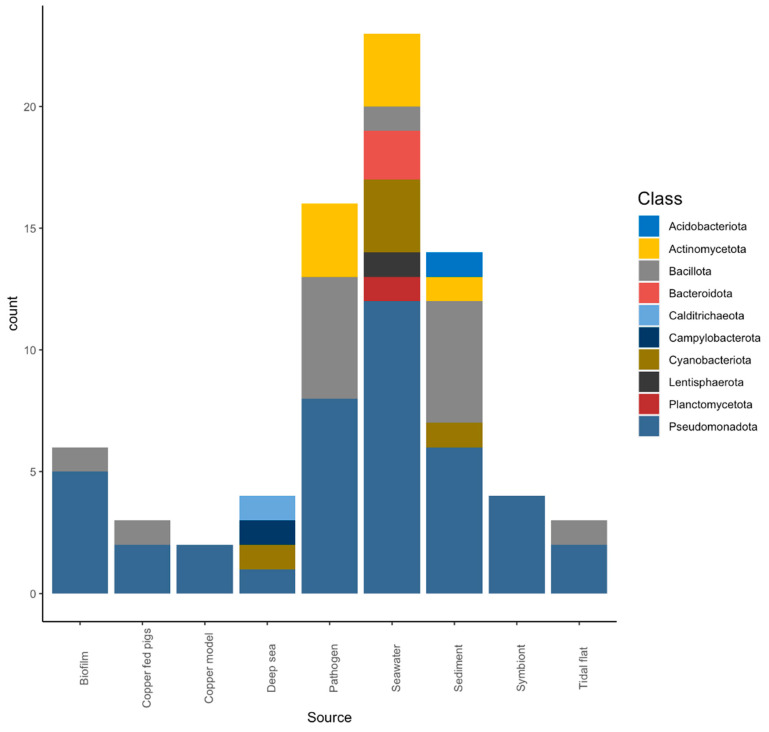
Copper is an essential trace element for living cells. However, copper can be potentially toxic for bacterial cells when it is present in excess amounts due to its redox potential. Due to its biocidal properties, copper is prevalent in marine systems due to its use in antifouling paints and as an algaecide. Thus, marine bacteria must possess means of sensing and responding to both high copper levels and those in which it is present at only typical trace metal levels. Bacteria harbor diverse regulatory mechanisms that respond to intracellular and extracellular copper and maintain copper homeostasis in cells. This review presents an overview of the copper-associated signal transduction systems in marine bacteria, including the copper efflux systems, detoxification, and chaperone mechanisms. We performed a comparative genomics study of the copper-regulatory signal transduction system on marine bacteria to examine the influence of the environment on the presence, abundance, and diversity of copper-associated signal transduction systems across representative phyla. Comparative analyses were performed among species isolated from sources, including seawater, sediment, biofilm, and marine pathogens. Overall, we observed many putative homologs of copper-associated signal transduction systems from various copper systems across marine bacteria. While the distribution of the regulatory components is mainly influenced by phylogeny, our analyses identified several intriguing trends: (1) Bacteria isolated from sediment and biofilm displayed an increased number of homolog hits to copper-associated signal transduction systems than those from seawater. (2) A large variability exists for hits to the putative alternate σ factor CorE hits across marine bacteria. (3) Species isolated from seawater and marine pathogens harbored fewer CorE homologs than those isolated from the sediment and biofilm.
铜是活细胞必需的微量元素。然而,由于其氧化还原电位,当铜过量存在时,对细菌细胞可能具有潜在毒性。由于其杀菌特性,铜在海洋系统中很普遍,因为它被用于防污涂料和作为除藻剂。因此,海洋细菌必须具备感知和响应高铜水平以及仅以典型痕量金属水平存在的铜的方法。细菌拥有多种调节机制,可响应细胞内和细胞外的铜,并维持细胞内的铜稳态。本综述概述了海洋细菌中与铜相关的信号转导系统,包括铜外排系统、解毒和伴侣机制。我们对海洋细菌的铜调节信号转导系统进行了比较基因组学研究,以检验环境对代表性门类中与铜相关的信号转导系统的存在、丰度和多样性的影响。对从海水、沉积物、生物膜和海洋病原体等来源分离的物种进行了比较分析。总体而言,我们在各种海洋细菌的不同铜系统中观察到许多与铜相关的信号转导系统的假定同源物。虽然调节成分的分布主要受系统发育影响,但我们的分析确定了几个有趣的趋势:(1)从沉积物和生物膜中分离出的细菌比从海水中分离出的细菌对与铜相关的信号转导系统的同源物命中数增加。(2)在各种海洋细菌中,假定的替代σ因子CorE命中数存在很大差异。(3)从海水和海洋病原体中分离出的物种比从沉积物和生物膜中分离出的物种含有更少的CorE同源物。