Medical Device Plug-and-Play Interoperability and Cybersecurity Program, Massachusetts General Hospital, Boston, MA 02115, USA.
Department of Anaesthesia, Harvard Medical School, Boston, MA 02115, USA.
Sensors (Basel). 2023 Apr 11;23(8):3890. doi: 10.3390/s23083890.
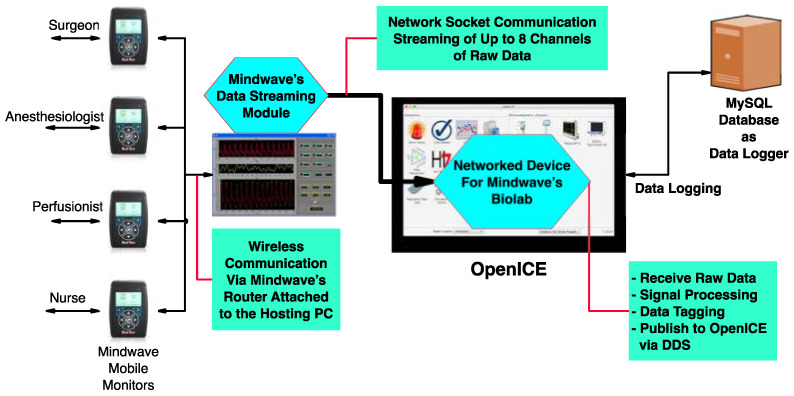
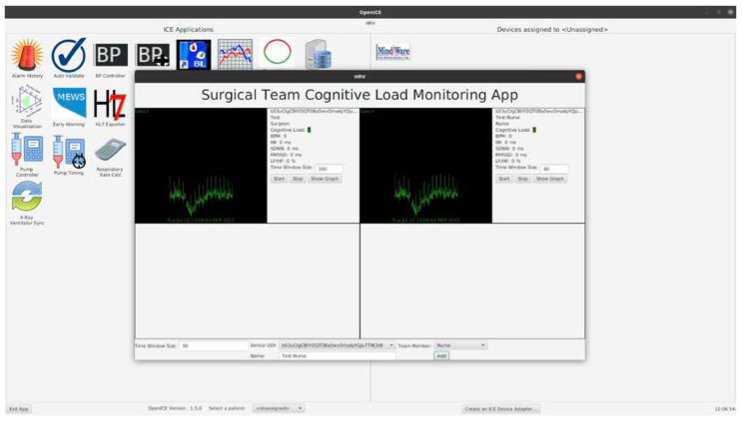
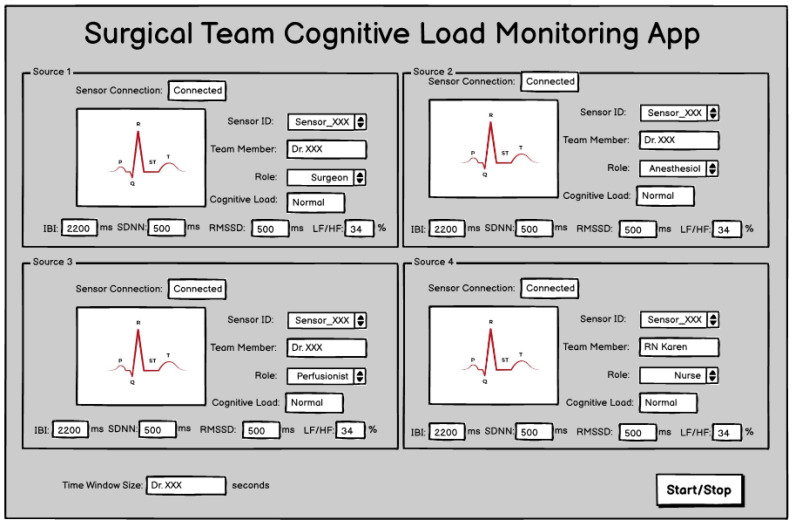
Clinical alarm and decision support systems that lack clinical context may create non-actionable nuisance alarms that are not clinically relevant and can cause distractions during the most difficult moments of a surgery. We present a novel, interoperable, real-time system for adding contextual awareness to clinical systems by monitoring the heart-rate variability (HRV) of clinical team members. We designed an architecture for real-time capture, analysis, and presentation of HRV data from multiple clinicians and implemented this architecture as an application and device interfaces on the open-source OpenICE interoperability platform. In this work, we extend OpenICE with new capabilities to support the needs of the context-aware OR including a modularized data pipeline for simultaneously processing real-time electrocardiographic (ECG) waveforms from multiple clinicians to create estimates of their individual cognitive load. The system is built with standardized interfaces that allow for free interchange of software and hardware components including sensor devices, ECG filtering and beat detection algorithms, HRV metric calculations, and individual and team alerts based on changes in metrics. By integrating contextual cues and team member state into a unified process model, we believe future clinical applications will be able to emulate some of these behaviors to provide context-aware information to improve the safety and quality of surgical interventions.
临床报警和决策支持系统缺乏临床上下文信息,可能会产生与临床无关的非操作性干扰报警,在手术最困难的时刻造成干扰。我们提出了一种新颖的、可互操作的实时系统,可以通过监测临床团队成员的心率变异性(HRV)为临床系统添加上下文感知能力。我们设计了一种架构,用于实时捕获、分析和呈现来自多个临床医生的 HRV 数据,并将其实现为开源 OpenICE 互操作性平台上的应用程序和设备接口。在这项工作中,我们通过新功能扩展了 OpenICE,以支持上下文感知 OR 的需求,包括一个模块化的数据管道,用于同时处理来自多个临床医生的实时心电图(ECG)波形,以创建他们个体认知负荷的估计值。该系统采用标准化接口构建,允许软件和硬件组件(包括传感器设备、ECG 滤波和节拍检测算法、HRV 指标计算以及基于指标变化的个体和团队警报)自由交换。通过将上下文提示和团队成员状态集成到一个统一的过程模型中,我们相信未来的临床应用程序将能够模拟这些行为,提供上下文感知信息,以提高手术干预的安全性和质量。