Giannotta Girolamo, Murrone Antonio, Giannotta Nicola
Azienda Sanitaria Provinciale Vibo Valentia, 89900 Vibo Valentia, Italy.
Oncologia Territoriale, Hospice Cure Palliative ASUFC, 33030 Udine, Italy.
Vaccines (Basel). 2023 Mar 28;11(4):747. doi: 10.3390/vaccines11040747.
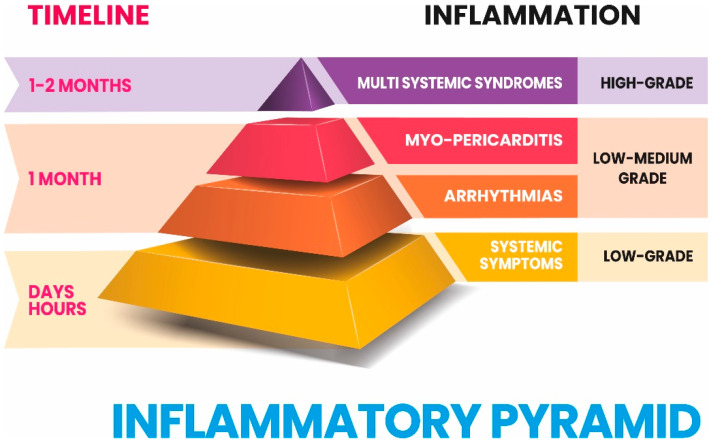
Each injection of any known vaccine results in a strong expression of pro-inflammatory cytokines. This is the result of the innate immune system activation, without which no adaptive response to the injection of vaccines is possible. Unfortunately, the degree of inflammation produced by COVID-19 mRNA vaccines is variable, probably depending on genetic background and previous immune experiences, which through epigenetic modifications could have made the innate immune system of each individual tolerant or reactive to subsequent immune stimulations.We hypothesize that we can move from a limited pro-inflammatory condition to conditions of increasing expression of pro-inflammatory cytokines that can culminate in multisystem hyperinflammatory syndromes following COVID-19 mRNA vaccines (MIS-V). We have graphically represented this idea in a hypothetical inflammatory pyramid (IP) and we have correlated the time factor to the degree of inflammation produced after the injection of vaccines. Furthermore, we have placed the clinical manifestations within this hypothetical IP, correlating them to the degree of inflammation produced. Surprisingly, excluding the possible presence of an early MIS-V, the time factor and the complexity of clinical manifestations are correlated to the increasing degree of inflammation: symptoms, heart disease and syndromes (MIS-V).
每一次注射任何已知疫苗都会导致促炎细胞因子的强烈表达。这是先天免疫系统激活的结果,没有这种激活,就不可能对疫苗注射产生适应性反应。不幸的是,新冠病毒mRNA疫苗产生的炎症程度是可变的,这可能取决于遗传背景和先前的免疫经历,通过表观遗传修饰,这些因素可能使每个人的先天免疫系统对随后的免疫刺激产生耐受或反应。我们假设,在接种新冠病毒mRNA疫苗(MIS-V)后,我们可以从有限的促炎状态转变为促炎细胞因子表达增加的状态,最终可能导致多系统超炎症综合征。我们已经在一个假设的炎症金字塔(IP)中以图形方式展示了这个想法,并且我们已经将时间因素与接种疫苗后产生的炎症程度相关联。此外,我们将临床表现置于这个假设的IP中,将它们与产生的炎症程度相关联。令人惊讶的是,排除早期MIS-V的可能存在,时间因素和临床表现的复杂性与炎症程度的增加相关:症状、心脏病和综合征(MIS-V)。