Veenstra Frouwke, Vriezekolk Johanna E, van den Bemt Bart J F, Schers Henk J, Sloot Bart, van den Ende Cornelia H M, van Herwaarden Noortje, Flendrie Marcel
Radboud Institute for Health Sciences, Radboud University Medical Center, Nijmegen, The Netherlands.
Department of Research and Innovation, Sint Maartenskliniek, Nijmegen, The Netherlands.
Rheumatol Adv Pract. 2023 Apr 10;7(2):rkad033. doi: 10.1093/rap/rkad033. eCollection 2023.
To describe beliefs of physicians and patients in primary and secondary care about urate-lowering therapy (ULT), to examine differences in physicians' medication beliefs and to examine the association of physicians' medication beliefs with the prescribed dosage of ULT, gout outcomes and patients' medication beliefs.
We conducted a cross-sectional study among rheumatologists and general practitioners (GPs) and their patients using ULT in The Netherlands. All participants filled out the Beliefs About Medication Questionnaire (BMQ). Demographics of physicians were collected through questionnaires. Patient and disease characteristics were collected through questionnaires and electronic medical records. Differences between rheumatologists and GPs in the BMQ subscales Necessity and Concern and the necessity-concern difference (NCD) score were analysed by two-sample -tests. Multilevel analyses were performed to examine the association of physicians' BMQ scores with the prescribed dosage of ULT, gout outcomes (number of gout flares, serum urate) and patients' BMQ scores.
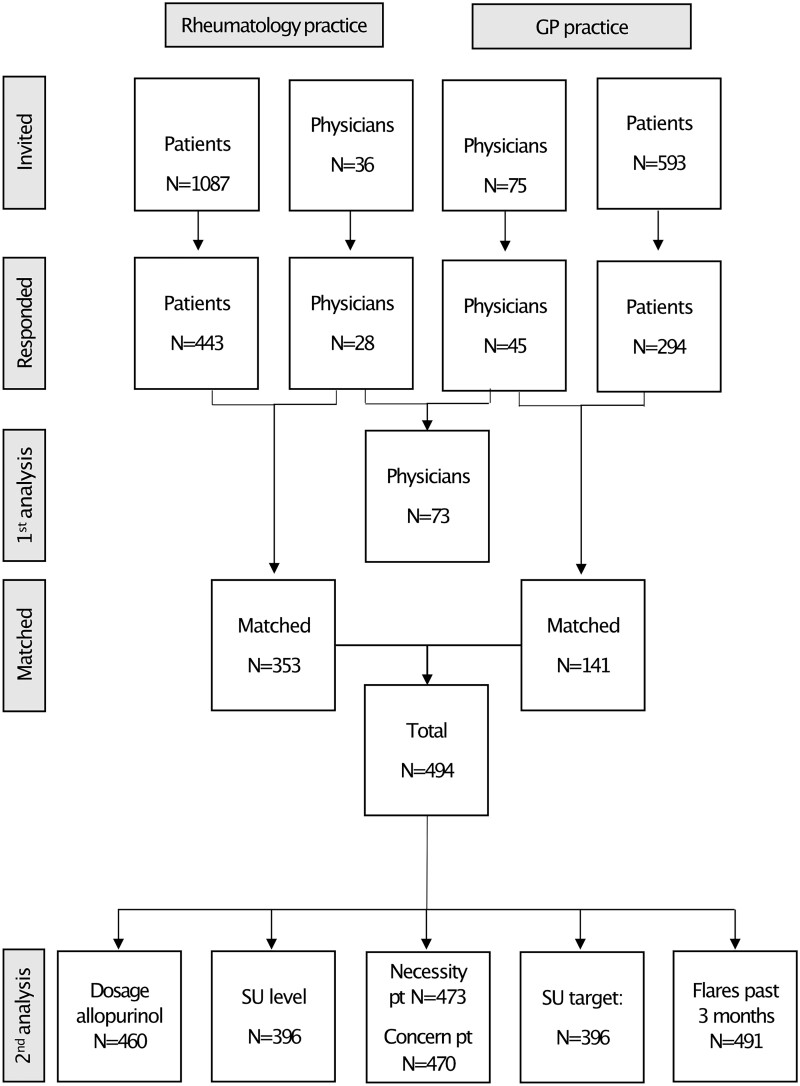
A total of 28 rheumatologists, 443 rheumatology patients, 45 GPs and 294 GP patients were included. The mean NCD scores were 7.1 (s.d. 3.6), 4.0 (s.d. 4.0), and 4.2 (s.d. 5.0) for rheumatologists, GPs and patients, respectively. Rheumatologists scored higher on necessity beliefs [mean difference 1.4 (95% CI 0.0, 2.8)] and lower on concern beliefs [mean difference -1.7 (95% CI -2.7, -0.7)] compared with GPs. No associations between physicians' beliefs and prescribed dosage of ULT, gout outcomes or patients' beliefs were found.
Rheumatologists had higher necessity and lower ULT concern beliefs compared with GPs and patients. Physicians' beliefs were not related to prescribed ULT dosage and patient outcomes. The role of physicians' beliefs in gout management in patients using ULT seems limited. Future qualitative research can provide more insights into physicians' views of gout management.
描述初级和二级医疗保健中医生和患者对降尿酸治疗(ULT)的看法,研究医生用药观念的差异,并探讨医生用药观念与ULT处方剂量、痛风结局及患者用药观念之间的关联。
我们在荷兰对使用ULT的风湿病学家、全科医生(GP)及其患者进行了一项横断面研究。所有参与者均填写了《用药观念问卷》(BMQ)。通过问卷收集医生的人口统计学信息。通过问卷和电子病历收集患者及疾病特征。采用双样本t检验分析风湿病学家和全科医生在BMQ分量表“必要性”和“担忧”以及必要性-担忧差异(NCD)得分上的差异。进行多水平分析以检验医生的BMQ得分与ULT处方剂量、痛风结局(痛风发作次数、血清尿酸)及患者BMQ得分之间的关联。
共纳入28名风湿病学家、443名风湿病患者、45名全科医生和294名全科医生的患者。风湿病学家、全科医生和患者的平均NCD得分分别为7.1(标准差3.6)、4.0(标准差4.0)和4.2(标准差5.0)。与全科医生相比,风湿病学家在必要性观念上得分更高[平均差异1.4(95%CI 0.0,2.8)],在担忧观念上得分更低[平均差异-1.7(95%CI -2.7,-0.7)]。未发现医生的观念与ULT处方剂量、痛风结局或患者观念之间存在关联。
与全科医生和患者相比,风湿病学家对ULT的必要性观念更高,担忧观念更低。医生的观念与ULT处方剂量及患者结局无关。医生的观念在使用ULT的痛风患者管理中的作用似乎有限。未来的定性研究可以更深入地了解医生对痛风管理的看法。