Majdi Alireza, Deng Zhengdao, Sadigh-Eteghad Saeed, De Vloo Philippe, Nuttin Bart, Mc Laughlin Myles
Exp ORL, Department of Neuroscience, Leuven Brain Institute, KU Leuven, Leuven, Belgium.
Research Group Experimental Neurosurgery and Neuroanatomy, Leuven Brain Institute, KU Leuven, Leuven, Belgium.
Front Neurosci. 2023 Apr 13;17:1154180. doi: 10.3389/fnins.2023.1154180. eCollection 2023.
One of the experimental neuromodulation techniques being researched for the treatment of Alzheimer's disease (AD) is deep brain stimulation (DBS). To evaluate the effectiveness of DBS in AD, we performed a systematic review and meta-analysis of the available evidence.
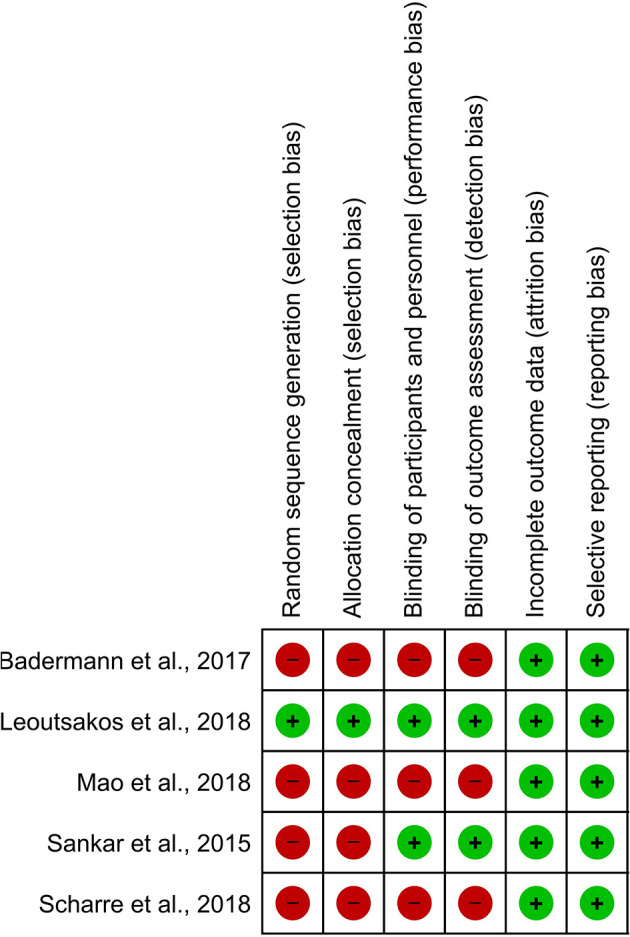
From the inception through December 2021, the following databases were searched: Medline PubMed, Scopus, Embase, Cochrane Library, and Web of Science. The search phrases used were "Alzheimer's disease," "AD," "deep brain stimulation," and "DBS." The information from the included articles was gathered using a standardized data-collecting form. In the included papers, the Cochrane Collaboration methodology was used to evaluate the risk of bias. A fixed-effects model was used to conduct the meta-analysis.
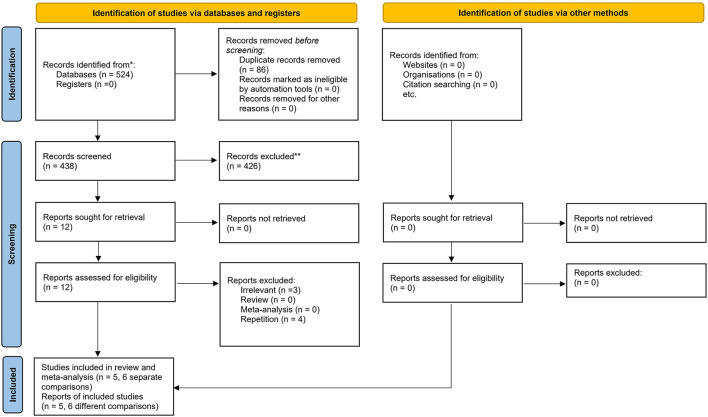
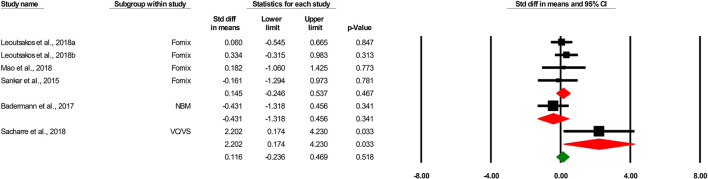
Only five distinct publications and 6 different comparisons (one study consisted of two phases) were included out of the initial 524 papers that were recruited. DBS had no impact on the cognitive ability in patients with AD [0.116 SMD, 95% confidence interval (CI), -0.236 to 0.469, = 0.518]. The studies' overall heterogeneity was not significant (κ = 6.23, = 0.053, df = 5, = 19.76%, = 0.284). According to subgroup analysis, the fornix-DBS did not improve cognitive function in patients with AD (0.145 SMD, 95%CI, -0.246 to 0.537, = 0.467). Unfavorable neurological and non-neurological outcomes were also reported.
The inconsistencies and heterogeneity of the included publications in various target and age groups of a small number of AD patients were brought to light by this meta-analysis. To determine if DBS is useful in the treatment of AD, further studies with larger sample sizes and randomized, double-blinded, sham-controlled designs are required.
正在研究用于治疗阿尔茨海默病(AD)的实验性神经调节技术之一是深部脑刺激(DBS)。为评估DBS治疗AD的有效性,我们对现有证据进行了系统评价和荟萃分析。
从数据库建立至2021年12月,检索了以下数据库:医学文献数据库(Medline)、PubMed、Scopus、Embase、Cochrane图书馆和科学网(Web of Science)。使用的检索词为“阿尔茨海默病”“AD”“深部脑刺激”和“DBS”。采用标准化数据收集表收集纳入文章的信息。在纳入的论文中,使用Cochrane协作方法评估偏倚风险。采用固定效应模型进行荟萃分析。
在最初纳入的524篇论文中,仅纳入了5篇不同的出版物和6项不同的比较(1项研究包含两个阶段)。DBS对AD患者的认知能力没有影响[标准化均数差(SMD)为0.116,95%置信区间(CI)为-0.236至0.469,P = 0.5