Davidson Alexandra V, Butler Faith M
University of Kansas School of Medicine-Salina, Salina, KS.
Department of Family Medicine and Community Health, University of Kansas School of Medicine-Kansas City, KS.
Kans J Med. 2023 Apr 24;16(1):94-104. doi: 10.17161/kjm.vol16.18958. eCollection 2023.
Evidence-based, nonbiased, counseling on contraceptive options, followed by shared decision-making, is key in facilitating reproductive justice in a diverse population. An estimated 3% of contraceptive users in the United States use fertility awareness-based methods (FABMs) for contraception, and demand for these methods is increasing. FABMs can be a highly effective form of family planning when used in accordance with evidence-based protocols. They are preferred by some patients due to medical contraindications to hormonal contraceptives, lack of side effects, religious convictions, preference to avoid hormones or contraceptive devices, improved body literacy, or a combination of the above. FABMs are infrequently covered in medical school curricula and are often perceived by physicians to be of low efficacy. There is an opportunity for improvement of physicians' evidence-based knowledge of FABMs, which has the potential to improve patient understanding of and access to the full menu of family planning options.
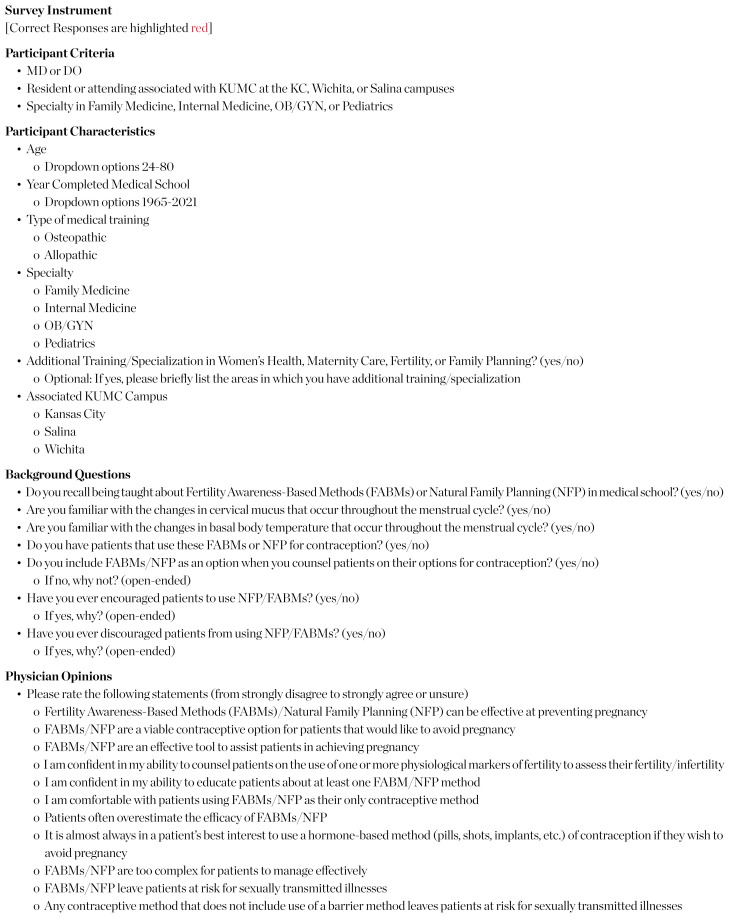
A self-administered, cross-sectional survey was distributed to assess physician knowledge and opinions of FABMs by key university contacts. Univariate and bivariate statistics were calculated for close-ended questions and responses to open-ended questions were analyzed for common themes.
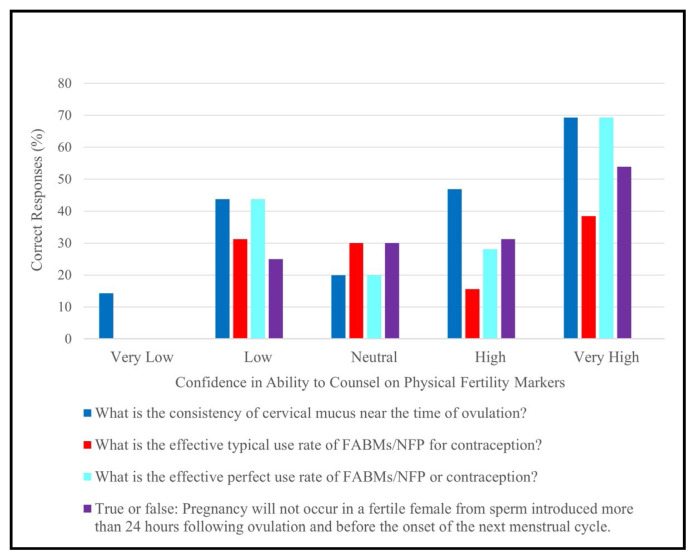
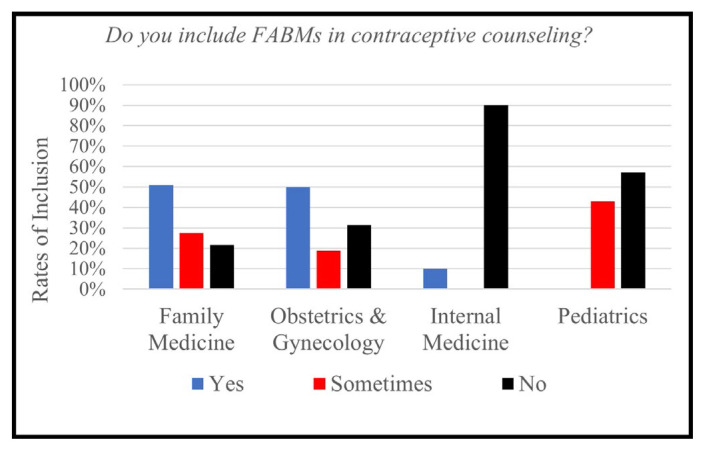
A total of 79 participants completed the entire survey. Another 11 submitted partially completed surveys. For completed surveys, questions assessing knowledge of key concepts underlying FABMs, performance by specialty was 55% correct for OB/GYN (n = 16), 55% (n = 47) correct for family medicine, 36% (n = 10) correct for internal medicine, and 35% (n = 6) correct for pediatrics. Negative, neutral, mixed, and positive opinions related to FABMs were represented.
There are opportunities to improve physicians' evidence-based knowledge of FABMs; this may improve patient-centered contraceptive care.
基于证据、无偏见地提供避孕选择咨询,随后进行共同决策,是在多样化人群中促进生殖公正的关键。在美国,估计有3%的避孕使用者采用基于生育意识的方法(FABM)进行避孕,且对这些方法的需求正在增加。当按照基于证据的方案使用时,FABM可以是一种非常有效的计划生育方式。由于激素避孕的医学禁忌、无副作用、宗教信仰、避免激素或避孕器具的偏好、提高身体认知度或上述因素的综合影响,一些患者更喜欢FABM。医学院课程中很少涉及FABM,医生通常认为其效果不佳。有机会提高医生对FABM的循证知识,这有可能增进患者对计划生育全部选项的理解并增加其获取途径。
通过主要大学联系人分发一份自我管理的横断面调查问卷,以评估医生对FABM的知识和看法。对封闭式问题进行单变量和双变量统计,并对开放式问题的回答进行共同主题分析。
共有79名参与者完成了整个调查。另外11人提交了部分完成的调查问卷。对于完成的调查问卷,评估FABM关键概念知识的问题,妇产科医生(n = 16)的回答正确率为55%,家庭医学医生(n = 47)为55%,内科医生(n = 10)为36%,儿科医生(n = 6)为35%。对FABM的负面、中性、混合和正面意见均有体现。
有机会提高医生对FABM的循证知识;这可能会改善以患者为中心的避孕护理。