Meyer Heidi C, Fields Andrea, Vannucci Anna, Gerhard Danielle M, Bloom Paul A, Heleniak Charlotte, Opendak Maya, Sullivan Regina, Tottenham Nim, Callaghan Bridget L, Lee Francis S
Department of Psychiatry, Joan & Sanford I. Weill Medical College of Cornell University, New York, New York.
Department of Psychological and Brain Sciences, Boston University, Boston, Massachusetts.
Biol Psychiatry Glob Open Sci. 2022 Feb 17;3(2):169-178. doi: 10.1016/j.bpsgos.2022.02.002. eCollection 2023 Apr.
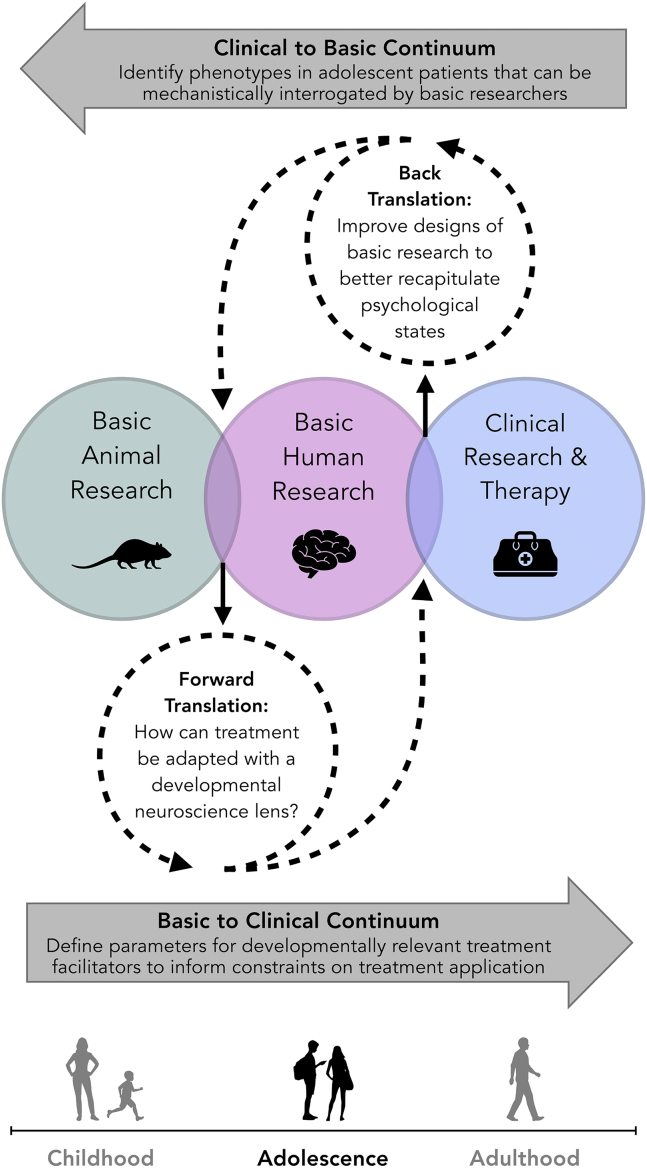
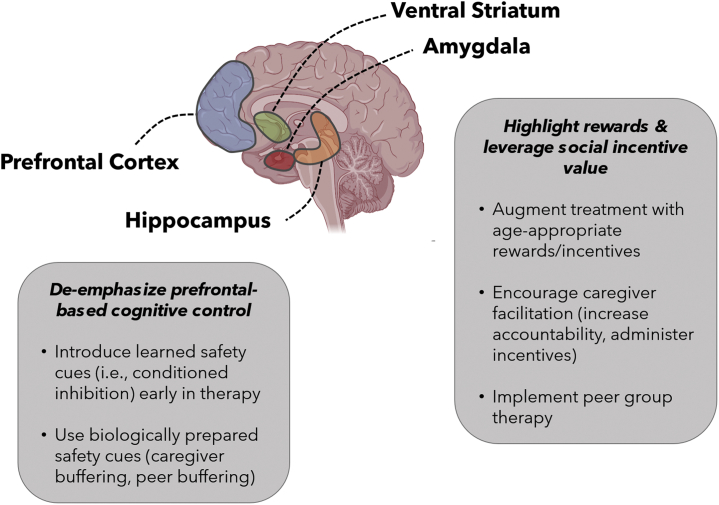
Significant advances have been made in recent years regarding the developmental trajectories of brain circuits and networks, revealing links between brain structure and function. Emerging evidence highlights the importance of developmental trajectories in determining early psychiatric outcomes. However, efforts to encourage crosstalk between basic developmental neuroscience and clinical practice are limited. Here, we focus on the potential advantage of considering features of neural circuit development when optimizing treatments for adolescent patient populations. Drawing on characteristics of adolescent neurodevelopment, we highlight two examples, safety cues and incentives, that leverage insights from neural circuit development and may have great promise for augmenting existing behavioral treatments for anxiety disorders during adolescence. This commentary seeks to serve as a framework to maximize the translational potential of basic research in developmental populations for strengthening psychiatric treatments. In turn, input from clinical practice including the identification of age-specific clinically relevant phenotypes will continue to guide future basic research in the same neural circuits to better reflect clinical practices. Encouraging reciprocal communication to bridge the gap between basic developmental neuroscience research and clinical implementation is an important step toward advancing both research and practice in this domain.
近年来,在脑回路和网络的发育轨迹方面已经取得了重大进展,揭示了脑结构与功能之间的联系。新出现的证据凸显了发育轨迹在决定早期精神疾病预后方面的重要性。然而,鼓励基础发育神经科学与临床实践之间进行交流的努力是有限的。在此,我们关注在优化青少年患者群体的治疗方法时,考虑神经回路发育特征的潜在优势。借鉴青少年神经发育的特点,我们重点介绍两个例子,即安全线索和激励措施,它们利用了神经回路发育的见解,可能对增强青少年焦虑症现有行为治疗方法具有巨大潜力。本评论旨在提供一个框架,以最大限度地发挥发育人群基础研究在加强精神治疗方面的转化潜力。反过来,来自临床实践的输入,包括确定特定年龄的临床相关表型,将继续指导未来在相同神经回路上的基础研究,以更好地反映临床实践。鼓励相互交流以弥合基础发育神经科学研究与临床实施之间的差距,是推动该领域研究和实践向前发展的重要一步。