Yang Lu, Wang Peipei, McGill Bronwyn
Sydney School of Public Health, University of Sydney, NSW, Australia.
Department of Hematology, Huashan Hospital, Shanghai, China.
Int J Nurs Sci. 2023 Mar 21;10(2):258-267. doi: 10.1016/j.ijnss.2023.03.010. eCollection 2023 Apr.
Physical activity (PA) in people with knee pain can help to relieve pain and prevent health problems. However, engaging in regular PA is challenging for them due to chronic musculoskeletal pain. An understanding of how the experience of knee pain affects PA is important to minimize the negative effects of knee pain on participation in PA among this population. We examined the quantitative evidence describing the relationship between the experience of knee pain and participation in PA.
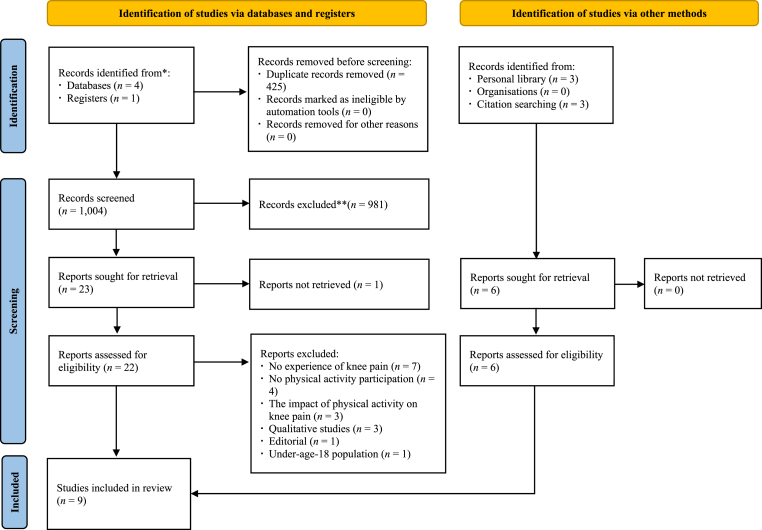
We conducted a scoping review based on the PRISMA-ScR process across 27 items and Peters' methodological framework. Searches using keywords were performed in Medline, PsycINFO, CINAHL and Scopus.
Nine studies were included in this review. While one study clearly showed that increased knee pain increased PA, four studies indicated that knee pain decreased PA among individuals with knee pain. One study revealed that increased knee pain decreased moderate PA, but no significant difference with light intensity PA. Three studies showed that knee pain had no impact on PA. Moreover, psychological factors (catastrophizing and pain-related activity interference) and certain activities of daily living were risk factors for insufficient PA among people with knee pain.
The limited quantitative evidence on the relationship between the experience of knee pain and PA participation highlights a gap in the knowledge base. The review findings found mixed results, with a negative, positive or no relationship between knee pain and levels of PA among individuals with knee pain. The findings also suggest that the relationship can be affected by psychological factors and different levels and types of PA. Therefore, practitioners should consider multi-component interventions which aim to increase PA levels of individuals with knee pain, after considering the above mediating factors.
膝关节疼痛患者进行体育活动(PA)有助于缓解疼痛并预防健康问题。然而,由于慢性肌肉骨骼疼痛,他们进行规律的体育活动具有挑战性。了解膝关节疼痛的体验如何影响体育活动,对于将膝关节疼痛对该人群参与体育活动的负面影响降至最低至关重要。我们研究了描述膝关节疼痛体验与体育活动参与之间关系的定量证据。
我们基于PRISMA-ScR流程和彼得斯的方法框架进行了一项范围综述。使用关键词在Medline、PsycINFO、CINAHL和Scopus中进行检索。
本综述纳入了9项研究。虽然有1项研究明确表明膝关节疼痛加剧会增加体育活动量,但有4项研究表明膝关节疼痛会降低膝关节疼痛患者的体育活动量。1项研究显示膝关节疼痛加剧会降低中等强度的体育活动量,但与低强度体育活动量无显著差异。3项研究表明膝关节疼痛对体育活动量没有影响。此外,心理因素(灾难化思维和与疼痛相关的活动干扰)以及某些日常生活活动是膝关节疼痛患者体育活动不足的危险因素。
关于膝关节疼痛体验与体育活动参与之间关系的定量证据有限,凸显了知识库中的空白。综述结果显示结果不一,膝关节疼痛与膝关节疼痛患者的体育活动水平之间存在负相关、正相关或无相关关系。研究结果还表明,这种关系可能受到心理因素以及不同水平和类型的体育活动的影响。因此,从业者在考虑上述中介因素后,应考虑采取多成分干预措施,旨在提高膝关节疼痛患者的体育活动水平。